Latin in a Week: The Review

3 August 2008

A week ago, most of the Latin I knew could be found on the back of a dime.

Okay, that’s a slight understatement. I had the usual collection of Latin expressions that one picks up: carpe diem, cogito ergo sum, quid pro quo, et cetera. I also had several of the slightly more arcane ones that you pick up in an academic setting (id est, ad hominem, post hoc ergo prompter hoc) and in other weird places I hang out (carpe noctem, aut pax aut bellum, nemo me impune lacessit). But that aside, I didn’t know beans about Latin.

Enter Veritas Press, at which one can evidently find staffers crazy enough to think it possible to teach Latin in a single week. I found out about this a week ago Thursday, signed up Friday morning, bought a textbook Friday afternoon, and enjoyed a restful weekend, because the class would start the following Monday. Iacta alea fuit.

We finished yesterday (Friday). It was great.
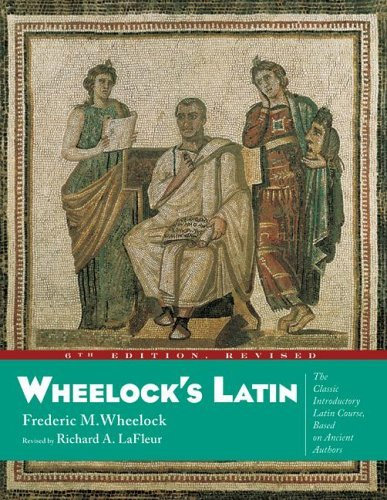
Everything about it was great: the textbook, the teacher, the online delivery system, and the company I got to keep as a student. The only little, tiny drawback was the fact that the class ran from 8 am to 4 pm, Eastern time. That means 5 am to 1 pm out here, and rolling out of bed at 4:45 am to study Latin was imperfectly blissful. My wife wasn’t a fan of the alarm going off that early, either. (But when I offered to sleep on the couch she gave me a speech about how she was willing to sacrifice a little sleep so that I could learn Latin — what a woman!)

But on with the review. First, the textbook. Written as GIs swelled the Read the rest of this entry »


Cantus Christi: Psalm-Singing for the Masses

27 July 2008

For my birthday, my darling wife bought me three presents: Cantus Christi, the accompanying CD set, and a 4-sermon series titled The Worship of the Saints. I’m going to review the first two here. The sermon series is definitely worth reviewing, but I’m still recovering from my shock. I’ll have to get to it later.

Cantus is a serious effort to recover psalm-singing in the church, as the proportion of the book devoted to the psalms demonstrates (196 out of 440 pages).

The single biggest challenge in psalm-singing is that while God gives us the words, He has not been pleased to preserve the original music. A saint who would sing psalms — as we are all commanded to do (Eph. 5:19, Col. 3:16, Jam.5:13) — must somehow come up with the music by which to sing them. Happily, this does not mean we have to write all the music ourselves.

Over the centuries, many saints have encountered this same challenge, and have written or adapted music for the psalms. Accordingly, Cantus is also a serious attempt to mine the wealth of the Western Church’s musical tradition. The music for the psalms relies heavily on the Genevan Psalter and other early Reformation musical sources, and the hymn tunes go back as far as A.D. 800. Psalm tunes include metrical songs (hymns that ordinary folks can sing without Read the rest of this entry »


News: Latin in a Week

26 July 2008

“Through the Bible in a Year.” It’s a common wording that I saw a lot growing up in devout Christian circles. The Bible’s a big book, but a year is plenty of time to get through it at a fairly enjoyable pace.

“Latin in a Week,” however, sounds like the province of fools and madmen. Closer inspection confirms the diagnosis: all 40 chapters of Wheelock’s Latin, in 40 hours of instruction. Veritas Press has had good results with this approach, though. Word is that students read unedited sections of Caesar and Cicero by the end of the class– it seems a result worth wagering a week’s hard labor for. Niemela and I have had success with similar experiments in short-term language teaching, but I don’t think we’ve ever done anything this ambitious…and online, to boot.

I have three reasons for doing this now. First, I need to bite the bullet and learn Latin at some point. I’m always telling my students that language learning is better done now than later — time to practice what I preach.  Second, if this works even close to as well as advertised, these people know some things about language learning that I need to know for my revamped first-year Greek class. So in addition to struggling with vocabulary, I’ll be keeping an eye on the teaching tactics. Third, learning to teach first-year language in an online environment is an important skill for me to develop, and this will furnish me with a model to work from.

I had been told that the class would run 9-5, Eastern time, i.e., 6-2 my time. For me, that’s fairly humane. I like mornings anyhow. According to the note on the website, however, the fun begins at 8:00 a.m. Eastern. Yes, apparently I’ll be doing Latin at 5 a.m.

Your prayers will be appreciated.


Censorship versus Patronage

20 July 2008

A lot of the behavior that elicits cries of “censorship” is actually nothing of the kind; it’s actually denial of patronage. It is to the advantage of artists — particularly the ones whose oeuvre consists entirely of pretentious, morally outrageous (and sometimes literal) crap — to conflate these two categories. It is very much to the disadvantage of the rest of us to let them get away with it.

Censorship is when someone with a degree of regulatory authority uses that authority against the work. This is the stuff of obscenity laws, book burnings, and so on. It is *not* the same thing as someone in the production/distribution chain refusing to participate, e.g., a gallery refusing to display a painting, a bookstore refusing to sell a book, or a member of the public refusing to buy, or even look at, either one. It is also not the same thing as refusing to give the artist a grant, whether of private or public funds. These are all denial of patronage, not censorship.

When an artist comes to someone with hat in hand, asking for something — a wall to display his work, shelf space to sell it, the purchase price of a sculpture, money to support himself while he works on his next project, etc. — he is asking for patronage. Whether he gets Read the rest of this entry »


Further News on the Apologetics Seminar

15 July 2008

It seemed appropriate to add a little more about the nature of my approach to apologetics, since what we’ll be doing is a little uncommon.

My basic orientation on apologetics is that it’s all of a piece with theology, evangelism, and culture. Having a gleefully Christian take on everything from anchovy migration patterns to Zulu cooking is an integral part of defending the faith, not to mention a very persuasive witness in itself. Of course, no one person can know about everything, so learning how to construct a Christian approach to the subject at hand is terribly important.

Read the rest of this entry »


Apologetics Seminar

13 July 2008

A local church here has agreed to host a four-week series on apologetics, taught by yours truly and starting this coming Friday (18 July), 7-9 pm in Orange, CA. Sorry about the short notice; we just got the details nailed down Friday night.

I’m titling the series “Biblical Apologetics for Busy Believers.” A rough, and tentative, outline follows:

Session 1: Start with God (Genesis 1-3) — All thinking must start with God, and the nature of God’s claims is such that no one can be neutral. A Christian must always begin with this understanding; to fail to start everything with God’s revelation is to make the same mistake that Eve made in the Garden of Eden. (As an example, we’ll consider a Christian response to the claim that there’s no good historical evidence for Jesus.)

Session 2: Without Excuse (Romans 1) — Unbelief has no excuse whatsoever; the unbeliever really does know the Christian God. To the extent that he refuses to acknowledge the triune God of the Bible, his Read the rest of this entry »


Basic Resources for Apologetics: An Overview

13 July 2008

If you’re looking for encyclopedic, facts-and-figures resources, there’s a ton of them on the market, and Josh McDowell’s material is still some of the best. A recent publication, Evidence for Christianity, combines and updates the evidential material from a number of previous works, and that’s the one I’d recommend, if you haven’t already got a few of McDowell’s works on the shelf.

Facts and figures are important, but in this post I want to address resources for how you use them. McDowell was never the best source for this — he’s more of the “make a bigger pile” school of thought. Until very recently, all the really good basic instruction on how to use the facts was on audio, but there wasn’t a book that did the job effectively and accessibly. Gary DeMar at American Vision has changed all that by transcribing and editing a series of talks Greg Bahnsen did for high school and college students back in the early nineties. The resulting book, Pushing the Antithesis: The Apologetic Methodology of Greg L. Bahnsen, is a gem. It’s accessible, relatively simple, and it has study questions at the end of each chapter. It’s also a little spendy, but it’s worth it. Bahnsen’s other basic book, Always Ready: Directions for Defending the Faith, is cheaper, but it’s a set of course syllabi edited together by Robert Booth. It’s much denser, and because the material was designed to be accompanied by live instruction, it’s much harder to plow through without help. Thanks to Pushing the Antithesis, the necessary help is now available in print.

Read the rest of this entry »


Anti-Gnostic Song of Solomon Translations and Commentaries

6 July 2008

Commentary and translation choices are always tricky. The Bible has inspired a lot of comment and translation over the years, and a surprising amount has been poorly done. Nowhere is this more true than with the Song of Solomon.

The first and most blatant problem is the number of interpreters whose starting point is a red-faced “It can’t possibly be saying that!!! So they gin up a flimsy excuse and explain how the Song is really about Christ’s love for the church.

Apparently the church has captivating hair, an intoxicating navel, and really nice breasts (Song 7:1-5). Of course, the real problem with this view is not the patent absurdity of it — and it is absurd — but the starting premise. Why shouldn’t the Song be exactly what it sounds like — a frank celebration of married love in all its complexity, delicacy, and lush sensual splendor?

Read the rest of this entry »


How to Use the Bible…according to God

29 June 2008

Both my parents went to Bible college. Dad is a Th.M. graduate of Capital Bible Seminary, and was a Bible and history teacher by trade for a couple of my formative decades. Needless to say, I learned how to study the Bible growing up. I took my first formal course in hermeneutics when I was 18, and quickly caught on to the fact that if my approach to the Bible was wrong, I could take all the Bible and theology courses in the world from the best teachers, and still come out lopsided. On the other hand, if my approach to the Bible was right, I could weather the storm of poor teaching if necessary, because the Bible itself would straighten me out.

With that in mind, hermeneutics became a major focus of my study for the next decade or so. I took hermeneutics and advanced hermeneutics courses in seminary, and when I graduated and began to teach, I taught hermeneutics myself. When Bob Wilkin of GES came up to teach an advanced hermeneutics course, I exercised my right to faculty audit and sat in the back to listen. It would be fair to say that I was mildly obsessed with the subject.

So imagine my surprise when, fairly late in the process, it dawned on me that hermeneutics has to be founded on the Bible itself. I’d been studying Charlie Clough’s Framework material, and as a result, presuppositional apologetics and philosophy from Bahnsen, Van Til, Frame, Rushdoony and others. All of this drew my attention to Romans 1-2, Colossians 2, Genesis 1-3, and other passages that made it increasingly clear that everything has to start with the triune God of the Bible and move forward from there.

It followed that one’s approach to the Bible must do the same.

Duh.

So I scrapped the seminary hermeneutics curriculum I had developed three years earlier, and set to work writing a new one. I began to develop a narrative foundation approach to hermeneutics. Almost immediately, I found out that “hermeneutics” was not the category I wanted to be working with. The Bible does deal with how it should be interpreted, but only as an organic part of a larger category: how the Bible should be used. The biblical authors are not interested in correct interpretation as an end in itself, but as a precursor to belief and obedience. This does make a difference in approach; meditation on the Word becomes a hefty part of one’s approach to Scripture, for example.

Within that larger enterprise, however, the biblical authors do present examples of how to interpret Scripture properly, and offer a few choice comments on proper interpretation. I recently had occasion to teach a ten-week course at two churches showcasing some of the more striking examples. I’ve not yet had time to write all this material out, but the handouts are available here, and you can find recordings of the sessions under my name on Grace Chapel’s website.


Seeing with New Eyes

22 June 2008

For those of you who last checked in with biblical counseling when Jay Adams was in his psychology-skewering heyday, you need to come have another look. The present generation of spokesmen for biblical counseling offers a more well-rounded, richer grasp of Scripture and a much more sober-minded tone. While there certainly was some justification for Adams’ jeremiads, the present generation seems to have rediscovered the value and utility of brotherly kindness, a mode of interaction sadly lacking in the early writings of the movement.

Of the present voices, one of the clearest and most articulate is David Powlison.

Seeing with New Eyes: Counseling and the Human Condition through the Lens of Scripture is not a “counseling model” as such. It is to a counseling model what a list of mountaintop elevations is to a topographic map of the entire mountain range: it touches on the high points, and leaves the rest alone. But this seemingly incomplete way of teaching turns out to be surprisingly instructive.

Read the rest of this entry »