14 September 2008
In the pagan world, when one person wrongs another, the first step is often to involve third parties: friends, a coworker, the boss, a lawyer, etc. In serious cases, the first step may be to take the offender to court. If either party is unsatisfied with the outcome of the court case, then the unsatisfied party can appeal to a higher court, and so on, until the Supreme Court gives a final ruling. In that system at its best, the goal is justice. For offenses among believers, however, Jesus instructs us in a different procedure and a different goal. In Matthew 18, Jesus establishes the pattern for a believer to follow when one of his Christian brothers has sinned against him. He says,
Moreover if your brother sins against you, go and tell him his fault between you and him alone. If he hears you, you have gained your brother. But if he will not hear, take with you one or two more, that “by the mouth of two or three witnesses every word may be established.” And if he refuses to hear them, tell it to the church. But if he refuses even to hear the church, let him be to you like a heathen and a tax collector.
The procedure seems clear enough. When some brother Christian offends you, there are four steps. We might think of these as a lower court, an appeals court, the (earthly) supreme court for Christian conflict resolution, and a final judgment. Read the rest here.
 1 Comment |
  How To, Meditations | Tagged: Bible, Christianity, conflict, conflict resolution, Deuteronomy, excommunication, Matthew, Matthew 18, practical theology, reconciliation, relationships, theology |
  Permalink
 Posted by Tim Nichols
7 September 2008
 “The site is not the source.” In bodywork, this maxim means that where the client feels pain is probably not the location of the real problem. Back pain can be the result of an ankle injury that didn’t heal completely; pain in the elbow can come from chronic tension in the neck, and so on.
The same holds true in theology. We feel the pinch in a lot of areas lately, and we usually set about defending at the site — the place where we feel the pinch.
The Bible suggests a different approach. “Man shall not live by bread alone, but by every word that proceeds from the mouth of God.” If we’re hungry, eating is not the only, or even the first, solution. The first thing is to go back to God’s Word.
The Battle Belongs to the Lord by K. Scott Oliphint makes this line of thought explicit in the field of apologetics. When pressed by various Read the rest of this entry »
Comments Off on Two Books for a More Robust Bibliology | Reviews | Tagged: Apologetics, Bible, biblical theology, bibliology, Christianity, clarity of Scripture, debate, K. Scott Oliphint, Mark D. Thompson, perspicuity, perspicuity of Scripture, Scripture | Permalink
Posted by Tim Nichols
28 August 2008
In 1915, Robert Frost wrote a famous poem titled “The Road Not Taken.”
Two roads diverged in a yellow wood,
And sorry I could not travel both
And be one traveler, long I stood
And looked down one as far as I could
To where it bent in the undergrowth.
Then took the other, as just as fair,
And having perhaps the better claim,
Because it was grassy and wanted wear;
Though as for that the passing there
Had worn them really about the same.
And both that morning equally lay
In leaves no step had trodden black.
Oh, I kept the first for another day!
Yet knowing how way leads on to way,
I doubted if I should ever come back.
I shall be telling this with a sigh
Somewhere ages and ages hence:
Two roads diverged in a wood, and I–
I took the one less traveled by,
And that has made all the difference.
For most Christians, the study of Greek is a road not taken, but usually there’s no clear point of decision. It’s one of those things that flits Read the rest of this entry »
Comments Off on NEWS: Orange County 1 John Class | How To, News | Tagged: 1 John, Christianity, Greek, greek instruction, koine greek, New Testament Greek, religion | Permalink
Posted by Tim Nichols
24 August 2008
The first of several planned papers on liturgical matters, “Against Liturgy-Bashing” attempts to clear away the nonsense that plagues our thinking in many American churches. To bring it closer to home: our local church is in desperate need of liturgical reform, and we cannot even begin to build a God-honoring liturgy until we have cleared away the underbrush of the pagan ideas that harden our necks and soften our heads. To that end, this paper addresses several common objections to liturgical worship. Two excerpts:
Does the leading of the Spirit require spontaneity rather than planning? Again, we can return to the commands to sing in order to see the fallacy here. Imagine if we all just got together, and on the count of three, all began to sing whatever words happened to pop into our heads, set to Read the rest of this entry »
Comments Off on Liturgy, Part 1: Against Liturgy-Bashing | liturgy, Meditations, News | Tagged: Christianity, church, liturgy, liturgy-bashing, religion, theology, Worship | Permalink
Posted by Tim Nichols
17 August 2008
If you had to be stuck on a desert island for [life, ten years, or some other long period of time], what books would you want with you?”
It’s a common thought experiment, and usually the occasion of much consideration and discussion. If you hang out with the more passionate readers, as I often do, it will also be the occasion of heated debate. Yesterday, I happened upon an interesting twist on it, and I’d like to share it.
So get out your pen and paper, and here we go.
No, seriously, get out a pen and paper. (Or open a Word document, or whatever). You’ll thank me later.
The challenge is to answer the standard question, as stated above, but with two additional conditions. First, all your physical needs are taken care of, so assume you have no pragmatic need for medical texts, homesteading reference books, etc. This is strictly life-of-the-mind stuff. (Of course, if you enjoy reading medical texts, that’s another thing…) Second, you have only two minutes to answer, starting right now.
Go. Tick tock.
Done? Good. I’d love to hear your list. This was mine: Read the rest of this entry »
Comments Off on Desert Island Reading | Classics, Meditations | Tagged: Christianity, church history, Classics, great books, philosophy, theology, western canon | Permalink
Posted by Tim Nichols
10 August 2008

The opening chapters of How to Read Genesis by Tremper Longman III are pretty good. So when I got to chapter four, titled “Myth or History? Genesis and the Enuma Elish” I was excited. I had just recently engaged an unbeliever on the question of whether the biblical stories — or at least the supernatural ones — were myth or history, and I have also long been intrigued by the contrasts between Genesis and Enuma Elish. I was looking forward to seeing Longman’s take on it.
I’m sorry to say that I was sorely disappointed. Longman writes:
Read the rest of this entry »
9 Comments | Meditations, Reviews | Tagged: Bible, Christianity, creation, Enuma Elish, Genesis, gnosticism, James Jordan, theology, Tremper Longman, worldview | Permalink
Posted by Tim Nichols
3 August 2008
A week ago, most of the Latin I knew could be found on the back of a dime.
Okay, that’s a slight understatement. I had the usual collection of Latin expressions that one picks up: carpe diem, cogito ergo sum, quid pro quo, et cetera. I also had several of the slightly more arcane ones that you pick up in an academic setting (id est, ad hominem, post hoc ergo prompter hoc) and in other weird places I hang out (carpe noctem, aut pax aut bellum, nemo me impune lacessit). But that aside, I didn’t know beans about Latin.
Enter Veritas Press, at which one can evidently find staffers crazy enough to think it possible to teach Latin in a single week. I found out about this a week ago Thursday, signed up Friday morning, bought a textbook Friday afternoon, and enjoyed a restful weekend, because the class would start the following Monday. Iacta alea fuit.
We finished yesterday (Friday). It was great.
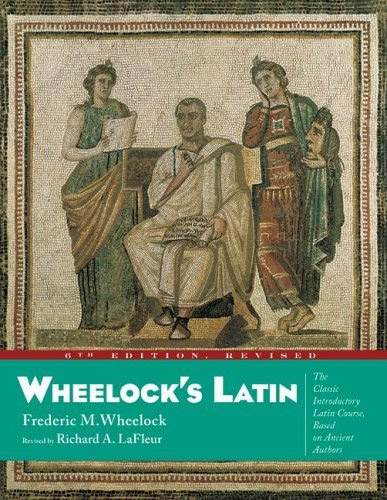 Everything about it was great: the textbook, the teacher, the online delivery system, and the company I got to keep as a student. The only little, tiny drawback was the fact that the class ran from 8 am to 4 pm, Eastern time. That means 5 am to 1 pm out here, and rolling out of bed at 4:45 am to study Latin was imperfectly blissful. My wife wasn’t a fan of the alarm going off that early, either. (But when I offered to sleep on the couch she gave me a speech about how she was willing to sacrifice a little sleep so that I could learn Latin — what a woman!)
But on with the review. First, the textbook. Written as GIs swelled the Read the rest of this entry »
3 Comments | Classics, Reviews | Tagged: Latin, Latin in a Week, Latin instruction, Veritas Press | Permalink
Posted by Tim Nichols
27 July 2008

For my birthday, my darling wife bought me three presents: Cantus Christi, the accompanying CD set, and a 4-sermon series titled The Worship of the Saints. I’m going to review the first two here. The sermon series is definitely worth reviewing, but I’m still recovering from my shock. I’ll have to get to it later.
Cantus is a serious effort to recover psalm-singing in the church, as the proportion of the book devoted to the psalms demonstrates (196 out of 440 pages).
The single biggest challenge in psalm-singing is that while God gives us the words, He has not been pleased to preserve the original music. A saint who would sing psalms — as we are all commanded to do (Eph. 5:19, Col. 3:16, Jam.5:13) — must somehow come up with the music by which to sing them. Happily, this does not mean we have to write all the music ourselves.
Over the centuries, many saints have encountered this same challenge, and have written or adapted music for the psalms. Accordingly, Cantus is also a serious attempt to mine the wealth of the Western Church’s musical tradition. The music for the psalms relies heavily on the Genevan Psalter and other early Reformation musical sources, and the hymn tunes go back as far as A.D. 800. Psalm tunes include metrical songs (hymns that ordinary folks can sing without Read the rest of this entry »
3 Comments | How To, liturgy, music, Reviews | Tagged: Christianity, church music, congregational music, hymnal, hymnody, hymns, psalm-singing, psalms, psalter, singing, Worship | Permalink
Posted by Tim Nichols
26 July 2008
“Through the Bible in a Year.” It’s a common wording that I saw a lot growing up in devout Christian circles. The Bible’s a big book, but a year is plenty of time to get through it at a fairly enjoyable pace.
“Latin in a Week,” however, sounds like the province of fools and madmen. Closer inspection confirms the diagnosis: all 40 chapters of Wheelock’s Latin, in 40 hours of instruction. Veritas Press has had good results with this approach, though. Word is that students read unedited sections of Caesar and Cicero by the end of the class– it seems a result worth wagering a week’s hard labor for. Niemela and I have had success with similar experiments in short-term language teaching, but I don’t think we’ve ever done anything this ambitious…and online, to boot.
I have three reasons for doing this now. First, I need to bite the bullet and learn Latin at some point. I’m always telling my students that language learning is better done now than later — time to practice what I preach. Second, if this works even close to as well as advertised, these people know some things about language learning that I need to know for my revamped first-year Greek class. So in addition to struggling with vocabulary, I’ll be keeping an eye on the teaching tactics. Third, learning to teach first-year language in an online environment is an important skill for me to develop, and this will furnish me with a model to work from.
I had been told that the class would run 9-5, Eastern time, i.e., 6-2 my time. For me, that’s fairly humane. I like mornings anyhow. According to the note on the website, however, the fun begins at 8:00 a.m. Eastern. Yes, apparently I’ll be doing Latin at 5 a.m.
Your prayers will be appreciated.
Comments Off on News: Latin in a Week | News | Tagged: Latin, Latin in a Week, Veritas Press | Permalink
Posted by Tim Nichols
20 July 2008
A lot of the behavior that elicits cries of “censorship” is actually nothing of the kind; it’s actually denial of patronage. It is to the advantage of artists — particularly the ones whose oeuvre consists entirely of pretentious, morally outrageous (and sometimes literal) crap — to conflate these two categories. It is very much to the disadvantage of the rest of us to let them get away with it.
Censorship is when someone with a degree of regulatory authority uses that authority against the work. This is the stuff of obscenity laws, book burnings, and so on. It is *not* the same thing as someone in the production/distribution chain refusing to participate, e.g., a gallery refusing to display a painting, a bookstore refusing to sell a book, or a member of the public refusing to buy, or even look at, either one. It is also not the same thing as refusing to give the artist a grant, whether of private or public funds. These are all denial of patronage, not censorship.
When an artist comes to someone with hat in hand, asking for something — a wall to display his work, shelf space to sell it, the purchase price of a sculpture, money to support himself while he works on his next project, etc. — he is asking for patronage. Whether he gets Read the rest of this entry »
Comments Off on Censorship versus Patronage | Meditations | Tagged: art, censorship, culture, intelligent design, NEA, NSF, patronage | Permalink
Posted by Tim Nichols
 Full Contact Christianity