
If you’re one of those true believers that honestly thinks mainstream Evangelical worship is in the midst of a new rebirth of wonder, you’re going to spend the first chapter of A Primer on Worship and Reformation: Recovering the High Church Puritan wondering what in the world is eating Doug Wilson.
Composed more as a corrective than an indictment, Primer assumes from the beginning that the reader has at least begun to suspect that North American Evangelical worship is largely hollow and bankrupt. If you’re not there yet, the first chapters probably won’t convince you, but keep reading. The latter chapters provide a basis for comparison, and against that vision, the status quo may never look the same again.
I’ve spent a couple of really delightful evenings with this book, so let me give you a more detailed picture of its contents. As so many Canon offerings do, the book begins with a broadside. It doesn’t even wait until the first page of text. By the time I’d read the table of contents, I had already caught the heady scent of sacred cow on the barbecue — the first chapter is titled “They’ll Know We Are Christians by Our Schlock.”
…modern evangelicals have a…deep and covetous hunger to be cool–and so we have bestselling authors, Grammy award winners, trademark lawyers, Designer Bibles with Study Notes for just about everybody, rock bands with guys filled with middle class white guy angst, earrings, and tattoos to match, rock bands with Christian women as sexy as it gets, for that special born-again T & A market niche, and onward into the fog. The biblical name for all this is worldliness. And to paraphrase the late P. T. Barnum, there is a sucker born again every minute. (p. 12)
All this is not just so much baptized misanthropy. First of all, it’s true. Second, worldliness is the correct label, and that’s an important point in itself. Third, Wilson is headed somewhere even more central:
Now what does all this have to do with worship, or the reformation of worship? All cultures have a cultus at the center. The center of every culture is its worship. There is no such thing as a religion-less culture, and the same is true of all sub-cultures. (p. 12)
Therefore, he says, the wreckage that is mainstream evangelical culture is the result of a decay in evangelical worship. Wilson has written elsewhere that in order to engage in, let alone win, the culture wars, it will be necessary for Christians to have a culture. Here, he takes it one step further: in order to have a reformation and renewal of Christian culture, we must first have a reformation of Christian worship. Wilson further supports his contention with a historical review of how we got into the desperate straits in which we presently find ourselves, followed by a chapter devoted to defining and defending the stance he’s dubbed “high church Puritan.” To my eye, these two chapters are largely summaries of ideas found in Reformed is not Enough, so if the ideas intrigue you, there’s more where it came from.
Where Primer really shines is in the chapters that follow. Here, Wilson describes the reformation of worship that he advocates, and it’s nothing short of glorious. He offers a brief chapter each on evangelism, liturgy, Scripture, the Lord’s Table, the Psalms, Feasting and the Sabbath, and rearing children as part of the church. In each chapter, the pietism, revivalism and individualism of modern Western Christianity come in for a good whipping, and the unity of Christ’s body and the corporate nature of worship are the threads that hold these seemingly disparate subjects together.
I find myself agreeing that we should reject what Wilson is rejecting, but sometimes hesitant to accept what he offers in its place, although I would happily attend a church that worships in the way he describes. Which is to say that in general, I believe he’s on the right track and making productive suggestions. I’m not going to go through them all — for that, you can buy the book — but let’s consider a three sample points: evangelism, the Sabbath, and the Scriptures.
The chapter on evangelism offers an end to guilt-driven, weird evangelistic encounters where Christians with no talent for it trap a random stranger in the park and try to tell him about Jesus before his dog finishes peeing on the swingset and he walks away. Wilson states that the Bible gives to the church the responsibility to preach Christ, and to individual believers it gives the responsibility to be ready to give an answer when asked (see 1 Peter 3:15).
Although we should reject the gawky and ham-handed approaches that Wilson is trying to avoid, a more nuanced handling of the Great Commission is called for here. In it, Jesus commands His disciples to make disciples who will, in turn, obey all His commands including the Great Commission. While the church is certainly to do this corporately, every individual has a part to play. When confronted with a believer, the job is to stir him up to love and good deeds, so that he becomes a better disciple. Likewise, when confronted with an unbeliever, sharing the gospel with him is required of us, in the best way we can. There are no exception clauses for people who don’t have the gift of evangelism. But it may be in a given instance that the best way we can share the gospel with an unbeliever is to simply do honest business with the guy. The situation calls for a more realistic view of human interaction than what usually obtains in church seminars on evangelism. Most people don’t go to the park to meet random strangers, and don’t care to be accosted by someone taking a survey on the ten commandments, or whatever the favored pick-up line might happen to be this week. There are people who can get away with it anyway, and people who can’t. The only way to find out which you are is to give it a shot. But if you’re not one of these people, find a better way of sharing your faith, and don’t let someone guilt-trip you into bad stewardship of your time and energy. If the whole body is not an eye, neither is it all a big mouth.
I would also take this a step further and say that a believer living the sort of life described in 1 Peter 3:8-17 is going to get asked why he lives that way — so if nobody’s asking, you’re doing it wrong. I suspect, though, that such a person will also be oozing Jesus out every pore, and he’ll initiate telling people about Jesus in ways that turn out to be surprisingly appropriate, because that’s who he is. But that’s the real thing of which the youth group trip to the park is a fun-house mirror’s demented reflection. You just can’t fake it if you don’t yet have the character for it.
An astute reader will notice that although we may construct the case differently, for the most part Wilson and I arrive at the same practical result on the subject of evangelism. I find myself in similar accord in a number of other places in the book.
I am not in accord, however, with the sabbatarian strain that runs through both “Covenant Renewal” and “Feasting and the Sabbath.” To separate the observance of one day (either the first or the seventh) as necessary obedience to the Fourth Commandment stands in blatant disregard of several direct statements in the New Testament, not least Romans 14:5-6 and Colossians 2:16-17. Both passages clearly make mandatory observance of the Fourth Commandment a thing of the past. To further buttress the position by appeal to the sabbath rest of Hebrews 4 (p. 36) misses a very large point in the immediate context. Theologians have long argued about how to understand the sabbath rest denied the exodus generation (vv. 3, 5-6), and which yet remains for God’s people (v. 9). Some — myself among them — argue that it’s millennial rest; others argue for some sort of spiritual succor here and now. What is blindingly obvious, though, is that it cannot possibly be the weekly Sabbath observance, because the Exodus generation actually did that, even after God turned them away from the land (Numbers 15:32-36).
I am sure that Wilson has thought about these things, and I would like to know what he says about them. I don’t know, because in Primer; Wilson more assumes his position than argues it. He seems to be raising passages that he regards as persuasive, without taking the time and space to explain why they should be persuasive, or to anticipate and answer common objections. But this is entirely fair; detailed defense for the position is clearly beyond the scope of this book. Primer‘s purpose is to paint a picture of what Sabbath observance could look like, and it does this job very, very well.
The resulting portrait is undeniably attractive. I love what Wilson has to say about feasting in general, and the concept of resting one day in seven is both wise and completely in accord with the way God designed the world — and man — to work. I observe a day of rest myself (on Saturday — pastors work on Sundays), and he paints a wonderful picture of a day brimming with both rest (Feasting and the Sabbath) and worship (Covenant Renewal). It’s glorious, and I have no doubt that a Sabbath spent at Chateau Wilson is a day well spent indeed.
With regard to the worship service itself, “Covenant Renewal” offers a badly needed prescription for coherent worship. Wilson advocates a pattern that, to my eye, has been observed more often than not in the historical Christian church, although I’m not sure it has been so clearly articulated as it is here (for further details, see The Lord’s Service by Jeffrey J. Myers). The modern church desperately needs to return to its roots in this area, and the practical, pastoral aspects of making the change would be worth a book-length treatment (hint, hint). In the meantime, Primer offers any reader a glimpse of what it could be like.
“Thundering the Word” addresses the preaching and interpretation of Scripture, and it’s a treat. The precision-worshiping hermeneutical “science” of the Enlightenment church comes in for a bad beating as Wilson champions the so-old-it’s-new idea that the Scriptures themselves teach us how to interpret the Scriptures. Having recently taught a ten-week course designed around that insight myself, I obviously don’t disagree. Some of the places Wilson goes with that insight, however, make me nervous.
When I first read his exposition of the Church as the last Eve (pp. 48-53), I wasn’t ready to agree, even if the Bible does say that Christ is the last Adam, and that He’s a bridegroom, and that the Church is His bride. Having considered it for a while, though, I find the evidence undeniable, and the pastoral applications quite edifying. I would now put down my initial reluctance to a lack of time in grade: I only made the switch to biblical hermeneutics a few years ago.
Other places I still don’t see a good reason to go. Wilson invokes Luke 24:25-27 in support of christological/typological interpretation. While there’s a sane way to do that, both the passage and the overall principle have been mightily abused. At the level of generality in Primer, it’s difficult to tell whether Wilson is advocating sanity or not. I am also reluctant to agree that “the New Testament set[s] the meaning of every Old Testament passage it addresses.” I’d prefer to say that the Old Testament is the foundation of the New, and therefore it limits what the New Testament can mean (Romans 1:16-17//Habbakuk 2:4), and the New Testament offers a variety of uses of the Old Testament: enlightening commentary on what the Old Testament does mean (Matthew 5-7), allusive analogies and parallels (1 Corinthians 10), additional insight not available from the Old Testament account (Hebrews 11:10), and brilliant narratival syntheses exposing themes and messages only latent in the Old Testament text (Romans 4). Here again, I suspect that we agree more than not, but at times it’s difficult to tell in a work of this length.
These three general areas by no means exhaust what I want to say about this book. It’s that kind of book: a discussion-starter, the sort of book that fits in your pocket, but keeps you in good conversation with like-minded believers for months. So buy it, and let’s talk.


 Posted by Tim Nichols
  “The site is not the source.” In bodywork, this maxim means that where the client feels pain is probably not the location of the real problem. Back pain can be the result of an ankle injury that didn’t heal completely; pain in the elbow can come from chronic tension in the neck, and so on.
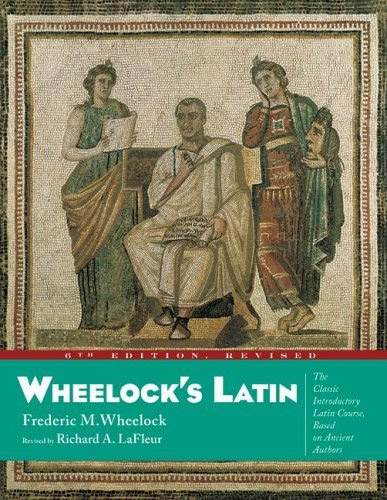 Everything about it was great: the textbook, the teacher, the online delivery system, and the company I got to keep as a student. The only little, tiny drawback was the fact that the class ran from 8 am to 4 pm, Eastern time. That means 5 am to 1 pm out here, and rolling out of bed at 4:45 am to study Latin was imperfectly blissful. My wife wasn’t a fan of the alarm going off that early, either. (But when I offered to sleep on the couch she gave me a speech about how she was willing to sacrifice a little sleep so that I could learn Latin — what a woman!)


 Full Contact Christianity
Anti-Gnostic Song of Solomon Translations and Commentaries
6 July 2008Commentary and translation choices are always tricky. The Bible has inspired a lot of comment and translation over the years, and a surprising amount has been poorly done. Nowhere is this more true than with the Song of Solomon.
The first and most blatant problem is the number of interpreters whose starting point is a red-faced “It can’t possibly be saying that!!! So they gin up a flimsy excuse and explain how the Song is really about Christ’s love for the church.
Apparently the church has captivating hair, an intoxicating navel, and really nice breasts (Song 7:1-5). Of course, the real problem with this view is not the patent absurdity of it — and it is absurd — but the starting premise. Why shouldn’t the Song be exactly what it sounds like — a frank celebration of married love in all its complexity, delicacy, and lush sensual splendor?
Read the rest of this entry »