“Every branch in Me that does not bear fruit He lifts up; and every branch that bears fruit He prunes, that it may bear more fruit. (John 15:2)
I know your translation doesn’t say “lifts up.” It probably says something like “takes away,” which is a valid translation of αἴρω, the Greek word that’s used there. The word means to lift up or to take away; context has to determine which meaning makes more sense in a specific instance. The problem here is that your Bible translators, while excellent at Greek, don’t generally know beans about agriculture, and so don’t understand the work the passage is rather plainly talking about.
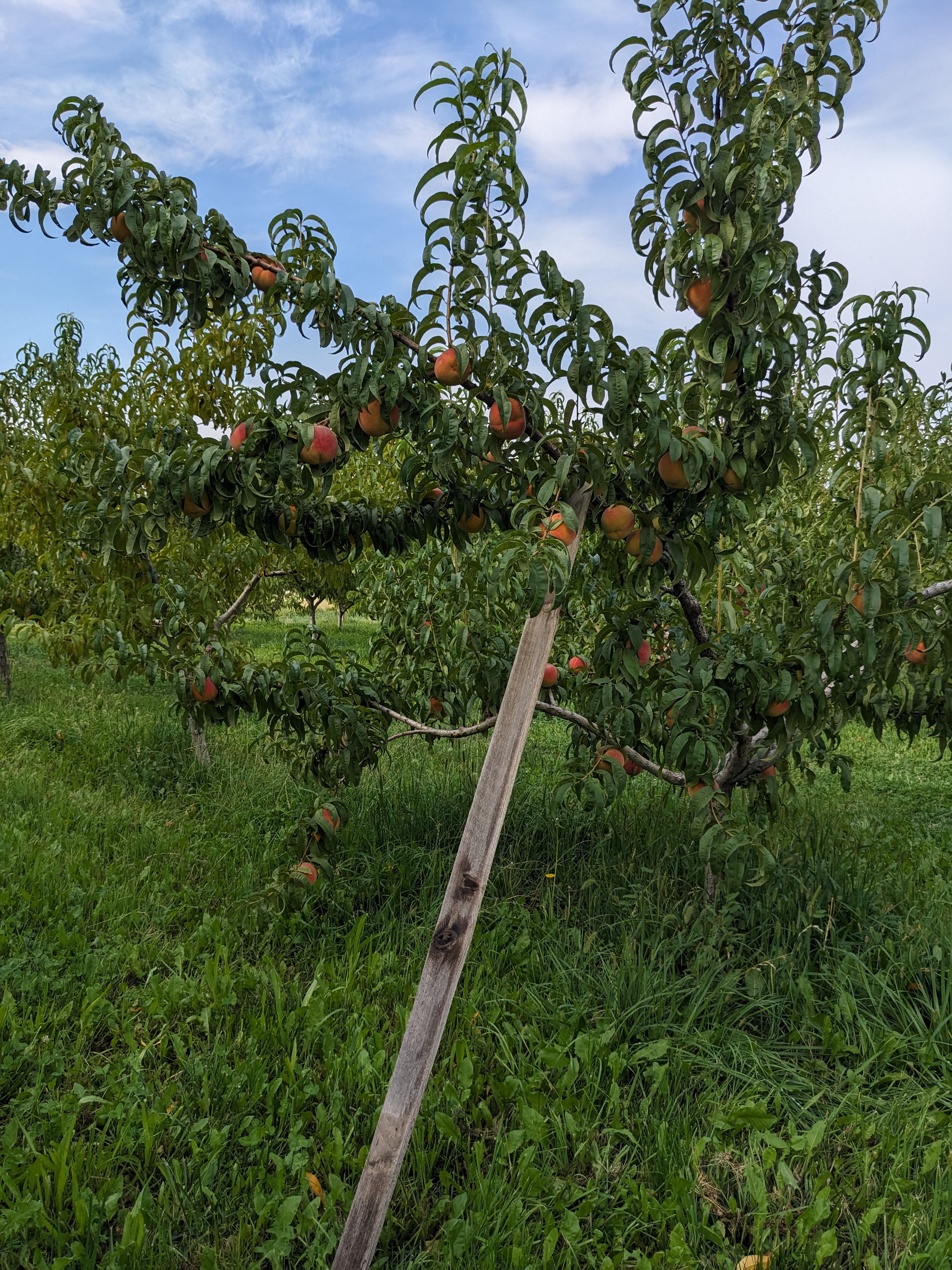
Taken in its agricultural context, John 15:2 isn’t a threat to throw you away if you don’t perform; it’s a promise that God the Father will lift you off the ground, away from pests and rot, in order to bring about good fruit in your life. (I took this photo at Stoned Fruit Orchard, Palisade, CO. Obviously it’s not a grape vine, but the same principle is at work. Buy their stuff; it’s all organic, perfectly tree-ripened, and wonderful!)
Someone will say, “But Tim, what about the branches getting burned in v. 6?” Great question! Two things to know here: First, note the different criteria at work: v. 2 talks about a branch that simply lacks fruit, while v. 6 talks about a branch that is not connected to the vine, which is a very different problem. Second, we’re talking about two different points in the year. The work described in v. 2 happens in the spring, to support the growing season. The work described in v. 6 happens in the fall, after all the fruit is harvested. At that point, you go through the vineyard (or orchard) and gather up all the dead wood.
At a pastoral level, these two things add up to a very different approach to life than the common “spiritual hustle culture.” The command here is not to bear fruit in order to be connected to the vine, or in order to certify your connection to suspicious fruit inspectors. The core command in the passage is not actually about fruit at all; it’s to abide in the vine. Jesus chose His analogy well; we should follow it all the way through. A branch doesn’t bear fruit in order to connect to the vine; that’s just not how plants work. It has to be connected to the vine first in order to have any hope of producing fruit.
Being connected to the vine doesn’t mean the branch can have no problems. A connected branch might be overproducing; when that happens, it’s trying to sprout more fruit than it can support. Left untended, an overproducing branch will make low-quality fruit because the nutrients will be spread too thin. The solution is to prune it back: cut off perfectly good stems and young fruit, so that what remains can be strong and healthy. That’s hard for us to take; we tend to want to cling to things the Father is telling us He will no longer support. But the right answer is to submit to the pruning and pour our effort into what He wants us to focus on.
A connected branch can also have the opposite problem: it can fall into the dirt, where it is vulnerable to rot and pests, and won’t produce fruit. The solution here is to take the branch and lift it up, just as v. 2 says. Propped up into the air and sunlight, away from moisture, dirt, and pests, the branch will be able to produce as it should.
As you can see from the picture above, these are very normal, solvable problems; addressing them is the routine business of farming. A branch that is not connected to the vine is an entirely different matter. That branch can’t produce fruit; can’t do anything but wither and die, in fact. The conclusion Jesus is steering us toward is simply this: abiding is the key thing; fruit is the result! The primary thing we aim for is not production but abiding in Christ. Apart from Him we die; drawing our life from Him, we live, and our Father tends us to bring forth fruit.
(For further reflections on this passage, see Being Lifted Up. For further scholarly work, see Gary Derickson, “Viticulture and John 15:1-6” Bibliotheca Sacra 153:609 (Jan 1996) and Derickson & Radmacher, The Disciplemaker: What Matters Most to Jesus Salem, OR: Charis, 2001)


Sweet.