Why I am no longer a Cessationist, part 2

4 August 2012
Quick review for those of you who just came in: I resigned from RMBC&S at their request, fielded a few questions about that, and went into some depth on how all this came about. Because it’s a long explanation, and because it takes time to write charitably and clearly for a public audience, I’m doing it in pieces. Here follows the next installment.

While the theory of cessationism was falling apart before my very eyes, the Lord also began to show me the practical bankruptcy of the position. The setup for this, unfortunately, was a set of really ugly political battles that I won’t describe here. For our purposes at the moment, there were four salient results. First, I came out of the whole mess deeply aware that my ecclesiastical tribe — which had raised and trained me to follow Scripture at any cost — was unwilling to live up to its own principles when its own habits and traditions were at stake. I had been safe up to this point only because I had stayed away from the “wrong” passages in Scripture. That was okay when I didn’t know any better, but knowing compelled me to take a good hard look at the places my tradition had taught me to develop blind spots. Second, I needed to grow in my leadership ability. My tribe didn’t really have any way to address that, being generally convinced that leadership, communication, personality, group dynamics, and other areas of general revelation about human beings were all a greased slide into rank liberalism. Third, I was pretty beat up. It was far from being my first political fight, but all things considered I think it was the ugliest (thus far). I was really hurting, and I wouldn’t heal without help. For the first time in my life, I couldn’t get it from my tribe. Finally, of the three communities I considered home, one unceremoniously gave me the boot, the second was regarding me with serious suspicion, and the third was willing to allow me to continue work within the community under strictures that ruled out most of the ministry God was calling me into, forcing me to pursue much of my ministry outside the boundaries of my home community.

I went out into the broader Christian community in Englewood, because that was the only venue the Lord had left open to me. I didn’t really know what I was looking for, other than a chance to pursue my calling and hopefully heal. I had no idea what God was about to do.

For a few months, I just wandered, meeting new people, deepening existing acquaintances, and just trying to get the lay of the land. When summer came, I had very little to do because of the seasonal nature of my work, so I was looking for some additional ministry. One day I found myself getting a ride home from a friend who was working 40 hours a week, taking 14 hours of classes in summer session, and planting a church in his copious free time. He was clearly strapped, and I asked if there was something I could do to lighten his load. He got back to me with a request to help organize his worship service — they had an established order of worship, but needed someone to handle the administrative end of things, making sure everything got done. I visited the church a few times in order to meet the necessary people, and about a month later, realized that the Lord had gone before me and knit me into this church. I bonded with them, and they with me…without trying, I had accidentally joined the church. You have to understand, I am not one of those guys that people instantly bond with. This kind of thing just does not happen to me — but God did it.

Knowing that God was doing something special, I went with it, and remained with the church for about a year. It turned out — I did not know this going in — that the church I had accidentally joined was charismatic. I don’t know what sort of picture that word raises in your head, Gentle Reader, so let me describe a little. The worship was heartfelt. The Bible teaching was well-prepared and generally well-delivered. I never saw someone speak publicly in tongues in our church. I did see a number of prayers for healing, and something which was described as prophetic ministry.

At its most general, this might be a group of us coming together in prayer, not just to speak to God, but to listen. On several occasions, as I waited patiently to see if God would speak to me, I would find a particular passage of Scripture leaping off the page at me for no apparent reason. As we all began to share what we heard, it would turn out that the passage of Scripture that jumped out at me was a perfect fit to someone else’s circumstances, or the answer to a question someone else was asking God. It was very often the case that everyone got a little piece of the puzzle, and none of it made sense until we got all the pieces on the table. It was clearly supernatural, and the fruit was stronger fellowship, deeper understanding of God’s Word, growing purity and sanctification and a deeper reliance on one another. On the strength of Jesus’ assurance that a ministry can be tested by its fruits, I was sure that this was of God. But I had no idea just how good it could be.

During a time of deep discouragement in the fall of last year, I had occasion to receive ministry from two young women with prophetic gifting. We spent less than a half hour together, but in that time, it became clear that somewhere along the way in my Christian walk — I don’t know when — I simply stopped believing that God was interested in my good. For some time, I had been pursuing a life of grim determination more suitable to a Norse myth than Scripture. In a matter of minutes, these two dear sisters dragged this lie out into the light, exposed my sin, brought me to repentance, and spoke the peace and encouragement that my soul desperately needed to hear. I won’t share the specifics of what they told me here, because it was incredibly personal, but I wrote it down and I still refer to it often. In their own ability and their own paltry knowledge of me, there is simply no way they could have known to say what they said. But their own ability had nothing to do with it. My walk with God took a strong turn for the better that day. The glory, of course, is Christ’s. But I’m also profoundly grateful to two young prophetesses who were willing to be used by God in a supernatural way.

In January of this year, I was sitting with two friends planning a small-group lesson for the church when the conversation turned to my schedule, my incredible degree of busyness. Both of these two had a measure of prophetic gifting, and the conversation quickly moved from the mechanics of scheduling to the idolatry in my heart that was driving the problem. Subsequent conversations went even deeper, and exposed a sinful vow I had made as a child, an inner idol I had been serving for nearly 30 years. Through the ministry of Scripture and Spirit-led encouragement, God has torn that idolatry out of my heart — although I have to stay vigilant to keep it from creeping back in. Old habits of worship die hard.

Had we but world enough and time, there would be more to tell, but this is a sample. I spent a year with people who were willing to be used by God in supernatural ways, and they dealt with hidden lies, sins and idolatries in my heart, some of which had been festering there for decades. God got an incredible amount of work done, and I am vastly freer today as a result. I have a long way to go yet, of course. But today I know my Father as someone who loves me, seeks my good, tends my wounds, and cares for me specifically. Of course I knew all this doctrine before, but now I’ve lived it more deeply than I’d ever imagined possible. That wasn’t the case before all this started.

But so what? The process is different, but what I’m describing here in terms of results is just garden-variety sanctification: rooting out the enemy’s lies, coming to believe and live the truth instead. Couldn’t the same result have been achieved in a cessationist ministry? I have two answers to that.
1. I was 35 years under ministry that relied on doctrine alone without this stuff ever getting touched; in less than a year, faithful believers who were willing to be used by God in a supernatural way dragged it all out into the light. Kinda speaks for itself, don’t it?
2. God “strikes straight licks with crooked sticks,” as the Gaelic proverb goes, and I’m sure that had He decided to, He could have dealt with these things through a cessationist ministry. He’s God; He can do anything. But you know what? That’s not how it happened, and I am obliged to honor, not someone’s fantasy of what God might have done, but what He actually did. What I received from God was the benefit of prophetic ministry in His Church.

So I may not simply take the sanctification benefits I reaped and run back into the cessationist fold, even if I wanted to. First of all, those benefits really did come to me in a way that simply precludes cessationism (not that the position had a biblical leg to stand on anyhow). “If you won’t believe the words,” Jesus said, “believe the works.” The works happened right in front of me, and I simply can’t deny them. (In Scripture, there are people who did deny the works even though they saw them — but trust me, you don’t want to be like those guys.) Second, Jesus also said “Freely you have received; freely give.” I received the benefits of supernatural ministry, and I now have a duty to share. If God will give me opportunity, I will do exactly that. The problem, of course, is that I didn’t start out with either experience or gifting for this. But Paul said to earnestly desire spiritual gifts, and especially that you may prophesy. I am obeying that command, and praying to that end. The fruit is coming slowly, but it’s coming.

If God is pleased to answer my prayers, then I will give to others as He gave to me. If not, then so be it; I’ll continue doing what I am gifted at now — shepherding and teaching — for His glory and the good of His saints. But no one will ever convince me that prophecy is not alive and well in the church today — it changed my life.


Resignation FAQ part 2: Why I am no longer a Cessationist

29 July 2012

I gave all the caveats for this post in my previous post, so I won’t repeat everything. Briefly, I am giving an account of why I am no longer a cessationist. I am not attacking anybody’s ministry and I am not setting out to criticize anyone. Some critique of cessationism and its proponents will come up inevitably along the way, but I can’t help that. I’m not trying to hurt anyone; I’m just telling about what God has done in my life.

I was raised in a cessationist tradition. The first thing you have to understand about cessationism is that it’s not monolithic. You have some guys that believe the modern-day phenomenon that Pentecostals call the gift of tongues is a demonic manifestation. You have some who view it as a natural expression of joy — but not the biblical gift of tongues. Every cessationist I know believes that God continues to answer prayer, and all of them believe that miraculous healings continue to occur today, but some will pray passionately and publicly for a healing, while others would feel that it’s sinful (or at least unwise) to “test God” in that way. Some cessationists have a deeply personal relationship with God, believing that they receive daily guidance from Him through impressions, inner leading, even dreams; others believe God only speaks through the Bible today (and sometimes, the same person will hold both points of view — about which more later). The common thread is the belief that certain miraculous gifts were given at the very beginning of the Church, for the purpose of establishing and validating the Church, and that shortly after the beginning, God ceased to dispense those gifts. Pretty much everybody includes apostleship, prophecy, healing, and tongues among the now-defunct gifts. Some would also include discernment, words of knowledge, words of wisdom. Some would say that these gifts absolutely ceased. Others don’t expect to find these gifts operating in the heart of Christendom, but expect to see them still in operation in situations analogous to the first century — like, for example, when a missionary makes first contact with a stone-age tribe deep in the jungle.

So in a sense, one can speak of “cessationisms” rather than “cessationism;” there’s enough variation to warrant it. The particular instance of cessationism that led to my resignation was RMBC&S’s teaching statement on the issue, which reads,

The miraculous gifts (apostles, prophets, healings, miracles including a word of wisdom or word of knowledge, and tongues) were temporary in nature as signs to unbelieving Jews and as a validation of the New Testament message and its messengers at the initial stage of the church.

I want to make clear that the RMBC&S statement is an instance of the sort of thing I’m rejecting, but this is not simply a matter of slightly different framing of the same basic sentiment. I am rejecting all cessationisms, root and branch.

I have always been an exegete at heart. If I am going to get up in front of people and say “Thus says the Lord…” I want to be very certain that the Lord has, in fact, said it. This goes back very early for me — I remember our family having knock-down-drag-out fights in the middle of family devotions over whether the passage at hand actually said this or that. This didn’t happen every week, but it wasn’t a particular rarity, either, and on those occasions my parents did not use their parental authority to end the debate — it was understood that the Word was the authority, we were all equally in submission to it, and it was vitally important that we manage to come to an understanding of what it said, so that we might obey it well. (These debates also formed in me the quality that several very frustrated folks have described as “not taking correction well.” It is in fact nothing of the kind — it is a gut-level understanding that you can’t win an exegetical argument with age or political authority any more than you can drive a nail with a kitchen sponge; just the wrong tool for the job. But for guys who are accustomed to doing that, it’s hard to take when a younger man refuses to play along. Oh well.)

Cessationism had always made theological and practical sense to me, and I had been taught that 1 Corinthians 13 was the go-to passage for an exegetical validation. This lasted until seminary. I was in my second or third year of seminary — I can’t remember which — and I had occasion to work through 1 Corinthians 13 in Greek. Ironically, the things I noticed are sitting right there on the surface of the English text, but I’d just never read the passage closely enough before to notice them. Certain gifts will cease — says so right there. But when? It certainly says nothing about the completion of the canon. What it does say is that these gifts will cease when knowledge is full rather than partial, when vision is accurate rather than dim, and when full maturity is reached. I didn’t think to pursue the implications of this at the time (that came later); I was so stunned at what the passage didn’t say that I barely noticed what it did say.

Surprised at what I found, I hunted down my Greek professor and asked if I had missed something. He grinned and said no — the passage does not, in fact, say what most cessationists think it says. He suggested to me that a case for cessationism would be better based on the historical evidence that the sign gifts did, indeed, pass out of existence in the first century, and that the modern manifestations that go by the name of tongues or prophecy fall woefully short of the biblical descriptions of tongues and prophecy. That made sense to me, and I went with it. I did, however, continue to want a genuinely exegetical case for the doctrine, and I continued to search for one.

Long story short, I didn’t find one, and I looked at a lot of cessationist arguments. Hebrews 1:1-2 certainly does say that God spoke through prophets in the past, but it doesn’t preclude prophets after Christ — and in fact, there were a number of them, as the book of Acts attests. Hebrews 2:3-4 tells us what purpose the signs and wonders serve, but never says they stopped. Likewise, Ephesians 2:20 says that the apostles and prophets are foundational, but it doesn’t say they have no continuing role (it also says that Christ is the chief cornerstone, and I’m pretty sure we all agree that He has a continuing role.) Even if 2 Corinthians 12:12 says that signs and wonders and mighty works were the signs of an apostle (questionable, but let it pass for the moment), it never says that nobody else did signs, wonders, and mighty works — and in fact, many others did, starting with the 70 that Jesus sent out, and continuing into Stephen, Philip, Ananias, and others. There were certainly people who were not healed miraculously — Paul had his thorn in the flesh (if that was a physical ailment), Timothy had his weak stomach, Trophimus was sick enough that he couldn’t leave Miletus with Paul, Epaphroditus almost died, and so on — but that didn’t mean that healing wasn’t happening; it just meant that not everybody was healed.

Now, the theology of cessationism made sense to me, but increasingly it looked like the theology of Calvinism: internally self-consistent and well worked out as a system, but utterly lacking in exegetical support for the key assumptions. In other words, something that could be true, but seemed to lack the necessary biblical evidence to establish for sure that it really was true. That made it an interesting speculation, but clearly not in “thus saith the Lord” territory. Knowing that the exegetical evidence was woefully insufficient and the theological formulations were speculative at best, I fell back on what, to me, was an obvious point of historical fact: the miraculous gifts seemed to have died out at the end of the first century, and some explanation for the (lack of) phenomena was required. If the explanation turned out to be a bit shaky and incomplete, there was still the brute fact that signs and wonders of the biblical type didn’t continue happening, which made cessationism (in some form) seem pretty likely.

At the same time all this was going on, I became friends with a Pentecostal pastor serving in Orange County, CA. You have to understand, I’d known some charismatic folks back in high school, and those guys pretty much confirmed every stereotype I’d ever been taught — they were flaky, emotional, undependable, unwilling to plan because they wanted to “let the Spirit lead,” which in practice meant doing whatever stupid thing came into their heads at the moment, unreflective, and uninterested in serious study of the Scriptures (again, they would rather “let the Spirit lead” than read the Bible — apparently it never occurred to them that He might be leading them to do just that.) So I’d steered clear of charismatic folks ever since, but this guy was wise, a serious student of the Bible, loving, down to earth — in fact, he was a godly man to whom I could turn for advice in ministry matters, with good results. It was news to me that you could be charismatic and not be a nutcase.

Sidebar: Many of the people who were responsible for my prejudice in the first place will admit, when pressed, that they know a few sane charismatics. However, they were only too happy to have me think that all charismatics were nuts, and never took the time to nuance that generalization by making the appropriate qualifications. This is a violation of the Golden Rule and the Ninth Commandment, which is to say, a major ethical problem. Just sayin’.

I remember that about this time, I found myself in a debate with a Calvary Chapel pastor over the gifts of the Spirit. I articulated my historical/practical defense, and he was underwhelmed. I remember his response like it was yesterday: “So what you’re really saying is just that you’ve never seen the gifts in operation?” he asked.

“No, no,” I said, “I’m saying that they just don’t happen after the first century.” Shortly thereafter, he disengaged from the conversation. At the time I felt like it was because we’d reached a stalemate. Looking back, I see that he realized I wasn’t ready to hear the counter-argument that he would have made. Being ready to hear that would take more than just a shift in my thinking: I needed God to do some work in my life as well.

God did that work by moving me to Englewood, CO. In Englewood, I encountered something I’d never seen — or even heard about — before. The evangelical pastors of the city would gather and pray for one another. I don’t mean one of those “prayer luncheons” where you eat a big meal and then spend 2 minutes praying at the end. I mean they’d get together for an hour, check in to see who needed prayer for what, and then wade in and spend 45 minutes of the hour in prayer for each other, for each other’s churches (as well as those churches not represented in the gathering) and for the city. These men were godly, wise pastors who genuinely cared for each other. They talked about how there’s really One Church in Englewood (even if it happens to meet in 24 different locations most weeks) — and they really meant it, and lived it. In order to show that to their congregations, they rented out the high school football stadium once a year and had a joint church service. The first year, there were 8 churches participating. This past year, 14 churches canceled their Sunday morning services to go to the stadium and meet together. In Englewood, I saw John 17 incarnated in ways I’d never seen before. These were the men I wanted to be when I grew up. As I got to know them better, I slowly realized that almost to a man, they were charismatic. Even the Dutch Reformed guy and the Anglican priest.

I had settled in my mind years ago that if you were going to practice something that you would call the charismatic gifts today, then obviously you had to follow the biblical guidelines for them — tongues must be interpreted, prophecies must be judged, and so on. I had never seen a charismatic church even try to implement those guidelines. Among these guys, it was a no-brainer: of course you had to follow the biblical guidelines. So my stereotypes of what it meant to be charismatic were shattering left and right. I recognized that I was seeing a practice of charismatic Christianity that had heard the cessationist criticisms of the various excesses practiced in the name of the Holy Spirit, taken the biblical content of the criticism to heart, and responded to it. In short, I was seeing maturity. Of course I was still a cessationist at this point, but I found myself forced to admit that these guys took the Bible seriously, and didn’t use charismatic phenomena as an excuse to dodge faithfulness to Scripture.

Speaking of faithfulness to Scripture, I was beginning to develop some biblical problems of my own. As I continued to investigate, the lack of exegetical evidence for cessationism became the least of my concerns: I was increasingly finding a great weight of biblical evidence against cessationism. About this time, a friend who headed a Bible study for a group of pastors and elders one day called me with news: “We’re not cessationists anymore.”

“Why not?” I asked.

“Because the final fulfillment of Joel 2 is still future. If, in the future, our sons and daughters will prophesy, then how can we believe that prophecy has already ceased?”

Good question. And that was just the beginning of the contradictions. I maintained that the New Testament was the authority for church doctrine and practice, but at the same time I also said that the practices that characterized the New Testament church should no longer characterize us today. I held the Great Commission as a charter for modern-day disciple-making, but surely “teaching them to observe all things I have commanded you” would include repeating Jesus’ commands to “heal the sick, cleanse the lepers, raise the dead, cast out demons” – and I neither obeyed these commands myself nor passed them on to my disciples. To the contrary, I taught my disciples not to do these things, nor trust anyone who (reportedly) did. I even disregarded passages like James 5:14-15 which spoke to supernatural expectations, but said nothing whatever about the putatively ceased miraculous gifts. Biblical commands began to leap off the page at me: “Do not despise prophecies.” “Do not forbid to speak in tongues.” “Desire spiritual gifts, but especially that you may prophesy.”

I began to wonder: if these things are supposed to continue, then why didn’t they? Why don’t they still happen? Upon investigation, I found that they do. Missionary friends return from the field with story after story — things they personally witnessed, things very much like the events of the Bible, things they don’t much talk about in the Western church because it freaks people out. And it wasn’t just the mission field. A close personal friend had his broken kneecap miraculously healed right here in the United States. Another friend was routinely seeing healing from a wide variety of ailments in direct response to his prayers. I had occasion to hear that guy speak on church history, and I was shocked at what I heard. To hear him tell it, the entire history of the church was just riddled with signs and wonders and healings. This was a history I had never heard about, despite being a church history teacher’s son and (I thought) a close student of church history myself. I had to know more.

I began to investigate, and what I found surprised me. You’d never know it from the history books I read in the course of my theological education, but it’s really true: signs and wonders have characterized the history of the Church from end to end, witnessed (and at times, performed) by such sober-minded saints as Augustin, John Knox, and Charles Spurgeon. The more I looked, the more I found, both in history and in the present day. Only by dismissing accounts of supernatural events out of hand as myths — or simply by refusing to pay attention to them — can we effectively maintain the illusion that these things stopped happening at the end of the first century. The fact that so many Christian historians were willing to do just that was incredibly disturbing to me. If these guys applied the same criteria to the biblical miracle accounts that they applied to accounts of anything that happened since, they would be 19th-century liberals. (Ahem.) Where did they learn to look at stories of God’s supernatural doings with such a priori skepticism? Certainly not from the pages of Scripture!

But while the theory of cessationism was falling apart before my very eyes, the biggest blow wasn’t theoretical at all.

I hope to have the rest of the story up next week, but this is as much as I have been able to write so far. Thank you for your attention, and I sincerely hope I am meeting my goal of being gracious to all concerned and truthful at the same time.


Resignation FAQ, part 1

22 July 2012

For those of you who haven’t heard, I’ve resigned — or more accurately, been asked to resign — from my seminary teaching position. You can find the announcement here.

As the dust has settled, a few questions have come to the forefront.

  • What will I do now?
  • Aren’t I mad about being asked to resign?
  • Why did I change my position on spiritual gifts?

Let’s take them in order.

What I will do now is exactly what I have been doing. Youth ministry at The Fount, writing curriculum for Headwaters Christian Resources, involvement in the Englewood community, seeking to know and follow Jesus, to introduce others to Him and help them follow Him, to be a better disciple, a wiser discipler, a more loving husband, a stronger friend. I won’t be teaching in the RMBC&S classroom, but I’ll continue to support the students, my friends among the faculty, and the mission of the school by whatever avenues are open to me; they’re doing good Kingdom work. The beauty of seeking first His Kingdom and His righteousness is that the work is not tied to any one organization (Pope Benedict, are you listening?). Organizational ties come and go. Wineskins wear out; all is mist, as the Preacher once said, but through it all, we fear God and keep His commandments.

And no, I’m not even a little mad about it. I don’t believe that this is an issue Christian brothers should divide over, but the school is serving a community that feels differently about it than I do. Theology is a contact sport, and when you change your position on something, you have to expect some organizational alignments to change as well; there’s nothing sillier than a professional theologian whining about having to change jobs after he’s changed his theology. That’s just the nature of the beast. When it comes to something like this issue — where the very, very contentious debates only died down about 40 years ago — the lines are brightly drawn and well policed. They’ll be gone in another 10-15 years, because people on both sides have matured, because much of the divisive craziness that characterized the debate 40 years ago isn’t around anymore, and because the younger generations are simply refusing to polarize around that issue — and God bless them for it. However, we have to deal with what’s going on now, and right now, things are still polarized enough that some folks feel the need to politicize the issue.
Also, not to put too fine a point on it, God will not be mocked. We reap what we sow. I was a foot soldier for the Doctrinal Purity Police in the not-too-distant past; in God’s good pleasure I am reaping a little of what I have sown. Of course I don’t like it, and I wish that God had arranged things differently. But discipline is never comfortable, because it brings change, and change is never comfortable. I look forward to being trained by it in order to reap the peaceable fruit of righteousness.

Finally, why the shift? This is the most common question I’ve gotten over the past days, and it’s more difficult to answer than you might expect, for two reasons. First, it’s not quite as simple a question as it looks, sitting there on your screen. Some people mean, “Please give me an autobiographical account of your shift.” Others mean, “Please tell me you haven’t turned into a snake-handling whacko.” (I haven’t, by the way.) Others mean, “Is there something wrong with my theology?” Still others, “Young man, we taught you better than this. No excuse will be good enough, but explain yourself anyway!” There are other nuances too — lots of subtext on this one. I need to be clear about which questions I can hope to answer. I intend to give an autobiographical account of how I came to hold this view. Along the way, I do also feel a responsibility to explain myself to the community that raised and trained me. If what I say addresses some of the other nuances along the way, then so be it, but these two are all I’m really trying for.

Second, it’s difficult to give an account for my shift because I’m kinda done being a foot soldier for the doctrinal purity police. I’m happy to be clear about what I believe and why, and I have no intention of dancing around the shortcomings of cessationism. As I always have, I’ll say what I believe to be true and make no apology for it. That said, there’s a lot of needless division and brother-hatred around this issue, and I have no desire to exacerbate the wounds already inflicted on Christ’s Body. I don’t want to be dishonoring to anyone, least of all to the community that raised and trained me. I can hardly avoid criticism — at least implied criticism — of that community; an autobiographical account of my shift will discuss why I started with their position, found it inadequate, and adopted a new one. That said, it is still a matter of Christian duty for me to be properly honoring and grateful to my community and the many gifts it has given me. This is a difficult balance to strike, and it is essential that I do it well. With that in mind, I’m going to delay answering this question publicly until I am able to do so in a manner that is agreeable to my conscience.

I intend to put an answer up in a few days to a week, but I’m making no promises. Articulating all this well has been significantly harder than I had thought it would be, and I had a full life before all this came up. I’ve got other things to do, and if this is going to take 50 hours, it will be a while before it gets done. I welcome private conversation on the topic at any time, so if you feel you need an answer sooner, please don’t hesitate to contact me. As I said in my resignation announcement, nobody has anything to hide here, and I’m happy to share the details in private conversation.


A Letter to my Colleagues and Students

19 July 2012

I was raised and trained in a cessationist tradition, but a number of years ago, I began to have serious doubts about the biblical integrity of cessationism (the belief that certain biblically attested spiritual gifts ceased shortly after the first century). Over a period of years, I have devoted considerable time, effort, and prayer to a careful study of the exegetical, theological, historical and practical issues involved.

Rocky Mountain Bible College and Seminary, where I have served as a curriculum designer and instructor since 2008, and an assistant professor since 2010, maintains a very specific teaching position on the gifts of the Holy Spirit. It reads,

The miraculous gifts (apostles, prophets, healings, miracles including a word of wisdom or word of knowledge, and tongues) were temporary in nature as signs to unbelieving Jews and as a validation of the New Testament message and its messengers at the initial stage of the church.

As a result, my possible shift on this issue had some fairly serious ramifications. I want to assure you that I hid none of this from Dr. Lewis. I consider him a mentor and a friend as well as being my boss at RMBC&S, and I’ve kept him apprised of my progress as I have wrestled through this issue. For his part, he made it clear that as long as I was willing to stick to the school’s teaching position while I was working through the issue, he was happy to have me continue on faculty. These things cannot happen overnight, and I’m very grateful for his openness and support while all this was in process. He is far from the only one; a number of mentors and friends have been generous with their time and insight. I am grateful to you all.

As the process continued, the conviction that began as a trickle of doubt about the viability of one exegetical argument in one passage became an overwhelming flood. I don’t say this lightly at all, but my conclusion is simple: cessationism is exegetically insupportable, theologically weak, historically false, unable to account for realities that I personally witnessed, and practically very far removed from the New Testament. The Bible simply doesn’t teach it. Of course this is a large claim, and my reasons for making it are a separate discussion that I will be happy to have; for the moment suffice it to say that I did my best to investigate every reasonable avenue. After discussion with Dr. Lewis, I wrote and submitted a letter in which I laid out my exception to the RMBC&S teaching position on spiritual gifts, and my reasoning for it.

At this point I felt myself in a bit of a dilemma. I do not believe that this sort of issue should divide Christian brothers. I continue to believe in the mission of RMBC&S and would like to continue aiding the school in our areas of common endeavor. As a result, I didn’t feel that I could simply resign in good conscience; it seemed to me that would convey a rejection of the school that I didn’t, and don’t, feel. On the other hand, I am well aware that within our tradition the lines on this theological issue are brightly drawn and well-policed, so my resignation might be necessary for the school’s sake. I had no desire to cause the school undue trouble, and of course I didn’t want to be one of those jerks who — just to make a point — refuses to resign and forces the administration to fire them. That’s no way to love your neighbor.

Unable to act unilaterally in good conscience, I sought Dr. Lewis’ counsel on a way to resolve the issue to our mutual satisfaction. I was prepared to tender my resignation immediately if the school wanted it; on the other hand if they would prefer to continue discussing how we might navigate our differences and continue to work together, I was open to that as well.

On July 17, Dr. Lewis chose to accept my resignation. At the same time, he also indicated that he would like for us to continue discussing these issues, and to continue discussion on the possibilities for looser collaboration as opportunities arise where we might serve together: ministry within the local community, student internships, and the like.

Working with RMBC&S and with Dr. Lewis has been a lot of fun, and I am grateful for my time there. My students and colleagues, each and all, have been a blessing to me. I continue to ask the Lord to bless the school, its students and faculty, and its mission to equip believers for service, and of course I remain happy to assist in that mission as the Lord may provide opportunity.

Please be assured that there are NO hard feelings; we all remain friends. We may not be working under the same organizational umbrella for the present moment, but we are all still working for the same boss, seeking His Kingdom and His righteousness — each in the manner that God has convicted him to do.

This kind of event, if not carefully and fully explained, presents opportunities for unfounded speculation and gossip. I would not have the enemy gain a toehold through this, so I have chosen to be as clear and specific as seemed advisable. If this isn’t clear and specific enough, please ask for more details; nobody’s got anything to hide here. Thank you for bearing with the length of the explanation, and again, if I have left you with some concern or doubt, please don’t hesitate to talk with me.

God’s richest blessings attend you as He leads you in His will for your lives. My love and my prayers go with you.

In His service,

Tim Nichols


Mission Creep in Ministerial Training

8 July 2012

Health clubs thrive on the people who sign a one-year contract on January 3 and then never actually come to the gym.  All the paying members ever showed up on the same day, the fire marshal would shut the place down.

Storefront martial arts studios live on beginners.  There are people who stick with it into the upper ranks, of course, but the endless parade of white belts who join, stick with it for six months or a year, and then quit?  Those people are the ones that are paying the rent.

What’s this got to do with training ministers?

Everything.

Say your pastor’s getting older, and the church realizes that come five, ten years, you’ll be needing a new pastor.  You’ve got a guy in the church, promising young fellow who’s definitely got the character and the gifts, but he needs the training.  Now, you could ship him off to seminary for a few years, and then hope you get him back.  But he’s got a wife, three kids, a mortgage, a dog, a steady job, and you’re asking him to pull up stakes, move to another state, struggle through four years of the most demanding academics he’s ever seen, spend his evenings waiting tables or sitting in a booth at a parking garage, trying to keep body and soul together on minimum wage and still be a good husband and a good father, only to come out of the experience thousands of dollars in debt, so he can come back to your church and get paid less than he’s already making right now–and for a lot more work.  He ain’t going.

Wait just a minute, you say.  What happened to dedication?  The church needs him!  Yeah, sure.  So do his wife and kids, and the needs of the wife and kids come first.  “He who does not care for his own has denied the faith and is worse than an unbeliever.”  As long as that’s the deal you’re offering, the only takers will be guys who are willing to put themselves a whisker away from disqualifying themselves from the very ministry they’re preparing for.  (And then we wonder why it’s so hard to hire a pastor who understands the church budget…)

So you think, “Well, okay…what if he could take evening classes right where he is?”  Ah, now you’re getting somewhere.  But there isn’t anybody offering evening classes within reasonable driving distance.  Now what?

Start something, of course.  Just to be talking about it, let’s say you can score a classroom in a church basement somewhere, and let’s say you have the skilled people you need to teach.  (That’s granting an awful lot, but let it pass for now.)  You’ve got one student, anyway…

…but where do you get enough to make this worth doing?  If you decide, right out front, that you’re training pastors for church leadership and pulpit ministry, and that’s it, then you won’t accept anyone unless you think they have a reasonable chance of being a pastor.  Right out the gate, that means you’re accepting nobody who seems to lack the pastoral gifts, and for many in the conservative world, no women, either.  So you’ve excluded a huge part of the population.  You’re happy, because you’re doing a narrow, well-defined job, but costs mount.  You need a photocopier for class handouts.  You need money for rent for your classroom.  Maybe you get enough things going at one time that you need two classrooms.  You need books for your library.  These are largely fixed costs, and you don’t have a lot of students to offset them.  You get some donors, but the truth is, with so few students, you’re serving a very small community, so the number of donors is small, and they don’t give much. A few years of barely making it, and you’re facing the possibility of having to close your doors.  You’ve got to bring in more money, or you’re going to go broke.  You’ve done everything you can think of to bring in more qualified students, but you can’t give people the pastoral gift — either they have it, or they don’t.

Meanwhile, you’re taking three or four calls a week from people who “just want to take a few Bible classes.”  You turn them down, of course, because you’re only training pastors.  But eventually, you start to wonder if maybe there’s another source of funds there.  So you give it a shot — you open up your entry-level courses to auditors.  They pay less, of course.  But you have a number who really want to do the work.  If your instructor’s grading the work, then he ought to be paid for that — so you let them take the class for credit, and charge them accordingly.

Shortly, you have a group of satisfied students who’ve taken everything that’s open to them and are hungry for more.  You open up the next group of courses.

And so on.  Fast-forward a few years, and you’ve got a Bible college on your hands.  Most of your students aren’t going to be pastors.  But anybody who shows up at the front door with a high school diploma and the tuition money can take classes, and then declare a “pastoral ministries” major.  Since you have the institutional memory of being a training institute for pastors, you’ve never made any sort of serious attempt at offering a well-rounded education.  Out of necessity, you’ve added an English Comp course or two, just because you had too many students coming in who couldn’t write a paper to save their lives.  You added English Grammar because you had too many guys flunking out of Greek and Hebrew because they didn’t know their own language.  But still, you mostly teach Bible.

Result: you graduate people who never had the pastoral gifts, never would have been selected to be pastors, and whose training is suited for nothing at all except pastoral work.  Churches hire these people because they have the training.  Disaster ensues.

What’s the answer?  I don’t know for sure (I have some ideas, but they’ll keep til next week).  One thing I can say for sure: this ain’t it.


What Doesn’t Belong to Caesar?

4 July 2012

As I’ve acquired a deeper and more theological view of American history, I’ve grown deeply ambivalent about uber-patriotic church services.  There’s a pep-rally atmosphere to it, a partisan spirit that seems deeply at odds with the Great Commission’s leveling admonition to disciple all the nations.  We’re glorying in our team, simply because it’s ours.

There’s an idolatry in it.  The Christian flag is on the speaker’s left, and the American flag is in the superior position, on the speaker’s right.  Now, I have issues with the ‘Christian’ flag, too — modeled after the American flag as it obviously was — but if we’re going to have a flag with a cross on it, why are we displaying it in the inferior position?  Is Jesus King of kings and Lord of lords, or is He subservient to the American government?  “Well,” people say, “that’s what the law requires.”  So it does.  Once upon a time it required burning a pinch of incense to the emperor as a god — a different way of indicating the same thing.  Christians used to know how to handle that kind of requirement.  What happened?

The pledge — which we say in church — is to the flag, and to the republic for which it stands.  That’s right, a bunch of professing Christians stand up, put their hands over their hearts, and pledge allegiance to a piece of cloth, and they won’t even blink.  I mean, it’s not like it’s actually a graven image; it’s sewn.  That’s totally different.  The finial on the flagpole is a golden eagle, not a golden calf — again, totally different.  This is your god, who brought you out of the land of Britain.

We are Christians.  Support of the civil magistrate is required of us.  In a certain way, then, there is a form of patriotism that is also required of us.  But we must have no other gods before Yahweh.  If we actually pay any sort of attention to what we are doing, is not our participation in the cult of the flag a blasphemous idolatry?  The words “under God” in the Pledge don’t wipe all this away; they make us like the ‘good’ kings of the northern kingdom in Israel — Jehu destroyed Ba’al worship at Yahweh’s command, but he did not take away the high places and he continued in the ways of Jeroboam the son of Nebat, who caused Israel to sin.  Yahweh doesn’t much appreciate ‘true’ worship mixed with idol worship — because that’s not true worship.

**

Then there are the comparisons between what we’ll do for America versus what we’ll do for the church.

America is an ideal, a culture, and it has its forms, which we conservative evangelicals respect.  When we have a July 4th service — and boy, do we put on a show for those — we do not remix the Star-Spangled Banner to some contemporary jingle so the young people can “relate.”  We don’t do this to America the Beautiful either, nor to God Bless America.   We stand when the national anthem is played, and we put our hands over our hearts.  We say the pledge, in unison, without a second thought.

Aside from the issues about the Pledge already noted, I’m happy with all this, in its place.  I think it’s great, and I don’t want to seem ungrateful that we’re willing to show genuine reverence somewhere.

But this in a church service, from people who won’t do anything approaching this level of reverence for the Christian faith?  Something is out of balance.

We won’t say the Creed in church because it might be vain repetition, but we think nothing of saying the Pledge.  We change our songs like they were dirty socks — an apt metaphor for some of them, I admit.  We can’t resist the temptation to ruin a centuries-old, grand, well-constructed song by resetting the chorus to some advertising jingle.  We forsake the music of the past just because it’s old, but we’d never think of doing the same with our iconic American music.  We stand for the national anthem without being told, but will we stand up for the reading of Scripture? Dream on.

We tell ourselves that this is because the truth of Christianity transcends all these low, material, ritual things.  We tell ourselves that.  But the truth is a little different. The truth is that our Americanism is profound, meaningfully incarnated in the life of our community.  Our Christianity is so weak and shallow we don’t even meaningfully incarnate it in church, let alone in the public square.


Resting With Lifted Hands

24 June 2012

Two days ago, I returned from a 10-day trip to visit some friends and family in Minnesota.  It was an incredible time, filled with joy and tears and good fellowship, and I came back home in desperate need of some down time.  I have not been able to rest as completely as I really wanted to — a friend is getting married this weekend — but it’s all good.

Taking rest in the middle of the hurly-burly is a growth area for me right now, and this is a golden opportunity to practice.  I’d like to say something about how it’s all about attitude or whatever, but I don’t know what it’s all about.   I’m just fumbling along, trusting God to deliver me from my anxieties and give me peace.  The Lord has not given us a spirit of fear, as the apostle once said.  For all that I’ve been a Christian for most of my 37 years, I’m still kinda new to this dimension of walking with God.

***

I’m new to a lot of things.  Although I had been aware of 1 Timothy 2:8 for a long time, I’d never really been convicted that it was something important to follow until pretty recently.  Suddenly I find myself lifting up my hands in prayer, and I don’t really know why other than that God says to do it.  I’m a theology geek — I want to understand before I dive into things like this.  I don’t understand, not at all.  I can dig through the biblical passages that talk about lifting hands (there’s a fair few, it turns out), and I can get a general concept for what the practice is about, more or less.  Some conclusions rise to the surface pretty readily.  But to be honest, I don’t really get it.  So I find myself having to simply rest on the Father.  He knows what it’s about; He’ll take care of it.  I’m just aiming for obedience seeking understanding.  I expect to understand in a year, or five.  But understanding comes from the Father; He’ll give it when it’s time.

I fumble about with this one too.  Sometimes I just plain forget.  Other times I find myself caught in a cleft stick between obedience to the command on one hand, and on the other hand, obedience to other commands like loving my neighbor or not putting a cause to fall in my brother’s way.  I do have a few people in my life who are thoroughly put off by the whole thing; seeing me raise my hands this way grieves and annoys them.  I’m not sure what to do about that.

Re-introducing obedience to a culture that has grown comfortable with disobedience has a lot of inherent problems, and I don’t navigate the territory perfectly.  There’s no recipe for this; I’m making decisions on a case-by-case basis, and sometimes I make the wrong call.  All I can do is try to remember to keep an eye on the Father and follow what He leads me to do.

And rest.  He knows what He’s doing.


Beyond Advice

17 June 2012

There are times when advice is exactly what you need, because you don’t see as well as other people.  There are many other times, though, when you aren’t quite that helpless.  This does not mean, however, that you do not need the collective wisdom and experience of the community.

Let’s say you ignore all advice that boils down to “Do it the way I did.”

Let’s say you also ignore all advice that boils down to “Don’t do it the way I did.”

What do you have left?

Quite a lot.  What you’re looking for is not advice.  What you’re looking for is experience by proxy.  Ask “What did you have to give up to get what you have?”  “What were the advantages of your choice?”  What were the disadvantages?”  “How would your life be different if…?”

If someone gives you flippant, easy answers, just move on.  Find someone else to talk to.  You’re listening for thoughtful reflection on a life unlikely at every turn, a life where there were always thousands of other choices — as you will always have thousands of other choices.  Your interlocutor will value certain outcomes and devalue others; that is his (or her) affair.  You might adopt some of those values; others you might pass by.  But the experience, the chance to learn how the world works by looking closely at someone else’s story — that’s gold.

You can’t just do what someone else did before you.  There are millions of little details that make your situation different from theirs.  Teenagers learn this and endlessly argue that they aren’t about to repeat a stupid mistake: “This is different!” they whine.  Of course it is.  But as their parents know, often the differences don’t really make a difference.  You aren’t looking for anything so simple as “I did it this way; you can too.”  No, you are looking for paths, for well-worn trails where many individuals, each of them with their own story, motives, and dreams, each one different in endless ways, nonetheless wore a common rut in the world.  Don’t want to wind up where the rut ends?  Don’t start where it starts.  But if it goes where you want to go…now you’ve got something.

To see the ruts in the world, you can’t think like a lab tech.  It’s not a science.  The world you live in is not a mechanism.  Yahweh is not a watchmaker; He is a spoken Word artist, and everything you see and smell and taste and touch, He spoke into being.  He is upholding it all, even now.  If you would live in harmony with His world, His art, then you have to make decisions artistically. You have to think in metaphors and symbols and types, in foreshadowing and themes.  You think typologically, not technically.

You can’t plan your life.  You can make plans and blueprints and timelines until you’re blue in the face, but God is the One who speaks the world into being, who fashioned the days for you, when as yet there were none of them.  He allows you to collaborate with Him, but there are thousands of other paths, and many of the critical decisions in your life are not up to you.  Will that car suddenly swerve across the double yellow line and hit you head-on at 55 miles an hour?  You don’t get to decide.  You drive straight on, trusting that it won’t.  So far, you’ve been right.  The next time, you could be wrong.  All is mist, as the Preacher once said, and all your plans are shepherding mist.

You can’t plan your life.  What you can do is live in a way that matches the sort of world in which you find yourself, a way that honors the Artist and His intentions for the work.


Survivor to Lifeboat: “You’re Losing Me.”

3 June 2012

This week I happened upon Fors Clavigera, the blog of James K. A. Smith, and read a suggestive little post on the millennial generation (for those of you who haven’t heard the term, it refers to people born from 1981 to 2000, or thereabouts).  In this post, Smith opines that it’s possible that millennials are just wrong about some things.  He links to a very well-written piece on the debates over homosexual marriage by millennial author Rachel Held Evans, which presumably articulates some of the attitudes he feels millennials may be wrong about.

In reading Ms. Evans’ article, one phrase leapt off the page at me.  “You’re losing us.”

It struck me for two reasons.  The first one is that it’s rather obviously true.  Millennials are, in fact, greatly put off by the culture wars, by continuing political battles over abortion, and certainly by the battles over homosexual marriage.  These battles are largely being waged by older generations, and millennials (taken as a group) want no part of it.  Millennials are famously one of the least-churched generations in American history, but Ms. Evans is speaking from the standpoint of Christian millennials who think of themselves as part of the church, but can’t stand the political battles.  Hence the message to the church: “You’re losing us.”

Which brings me to the second reason that phrase struck me so forcefully: “You’re losing us” is the language of consumerism, the complaint of a dissatisfied customer who is being kind enough to clue the business owner in on why his other customers are disappearing.  That is a really odd way to address the church, which a wise man once described as the pillar and ground of the truth. The church is the New Jerusalem, and she is the mother of us all.  Like the man said, “Forsake not the law of your mother.”

We have a duty to cling to her — including the past generations that are part of her.  The younger generation may well see the older generation’s follies for what they are, but “foolishness is bound up in the heart of a child.”   If the younger generation takes the older generation’s mistakes as excuses not to walk with the wise and learn what its elders have to teach, well…fools hate wisdom and instruction.  Solomon knew as well as anybody that the older generations were composed of sinners, but he wrote what he wrote for a reason.

Which is to say that I want to take a step further than Prof. Smith.  It isn’t just that millennials are wrong about some issues.  It’s that millennials have a fundamentally skewed orientation toward church.  They need to stop thinking of the church losing them, and start being concerned that they are losing the church. The church is a lifeboat, and it’s a wide, deep, shark-infested ocean out there.  Striking out on your own is a bit naive at best.  You might complain that there’s a centipede crawling around the bottom of the lifeboat, but you don’t jump overboard because of it.

Some of what millennials are reacting to — the teaching that homosexual behavior is sin, for example — is just black-letter Bible, and they need to make their peace with it.  Yes, it’s hurtful to your LGBT friends.  Mine too.  Yes, that strains the relationship and causes you distress.  Loving your (sinful) neighbor and your God is tough that way; welcome to the trials of the Christian life.  “Count it all joy when you fall into various trials, knowing that the testing of your faith produces patience.”  Can’t handle that?  Can’t see how it all works out for anybody’s good?  “If anyone lacks wisdom, let him ask of God, who gives to all generously and without reproach, and it will be given to him.”  Pray more.  Sounds simplistic, I know.  It’s not.  Pray more.

But let’s be honest.  The responsibility for the situation is not all on the millennials.  Just because they have a duty to remain in the lifeboat doesn’t justify someone stocking the boat with centipedes. Some of what millennials are reacting to is just plain sin.  For example, the outright hatred that many in the older generations heap upon the LGBT population.  Other things are perhaps not sin, but certainly a bit foolish.  For example, a commendable desire to defend the institution of marriage that inexplicably expresses itself as a ferocious dedication to setting up legal bans against gay marriage, but not a single word about re-criminalizing adultery.  Really, guys?  Which destroys more marriages in your experience, old-fashioned adultery or a couple of gay guys getting hitched?  If the goal was really to bring the weight of the legal system to bear in order to protect the institution of marriage, which one would go further, do ya think?  (Which brings us back to the hatred issue, doesn’t it?  Try getting a law passed that re-criminalizes adultery.  Can’t be done, and we all know it.  Why?  That’s “protecting marriage” too.  But of course you know why — the gay marriage bans aren’t getting passed because people want to protect marriage; they’re getting passed because a sizable chunk of the population hates gays.)

There’s work to do on all sides here.  In the past year it has been my very great privilege to work with a group of millennials that cares very much about clinging to the church, about building bridges to the older generations.  It’s been wonderful to see.  I’m hoping to see the older generations respond by embracing the younger cohort and hearing the very real concerns their different generational vantage point allows them to see.  It’s a big Body; we need all the parts working together.


Expiration Dates

27 May 2012

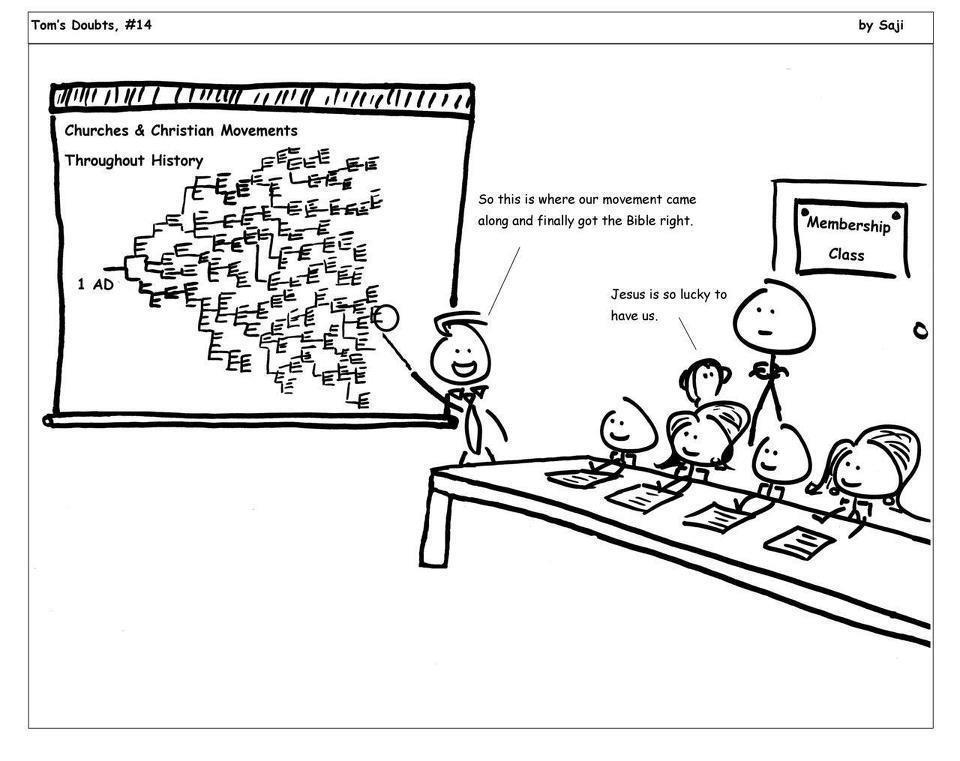
Theological systems come and go.  Mostly, there are some central insights that don’t really fit into the milieu from which the new system arises, and then people try to push those insights out into the corners.  The result is a new theological system.  Often, that initial crucial insight is good — a breath of fresh air, a kiss on the lips, water in the desert.  Usually, some of the derivative insights that arise in the early days of the system are also good.

But the system as a whole has some blind spots and a few problems.  As time goes on, these get developed and magnified rather than reduced, and the whole thing gets stale.

Meanwhile, the Church at large is internalizing those crucial initial insights without necessarily converting to the system (“Well, I don’t agree with those guys on everything, but they’ve got a point about xyz”).  Alternately, the Church converts to the system, internalizes its key aspects, and then de-converts without losing those crucial insights in the process.  It’s important to realize that this dynamic wouldn’t happen without the formation of a system.  The core insight is not usually obvious to people in the beginning.  It conflicts with the existing system at a number of points.  That insight has to be elaborated in some detail and its implications worked out before people are willing to accept it.  System-building provides that work of elaboration.

However, there comes a point where the system has had the impact it’s going to have, the Body has absorbed its benefits, and it’s time to move on.  The system has reached its expiration date; as a system of thought, it has outlived its usefulness.  Its purpose, in the end, was to serve as a vehicle through which the Body could come to grips with a few crucial truths.  That work done, the members of the Body now regard those truths as self-evident, and the delivery vehicle can fall to the wayside.  There’s no need to keep the old wineskin after you’ve drunk the wine.

One of the signs that a system has reached its expiration date is that people will deny the system while holding to its key insights as self-evident.  In extreme cases, people are totally unaware that the “self-evident biblical truths” they are affirming only came to be considered self-evident because the system they so despise made people aware of them.  For example, missional types who regard the Trinity as the central biblical teaching for human relationships, but can’t say the word “Christendom” without sneering — they have somehow forgotten that Christendom furnished the historical conversation that resulted in the “self-evident” doctrine of the Trinity.  The Calvary Chapel movement furnishes another useful contemporary example.  Where else can you find pre-mil, pre-trib theology that holds to a firm distinction between the Church and Israel — and so abominates dispensationalism as a divisive and damaging doctrine that they actually ban discussion of dispensationalism in a home Bible study?

**

Ugly stuff happens along these fault lines.  I know of a situation where a Calvary Chapel-connected school was offered three faculty members — a Bible/theology teacher, an OT/Hebrew teacher, and a NT/Greek teacher — all three capable, all three offering skills and teaching far beyond anything the school had in its existing program.  The doctrinal statement wasn’t a problem.  The financial arrangements weren’t a problem.  Then somebody allowed as how all three teachers hailed from a dispensational background, and that was the end.  Not “Uh, guys, listen, can we talk about that?”  No deal, no discussion, nope, sorry, never gonna happen.  The school spooked and ran, and never looked back.  In fact someone tried to oust the president of the school simply because there’d even been a thought of working with dispensationalists.

Sad.  The students could have developed whole skill sets that school couldn’t and can’t deliver, but the administration they were trusting to deliver a good education couldn’t see past a word.

**

On the other hand, did it serve anyone well for the three teachers to use that word?  Was the term “dispensationalism” really necessary — or even helpful?

I’m not sure it is.  Dispensationalism is so diluted and diverse now that it’s necessary to heap adjectives upon it in order to have any hope of describing an actual position — “progressive” and “classic” are the favorites, but they don’t help much.  There’s substantial difference among “classic” dispensationalists — four dispensations, seven dispensations, etc. — and even more among the folks who take the “progressive” label.

When a student balks at learning a laundry list of theological terms, we tell him that it’s necessary in order to help the conversation along.  Having labels for things helps us to understand each other so that we can have good discussions.

Certainly worked out that way, didn’t it?

**

So it is that people who try to have a dispensational take on everything are about as helpful as those who try to have a Reformed take on everything — both systems, in their respective times, were a kiss on the lips, manna from heaven, good and godly work highlighting key aspects of Christian truth that were in danger of being forgotten.  Glory to God for them both.

Both systems, as systems, have now passed their expiration date.  In the end, they were not timeless systems of thought, but simply delivery vehicles for a few key insights.  The work is done; the Great Conversation has moved on.  Not everyone has accepted those few key insights, but they have been rendered difficult to forget: a Roman Catholic divinity student might ignore Hus, but he’s going to have a hard time avoiding the Reformation.  Moreover, a great many of the reforms called for by the Protestants (e.g., moral reform of the clergy) did take place in the Counter-Reformation, because the moral purity of the Protestant churches put the Roman church to shame. So the Reformation had its impact even on the Roman church which supposedly rejected it.  Dispensationalism likewise: today you can hear people who were never dispensational talking about how a certain biblical event took place “at a different point in the story” than where we are today, and you have to take that into account.  Hmmm….

Christ is building His Church, and He is using all these different movements and theologies to do it.  The gates of Hades have not prevailed, and will not.  And what Christ is building is His Church, not some sect or movement or particular theological system.  Christ’s blessing rests on these subsets of the Church for a time, as a means to edifying the whole Church.  Working in such a subset is good, honorable work, but it helps to keep in mind that you only see part of the picture.

Whatever strand of the Tradition you’re part of, whatever theological system you subscribe to, remember this lesson.

**

Cartoon used by gracious permission from Pastor Saji of St. Thomas the Doubter Church, Dallas, TX.

For a different take on the temporary nature of theological systems and creeds, see Jim Jordan’s Symbolism: A Manifesto (particularly the last 3 pages).