We taught through the entire story of the Bible over two years in two middle school classrooms, and every week we debriefed afterwards…in front of microphones. If you’d like to listen in, the episodes are now dropping every three days or so on the Headwaters website.
Bible Class Debrief
10 May 2024
 Comments Off on Bible Class Debrief |
  Exegesis, News |
  Permalink
 Posted by Tim Nichols
Confess With Your Mouth
7 May 2024Do you have to confess Jesus with your mouth to be saved?
YES!!! That’s literally exactly what Romans 10 says. In case v. 9 was somehow unclear, v. 10 clarifies it. The belief leads to righteousness, but salvation comes of confessing with your mouth. That’s just what it says. The only thing for any faithful Christian to do here is shout a hearty “AMEN!”
Having done that, we need to be sure we understand what Paul actually meant, because he’s not a post-Great-Awakening American like we are, and in contemporary English we have some ways of using religious language that are–by biblical standards–a little odd. When we use the word “saved,” in a spiritual context, we pretty much always mean “going to heaven, as opposed to going to hell.” So you can say “The lifeguard saved me,” and we all know you mean that he pulled you out of the wave pool, but when you say “Jesus saved me,” we all think of heaven.
Our default meaning for “saved” is a biblical usage–you can see Paul use it in Ephesians 2:1-10–but it’s not the biblical default meaning. When you see the word “saved” in the Bible, you need to ask a few more questions, like “Saved from what?” In Romans in particular, we need to remember that by the time we encounter 10:9-10, we’re ten and a half chapters in. Let’s not forget what came before it–you did read what came before it, right? Paul has already told us what he means by “saved” here; he began the theme in ch. 1 when he told them he was ready to preach the gospel (1:15) to the faithful saints in Rome (1:7-8), explaining that he’s not ashamed because the gospel saves–there’s our word–those who believe (1:16). We tend to impose our default meaning on 1:16 — you believe and now you’re going to heaven, i.e., “saved” — but that’s not quite what it says. Paul is saying that the gospel saves those who already believe, and he makes that clear in the next verse by quoting Habakkuk 2:4, which is plainly talking about someone who’s already a just man being saved from physical death by his faith. (Think Daniel in the lion’s den, or the three Hebrew children in the fiery furnace — they are among the direct recipients of the promise in Habakkuk.)
Paul goes on to discuss how we’re all justly damned in 1:18-3:20, and then begins to discuss the possibility of attaining God’s righteousness apart from the Law, through faith in Christ (3:21-4:25), and then moves on in 5:1 to discuss our status once we’ve attained that righteousness, being justified by faith. Here’s where our word “saved” comes up again: “MUCH MORE then, having now been justified by His blood, we shall be SAVED from wrath through Him” (5:9). Being “saved” in Paul’s usage here is much more than being justified. Like Abraham, your faith is accounted for righteousness, and you are justified on that basis — the same thing 10:9-10 says: “for with the heart one believes unto righteousness.” But God has more — “much more!” — in store for you than that.
Paul goes on to discuss how we deal with sin in this life (according to 6:23 it’ll kill you). As he develops his argument, Paul makes it clear that while arranging your mental furniture correctly is important (ch. 6), it’s not enough to keep you out of sin (ch. 7). Actually living resurrection life in your dead/mortal body requires active intervention by the Spirit (8:10-11), and when we allow the Spirit to work through us, He intervenes not only in our deeds, but even in our prayers (8:26ff). And if our own mortal nature can’t separate us from God’s love, then nothing can (8:31-39). So “saved” in Paul’s usage here has nothing to do with going to heaven when you die, and everything to do with being delivered from physical death. To borrow a paraphrase from St. Schwarzenegger, “Come with me if you want to live.” God’s faithfulness to His people is nowhere better demonstrated than in His continuing pursuit of His people Israel, which is Paul’s subject in ch. 9-11, where our text appears.
In that context, Paul asserts that we receive righteousness through faith (as discussed in ch. 4, and which is what we mean in contemporary English by “saved”), but being delivered from God’s wrath on sin in this life requires more than that. Specifically, you need to be willing to speak up.
2 Comments | Exegesis | Permalink
Posted by Tim Nichols
Not Exegesis
27 February 2024Explaining what a passage doesn’t mean is not exegesis.
I don’t think this should be controversial, but apparently it is.
One way this shows up is a misguided application of a concept called “the analogy of faith.” Suppose we’re exegeting Passage A, and it looks like it might be saying something dangerous. Somebody in the room will immediately resort to the following argument: Scripture can’t contradict Scripture; Passage B says X (which precludes the Dangerous Idea), and therefore Passage A cannot be saying not-X (the Dangerous Idea). The argument is valid, as far as that goes, but there’s room for a multitude of mistakes in the definitions of X and not-X. Once upon a time, back when they were working out the hypostatic union, you could have applied this strategy thus: We all know that humans can’t be God; Passage B says Jesus is really God; therefore, whatever it is that Passage A might be saying, it can’t be saying that Jesus is really human. Of course the problem with that argument is that while it’s true that humans can’t ascend to deity, God can condescend to humanity–and did! I could do a whole treatise on proper and improper applications of the analogy of faith argument, but my point today is much narrower: that argument is not exegesis of the passage at hand.
See, when Passage A seemed about to say something threatening, we ran off to Passage B and exegeted that instead. And since Passage B is our very favorite passage on the (presumed) matter at hand, we may well have exegeted that passage in loving detail. But that doesn’t actually tell us anything about the meaning of Passage A. We don’t know what Passage A tells us to think or believe or feel. We don’t know what it calls us to do. We claim to believe that all Scripture (Passage A included) is the very word of God, profitable for doctrine, reproof, correction, and instruction in righteousness. But what we’ve actually done is wad Passage B up and stuff it in our ears to prevent us from getting the wrong idea when Passage A is read.
It works, too. But it also keeps us from getting the right idea when Passage A is read. God wrote that passage for a reason, and even if we’re right that it’s not saying the Dangerous Idea, it certainly is saying something. Shouldn’t we want to know what?
There’s a better way. Dig in. Learn what Passage A actually says. When you know what it really says, that will be the sole and sufficient refutation for all the dangerous misinterpretations out there. You’ll be able to handle them, and more importantly — and I can’t emphasize this enough — you’ll know what the passage actually says. You can trust what it’s telling you, and apply its lessons to your life, and you’ll be far the richer for it.
And anyway, if you’re actually sure, based on the analogy of faith, that Passage A really can’t be saying the Dangerous Idea, then what are you afraid of?
Comments Off on Not Exegesis | Exegesis | Permalink
Posted by Tim Nichols
“Not A Young Man”
30 January 2024Among the list of qualifications for eldership is “not a novice” (1 Tim. 3:6). Depending on the translation you read, it may say “not a new convert” or “not a recent convert” or “not new in the faith.” The words “convert” and “in the faith” are simply not in the passage here. The word is νεόφυτος, and it means “young man.”
So why did some translators add the extra words? For the same reason they usually do: for clarity in English translation. There are two possible meanings: a literal reading (“not a young man”) or a metaphorical extension (“not young in the faith”). Translators who favor the metaphorical interpretation have often chosen to clarify their meaning by adding the additional words. In this case, that is a mistake.
First, let’s start with the vocabulary. Paul uses two different words in his writings to refer to the office under discussion here. The one in this passage means “overseer,” and the other word literally means “old man.” So when Paul says that the appointee should not be “a young man” — well, I ask you. The word Paul chose for this qualification refers to a new-growth plant in Job 14:9 and Isaiah 5:7; it’s applied to the younger generation in Psalm 127:3 and 143:12. In other words, Paul’s Greek OT source material uses the word literally.
Does that mean it can’t be metaphorical here? Not at all. Paul could be crafting a novel metaphor by applying the literal term in a new metaphorical context. As Christians, we already refer to conversion as being born again; calling a new convert a “young man” regardless of his chronological age would make a certain sort of sense. (In fact, that’s exactly the process by which new metaphors enter language.) But is Paul doing that here? If he were, how would we know?
One obvious way would be for Paul to add the extra words himself. If he’s crafting a novel (if fairly obvious) metaphor, it would be fitting to specify it: “not a young man in the faith.” But he doesn’t do that. Another way would be for the context to make it otherwise obvious that’s what he must mean. Proponents of the metaphorical view will argue that this is the case, because Timothy himself is a young man. Surely Paul can’t be giving young Timothy the job of appointing elders, and then telling him, “Don’t appoint someone your own age.”
Ah, but he could! In fact, we already know that Timothy doesn’t meet all the criteria in the list of qualifications. Being unmarried, Timothy isn’t the husband of one wife (for that matter, neither is Paul). Timothy doesn’t have a household to rule well. We don’t need to claim some special spiritual meaning for these terms, as if “husband of one wife” would refer to Timothy’s fidelity to the Church, the Bride of Christ, or that “rules his household well” must mean that Timothy functions properly in the “houselold of God.” No, “husband” and “household” have their ordinary meanings, and Timothy is a valid exception.
How is Timothy supposed to function in that situation — appointing people that meet qualifications he doesn’t? He’s exemplary. The overriding qualification is blamelessness. Paul has that, despite not being a husband. Timothy also has that, despite being young. When we’re evaluating elder candidates, if a man gives us reason to doubt his faithfulness to his wife, he’s not qualified. If we look at his household and think “yikes!” he’s not qualified. And if we look at him and see that his youth is a drawback, he’s not qualified. If, in contrast, we look at him and think “I wish I was like that” — if he’s exemplary despite being young — then he is qualified, in the same way that Timothy was qualified.
The older men who are married and running households are wishing they were like Timothy in word, conduct, love, spirit, faith, and purity. He’s setting an example for them, not the other way round. Because Timothy is exceptional, Paul has recognized him as an exception. And thus we can see that “young man” refers to age in the same way that “husband” refers to marital status and “rules his household well” refers to familial and business affairs — all the terms have their ordinary meanings in the context.
So how do we apply the criteria like Paul would? Clearly it’s not the case that no young man would ever serve as an elder, but it would be rare, and with good reason — chronological age actually is a concern. On the face of it, this ought to be obvious just from the terms chosen for the office: one means ‘overseer,’ but the other literally means ‘old man.’ Maturity matters, and most young men haven’t taken sufficient advantage of the scant time they’ve had, or haven’t had enough experience, to season them out. Life experience and maturity are simply more common in older men, thus most of your elders will be, well, elder men.
If the candidate you’re looking at strikes you as a greenhorn in any sense, you probably shouldn’t pick him. On the other hand, if he’s been raised in the faith from childhood, as Timothy was, and he presents himself as exemplary in word, conduct, love, faith, and purity, as Timothy did — sure, go with that guy.
Comments Off on “Not A Young Man” | Discernment, Ecclesiology, Exegesis, Meditations | Permalink
Posted by Tim Nichols
Coming Soon!
20 January 2024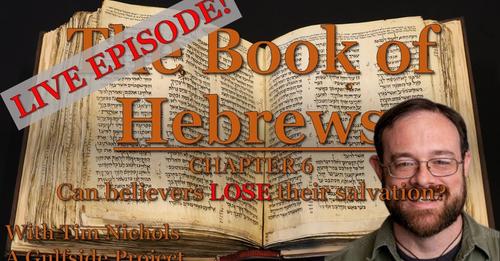
I’ll be joining Chris Morrison of Gulfside Ministries for a special live podcast on Hebrews 6 on January 27th at 10 am Mountain Time. Come join us!
Comments Off on Coming Soon! | Exegesis, Uncategorized | Permalink
Posted by Tim Nichols
Get Curious!
12 November 2023When you see someone behaving unreasonably, there is one thing that you can know for certain, and it’s not what you think. Of course we all want to think that we know the other person is being unreasonable. But that’s difficult to know for sure. You’ll find that the person who presently seems so unreasonable to you doesn’t think they’re being unreasonable. In fact, it can be quite a challenge to explain to them why they’re being unreasonable, even when it’s obvious to everybody else in the room. And if we’re honest, I think we’ve all had the experience of being that person: in the moment believing ourselves thoroughly reasonable, only to discover in hindsight that wasn’t the case—and everybody but us knew it. It’s surprisingly difficult to assess your own reasonableness from the inside.
It’s safe to assume that you won’t know you’re being unreasonable without outside help. So when you find yourself internally certain that someone else is being unreasonable, all you really know for sure is that you don’t share their concerns and priorities.
Why does that matter? James 1:19 has the answer: “Let every man be swift to hear, slow to speak, slow to wrath.” You can escalate, condemn, demand compliance. But rather than being quick to anger, slow down. Listen. There’s something going on in this other person that you don’t know about. Ask questions. Study the person in front of you. Get curious. See if you can grasp what’s going on in their world.
Of course, it really may be that the other person is being unreasonable—after all, it won’t always be you. But you can always get angry later, if you need to. Get curious first.
Comments Off on Get Curious! | Exegesis | Permalink
Posted by Tim Nichols
Where the Road Goes
17 October 2023Suspicious Christians like to say that you shouldn’t take grace too far. If it’s just all grace, all the time, then nobody will be motivated to do the right thing. You have to lower the boom on people at some point. The more biblically savvy of them will point to Romans 6:1, where no less an authority than Paul himself faces the question, “Shall we keep on sinning?” and answers it with a resounding “NO!!!”
“See?” they say. “Even Paul says you shouldn’t take it too far.”
But I want to know what “it” is that we “shouldn’t take too far.” What is it that they think grace is? Because they’ve fundamentally misunderstood both grace and Romans if they think “shouldn’t take it too far” is what Paul is saying in 6:1. The message of Romans 6 is not that you should only go so far down the road of grace. The message of Romans 6 is that when you red-line the engine and take it all the way to the end of the neverending road of God’s grace, that road doesn’t go anywhere near sin. Far from it!
When grace superabounds your sin, no matter how much sin there is, then–and only then–you can know that you’re truly dead to sin and alive to God; you can reckon yourself so. On that basis–what other basis would serve?–you can surrender your members as instruments to God. Of course that doesn’t quite work out the way you’d hope, there being another law in your members that strives toward sin despite your best intentions. Serving God with your mind and sin with your flesh is a devil’s bargain if ever there was one–“who will deliver me from this dead body?” indeed! Glory to God, He doesn’t leave us there.
The Law–the ever-present admonition not to go too far–could never deliver us from that predicament. But what the Law could never do, God did by raising Jesus from the dead. That same Spirit now indwells us, and although our bodies are not yet redeemed, He cheats and gives spiritual life to our (yet-dead) bodies. The life of the Resurrection is available to us now, before the Resurrection, and so we are able to offer our Spirit-indwelt bodies as a living sacrifice that is acceptable to God.
No amount of “not taking grace too far” could have rendered our yet-dead bodies even an acceptable sacrifice, still less a living one; nothing short of a resurrection could possibly do that. And a resurrection is precisely what we have–not ours, but His, and we participate in it solely by grace.
Now obviously all this is ridiculous, but Jesus did it anyway. Good thing He didn’t listen to the people who would have told Him not to take it too far.
Comments Off on Where the Road Goes | Exegesis, Preaching, Stealth Romans | Permalink
Posted by Tim Nichols
Let Your Shame Die
5 September 2023“For both the Sanctifier and the sanctified are all of one, for which reason He is not ashamed to call them brethren, saying, ‘I will declare Your name to my brethren; In the midst of the assembly I will sing praise to You,’ and again, ‘I will trust in Him,’ and again, ‘Here am I, and the children whom God has given Me!’ (Hebrews 2:11-13)
I’d encourage you to keep reading through the end of the chapter. The context here is Jesus’ present ministry as our High Priest before the Father.
His present ministry.
It doesn’t say He was not ashamed to die for you. It does not say that He will not be ashamed of you when you’re resurrected. It says He is not ashamed to call you His brother or sister right now.
Let that sink in: Jesus, now, is not ashamed of you, now.
When you are weak, when you ask for help, when you should but you don’t, when you sin–Jesus is not ashamed to be your brother. He is not ashamed to admit it loudly in the throne room of heaven, in front of the Father, the angels, the saints who’ve gone before us, even in front of the accuser who stands before God day and night pointing out every sin and mistake you make. He’s not embarrassed by you.
So don’t be embarrassed to ask Him for help.
2 Comments | Exegesis | Permalink
Posted by Tim Nichols
“The Children God Has Given Me”
1 August 2023I had a chance to talk with Chris Morrison of Gulfside Ministries in our continuing series on Hebrews. Our latest conversation covered 2:5-18. Hope it’s helpful to you!
Comments Off on “The Children God Has Given Me” | Exegesis | Permalink
Posted by Tim Nichols
Swan-Diving off the Skyscraper?
8 July 2023“Thou shalt not tempt the Lord thy God.” This was Jesus’ answer when the devil enticed Him to jump off the pinnacle of the Temple (see Matthew 4). The pinnacle was (for the time) a dizzyingly high point. Many Christians look no further than that, take it as the ancient equivalent of being tempted to swan dive off the Empire State Building to see if God would protect you. In this reading, “Thou shalt not tempt the Lord thy God” is a general rule not to do stupid things hoping that God will save you. Look both ways before crossing the street. Skip dessert; your arteries and your waistline don’t need it. Max out your 401(k) contribution. Jesus would.
The problem, of course, is that throughout the Bible, God has people break this rule. Moses is wanted in Egypt, but God sends him back. There’s no water or food in the desert past the Red Sea, but God leads Israel out there anyway. Jesus is a homeless wanderer for three years. They stoned Paul at Lystra, and he barely escaped with his life, but he’s going back to encourage the church there. The Macedonian churches give “beyond their ability.” What gives?
Scripture does expound some general principles about sowing and reaping and handling risks, but trying to find those ideas in this text is biblically ignorant and sloppy. None of that is what “Thou shalt not tempt the Lord thy God” is talking about.
It’s not a ‘general rule,’ it’s a specific quote from Deuteronomy (6:16), as are Jesus’ other responses to the devil’s temptations (cp. Matthew 4:4//Deuteronomy 8:3, Matthew 4:10//Deuteronomy 6:13). Read Deuteronomy 6:16 in context: Moses is warning the conquest generation not to be like their parents, and specifically warns them against the sin their parents committed at Massah (Heb. “Temptation”). That sin is described in Exodus 17:7. See also Deuteronomy 9:22 and 33:8, where Moses brings it up again.
(According to Exodus 17:7, the place is also called Meribah (Heb. “Rebellion”), and by that name it comes up in Psalm 95, which is then a central part of the argument of Hebrews 3-4. So the warning gets repeated in David’s time, and is still an issue for Christians — praise God that we have Jesus’ example to follow in resisting it!)
What, exactly, is the sin at issue here? Read Exodus 17: Israel tempted God at Massah, saying, “Is the LORD among us, or not?” Was the question legitimate? No! This is after all the plagues, after Passover, after He saved them through the Red Sea, after He gave them drinkable water at Marah, after He began literally dropping food (manna) from the sky daily. They are following the pillar of cloud by day and the pillar of fire by night; it couldn’t be clearer that He has led them to this place in particular. They have every reason to trust that He will provide for them in the place He has led them to.
He had even already warned them at Marah (Exodus 15:25-26) the last time they complained about water. Now, the next time they come up short on water, they accuse Moses (and God): “Why have you brought us up out of Egypt to kill us, our children, and our livestock with thirst?” They have no faith that God will bring them to the place He promised. Deuteronomy 6:16 is Moses’ admonition to the next generation not to commit that same sin, and that’s what Jesus quotes.
What does that have to do with the situation Jesus is facing? The temptation is to leap off the pinnacle of the Temple. There’s no danger; it’s not yet His time, and to whom do the assurances of Psalm 91:10-12 apply, if not to Jesus Himself? Does He not fulfill the conditions of 91:9? Jesus could kick off His ministry by floating down from the pinnacle, carried by angels into the throngs of worshippers gathered in the courts of the Temple. What a way to start! Why not?
But no. Jesus has reason to know that God is with Him: the Father spoke over Him from heaven at His baptism, the Spirit descended on Him in the form of a dove, and John witnessed the whole thing. It is the Spirit who has led Him out into the desert, where He has gone without food these past 40 days (an occasion for another temptation that He also answers out of this passage in Deuteronomy). He should remain committed to following the Father’s lead, and not gin up His own solution to the question of launching His ministry — effectively accusing the Father of leading Him to the wrong place.
The recipients of Hebrews faced a similar temptation. These were the people who stayed in place after the stoning of Stephen when everyone else fled, who cheerfully accepted the persecutions of that time to remain where God had called them to be. They are tired, beaten down, and are considering giving up and returning to the Temple worship — effectively accusing God of leading them astray. Hebrews 3-4 treat this as parallel to Exodus 17, but the warning of Hebrews 2 has already made it clear that although the cases are parallel, this would be a much worse sin than the Exodus generation committed in the desert, and would be subject to a much harsher punishment.
We continue to face this perennial temptation today. When a financially tight month tempts us to believe that God is not caring for us, when we discipline children out of panic rather than trusting God’s kindness to us and mirroring it to our children, when we do something flashy and self-aggrandizing at work (or in ministry) rather than trusting God’s leading and His ability to promote us in His time, we face this same temptation. Let’s handle it the way Jesus did: “Thou shalt not tempt the Lord thy God.”
 Full Contact Christianity