Neighborhood Sacramentology: Baptism

18 November 2012

In a previous post, I began discussing the gap between the western institutional structure we think of as “the church” and the activity of the Body of Christ as the Church in the world. Given that “church” as the New Testament uses the term is hardly coextensive with the 501(c)(3) corporate model that we use today in the US, what does that mean for sacramental observance?

For baptism, it’s a no-brainer. The New Testament shows us nary a single example of baptism in any other pattern than this: the new believer is baptized immediately upon profession of faith, by whoever is handy, with the nearest available water. There’s just no NT concept of getting interviewed by the elders or the priest first, waiting three weeks until the next time the baptistry will be filled up, none of that. Maybe there was an occasion with somebody, sometime, where wisdom dictated that one or more of those extrabiblical constraints was a good idea in some particular case, but there’s no call to be accepting that as the normal pattern.

So that one’s pretty obvious: if we follow the NT pattern, when someone professes faith, we baptize ’em right then. If they happen to be in a church building at the time, well, so be it. If not…the bathtub, pool, pond, or river will do just fine. If Baby Jesus could be laid in a manger, His disciples can be baptized in a horse trough.


The (Western) Institutional Church…and everything else

28 October 2012

[In a number of ways this is a follow-up to the River Ecclesiology series.]

Suppose you want to know what God is up to, what is going on with the church and the growth of His Kingdom. Where do you look?

You could talk about this on a national or international scale, but let’s think locally for a moment. One place to start is with the telephone directory. Go that route, and you find, say, a couple dozen churches. Some of them are totally independent nondenominational entities. Others are affiliated with a denomination — some national, some international in scope. Some churches will have a meaningful denomination-type affiliation beyond the denominational level as well, as with NAPARC, the Eastern Orthodox communion, or the Anglican communion. There may also be churches with an affiliation that functions (in some ways) in place of, or parallel to, denominational ties, as with Acts 29, the National Association of Evangelicals, or the Grace Evangelical Society. All this you could establish with a phone directory, a few telephone calls, and perhaps a glance at the church org charts.

But is that it? There was a time, perhaps, when it would have been. Personal ministry has always happened mostly outside the walls of the church, but there was a time when most of the people doing personal ministry were church members, overseen (at least loosely) by their institutional church community. But no more. Today, there are countless communities and networks outside the church that exist for Kingdom purposes.

To continue your survey of what God is doing in your locale, you would now have to leave off a study of church institutions and begin to go out into restaurants and cafes, pubs and parks. There, you might find remarkable things.

You might find that the pastors of these various churches gather and pray for one another. Not one of those gatherings where you brag on how well things are going for 45 minutes and then shoot up a quick prayer for God’s blessing on all the pastors at the end. No. A serious gathering where the shepherds of the city armor up and go to war on each other’s behalf, and for their city. A quick, 15-minute sketch of where everyone’s at, then 45 minutes of laying siege to heaven. Or more. (Sounds like pure fantasy to some of you, I know, but I’ve seen it happen.) Quiet as it’s kept, you might even find the occasional Roman Catholic priest or Missouri Synod Lutheran pastor participating in these gatherings.

Given that kind of unity, informal leadership would likely emerge. In order to make things work at all with pastors from so many different denominations and backgrounds, they would have to take a great deal of care not to step on each other’s toes. But inevitably, as they cared for one another, a pattern would begin to emerge. Some few men would clearly be more capable of shepherding the others and tending their wounds, and so, as time passed, there would be a few who came to be first among equals — the pastors of the pastors, as it were.

By the way, that’s the ancient function of a bishop — pastor of pastors. So from the phone-directory-and-org-chart perspective, your town might have no bishop of its own, while at the same time having a number of denominational churches in subjection to their several bishops elsewhere, and others in subjection to no bishop at all. Meanwhile, functionally speaking, that same town might have two or three devoted local bishops deeply invested in caring for its pastors. If these men are wise, they might also be identifying the young pastors that have the potential to take on the same responsibilities in another decade or two — taking those young pastors under their wings and carefully, informally, without stepping on toes, mentoring them.

If you have that much going on among the pastors, you might also have a great deal more going on among the people: prayer gatherings; ministries to the aged, infirm, and poor; informal networks of neighbors that gather for a party at someone’s house now and then, the network of relationships among the ‘regulars’ of a particular cafe or pub that some local Christian has adopted as a Kingdom hub. These extended families of people might cross all the denominational lines, and draw in a number of people who will never darken the door of an institutional church. But they come to meet God and His people in a backyard, a park, a pub — to care and be cared for, to serve and be served.

How are we to think about these things? The host of a regular backyard gathering of neighbors would never think of his home as a chapel, nor himself as a parish priest. The Christian who adopts a pub and its regulars would not call himself a chaplain. The pastor who shepherds the other local pastors would never call himself a bishop. And yet, in a certain fairly obvious sense, aren’t they?

How do these unofficial efforts relate to the official, institutional ones? At what point are they churches? How would we know? How do they relate to sacramental observance? In abstaining from serving communion, is that regular neighborhood gathering maintaining proper boundaries and respect for the church, or is it a de facto church depriving its members of the Lord’s body and blood, to their detriment?

At a historical level, the old Reformation discussion of ‘marks of a true church’ would seem to be relevant to this discussion. However, it was born out of a very different historical situation. How can we translate that conversation into something helpful for this one?

I don’t have answers to these questions. I would very much like to. Those of you who are willing, let’s start a conversation about it.


Mere Supernaturalism

12 August 2012

As I have discussed my transition away from cessationism with various people, it has become clear that there are actually two related issues entangled together. In my life, they came as a set, but there’s no reason why everybody’s experience would be the same as mine.

The first issue is the question of whether certain miraculous spiritual gifts ceased operating as individually vested gifts after the initial launch of the Church. This is the issue around cessationism proper. Many charismatics don’t understand this, and thus are confused when a cessationist professes to believe that miraculous healings still happen today, that God answers prayer today, and perhaps even that God can still speak through visions and dreams today. The issue in cessationism is not healings, but a particular person having the gift of healing; not someone hearing from God in a general sense, but a particular person having the gift of prophecy. (Generally. This distinction does not hold for tongues — every cessationist I know says it’s over and done with, period.) So with cessationism vs. continuationism, we’re talking about whether the Spirit continues to dispense all the biblically attested spiritual gifts in the present day.

The second issue, although related, is distinct from cessationism: the expectation that God will intervene supernaturally. From the Red Sea to the present day, God’s people have struggled with the temptation to forget that God intervenes in the world. We tend to think of this as a peculiarly modern temptation, but a quick look at the Exodus generation shows us this is not the case.

Hold that thought a moment.

***
In eschatology, the wide dividing line has typically been between premillennialists on the one hand, and post- and amillennialists on the other. That’s where the bright political fault lines have been drawn. I want to suggest that this is a mistake.

The lines ought to have been drawn between those who look to the future with hope and expectation, and those who look to the future with gloom and the spirit of Chicken Little. This is the difference that makes a difference. I’m an optimistic premil (or if you like, a dominion dispensationalist), and I have much more in common with a patient postmil than I do with either my doom-and-dystopia premil brethren or most amil folk.

This is not to say that the theological question of when Christ returns relative to the millennium is unimportant. I believe it is an important question, and one which Scripture plainly answers. What I am saying is simply that optimism or pessimism about the future is vastly more important. We who can look at the nations raging, laugh at them with Yahweh, and seek first God’s Kingdom and His righteousness on earth as it is in heaven — we are one breed. The Chicken Littles are something else, and whatever their doctrinal statements might say, their spirit of fear and their little pronouncements about “polishing the brass on a sinking ship” are not from God, because He doesn’t give that spirit or talk that way.

***
In similar fashion, I believe that in the battles over the charismatic movement, evangelical Christians drew the bright political line in the wrong place. I know folks who are charismatic in their theology, but day in and day out, expect no divine intervention in their lives. I also know charismatics who go to church, belt out a couple of paragraphs in tongues, and go home — but don’t pray with authority, don’t seek to hear from God, and don’t seek to minister to others in any supernatural way. By the same token, I know rock-ribbed cessationists who believe God speaks in dreams, pray for miracles, and trust Him to supernaturally order their affairs and relationships.

We drew the political line between those who practice all the biblically attested spiritual gifts today, and those who do not. However, the far more important issue is whether, on either side of that line, a person will seek to resolve his problems through doctrine alone, or whether in his daily practice he will also expect God to intervene supernaturally.

I’m open to suggestions for naming these positions, but for our present purposes, I’d like to call them doctrinalism and supernaturalism, respectively.

Two points of clarification. First, I’m talking about habits of practice, not talking points. I know lots of people who on paper, and when pressed will admit that it’s possible God would intervene miraculously today, but in practice, from day to day, they rely on doctrine alone, and they teach their followers to rely on doctrine alone. These people are doctrinalists, no matter what they say.
Second, I am not setting up an either-or situation here. It’s not either doctrine or supernatural intervention. I am talking about people who rely on doctrine alone versus those who look to doctrine, but also seek for God to intervene supernaturally in the present.

Again, I am not saying the cessationism question is unimportant. Not at all. I think the stakes are very high in that conversation. In the interests of full disclosure, let me just go ahead and spill the beans: I believe that most cessationists and most charismatics have one critical thing in common: an allergy to biblical discernment. I believe that the Church will not grow into health and maturity unless she employs all the biblically attested gifts (cessationists, I’m lookin’ at you), and she employs them with testing and discernment, as Scripture requires (charismatics, I’m lookin’ at you too), and all of that in the context of loving God enough to take His Word seriously and be visibly united with His people. So yeah, I think it’s an incredibly important issue.

However, supernaturalism/doctrinalism is a much more important issue. The question of whether God will intervene through the gift of healing is important, but the question of whether God will intervene at all is obviously an even more important question.

I would contend that in most ministry venues, supernaturalists — charismatic or not — are natural allies. Doctrinal statements can create a barrier where no biblically founded barrier exists, of course, but those who look for and appreciate God’s intervention can work together, if they’re allowed to — or if they simply choose to move forward no matter what their more sectarian brethren might prefer.

And then later, over a bottle of wine, they can argue over whether the miraculous healing they just prayed for, and received, was the result of the gift of healing, or whether it was simply an answer to prayer.


What Doesn’t Belong to Caesar?

4 July 2012

As I’ve acquired a deeper and more theological view of American history, I’ve grown deeply ambivalent about uber-patriotic church services.  There’s a pep-rally atmosphere to it, a partisan spirit that seems deeply at odds with the Great Commission’s leveling admonition to disciple all the nations.  We’re glorying in our team, simply because it’s ours.

There’s an idolatry in it.  The Christian flag is on the speaker’s left, and the American flag is in the superior position, on the speaker’s right.  Now, I have issues with the ‘Christian’ flag, too — modeled after the American flag as it obviously was — but if we’re going to have a flag with a cross on it, why are we displaying it in the inferior position?  Is Jesus King of kings and Lord of lords, or is He subservient to the American government?  “Well,” people say, “that’s what the law requires.”  So it does.  Once upon a time it required burning a pinch of incense to the emperor as a god — a different way of indicating the same thing.  Christians used to know how to handle that kind of requirement.  What happened?

The pledge — which we say in church — is to the flag, and to the republic for which it stands.  That’s right, a bunch of professing Christians stand up, put their hands over their hearts, and pledge allegiance to a piece of cloth, and they won’t even blink.  I mean, it’s not like it’s actually a graven image; it’s sewn.  That’s totally different.  The finial on the flagpole is a golden eagle, not a golden calf — again, totally different.  This is your god, who brought you out of the land of Britain.

We are Christians.  Support of the civil magistrate is required of us.  In a certain way, then, there is a form of patriotism that is also required of us.  But we must have no other gods before Yahweh.  If we actually pay any sort of attention to what we are doing, is not our participation in the cult of the flag a blasphemous idolatry?  The words “under God” in the Pledge don’t wipe all this away; they make us like the ‘good’ kings of the northern kingdom in Israel — Jehu destroyed Ba’al worship at Yahweh’s command, but he did not take away the high places and he continued in the ways of Jeroboam the son of Nebat, who caused Israel to sin.  Yahweh doesn’t much appreciate ‘true’ worship mixed with idol worship — because that’s not true worship.

**

Then there are the comparisons between what we’ll do for America versus what we’ll do for the church.

America is an ideal, a culture, and it has its forms, which we conservative evangelicals respect.  When we have a July 4th service — and boy, do we put on a show for those — we do not remix the Star-Spangled Banner to some contemporary jingle so the young people can “relate.”  We don’t do this to America the Beautiful either, nor to God Bless America.   We stand when the national anthem is played, and we put our hands over our hearts.  We say the pledge, in unison, without a second thought.

Aside from the issues about the Pledge already noted, I’m happy with all this, in its place.  I think it’s great, and I don’t want to seem ungrateful that we’re willing to show genuine reverence somewhere.

But this in a church service, from people who won’t do anything approaching this level of reverence for the Christian faith?  Something is out of balance.

We won’t say the Creed in church because it might be vain repetition, but we think nothing of saying the Pledge.  We change our songs like they were dirty socks — an apt metaphor for some of them, I admit.  We can’t resist the temptation to ruin a centuries-old, grand, well-constructed song by resetting the chorus to some advertising jingle.  We forsake the music of the past just because it’s old, but we’d never think of doing the same with our iconic American music.  We stand for the national anthem without being told, but will we stand up for the reading of Scripture? Dream on.

We tell ourselves that this is because the truth of Christianity transcends all these low, material, ritual things.  We tell ourselves that.  But the truth is a little different. The truth is that our Americanism is profound, meaningfully incarnated in the life of our community.  Our Christianity is so weak and shallow we don’t even meaningfully incarnate it in church, let alone in the public square.


Expiration Dates

27 May 2012

Theological systems come and go.  Mostly, there are some central insights that don’t really fit into the milieu from which the new system arises, and then people try to push those insights out into the corners.  The result is a new theological system.  Often, that initial crucial insight is good — a breath of fresh air, a kiss on the lips, water in the desert.  Usually, some of the derivative insights that arise in the early days of the system are also good.

But the system as a whole has some blind spots and a few problems.  As time goes on, these get developed and magnified rather than reduced, and the whole thing gets stale.

Meanwhile, the Church at large is internalizing those crucial initial insights without necessarily converting to the system (“Well, I don’t agree with those guys on everything, but they’ve got a point about xyz”).  Alternately, the Church converts to the system, internalizes its key aspects, and then de-converts without losing those crucial insights in the process.  It’s important to realize that this dynamic wouldn’t happen without the formation of a system.  The core insight is not usually obvious to people in the beginning.  It conflicts with the existing system at a number of points.  That insight has to be elaborated in some detail and its implications worked out before people are willing to accept it.  System-building provides that work of elaboration.

However, there comes a point where the system has had the impact it’s going to have, the Body has absorbed its benefits, and it’s time to move on.  The system has reached its expiration date; as a system of thought, it has outlived its usefulness.  Its purpose, in the end, was to serve as a vehicle through which the Body could come to grips with a few crucial truths.  That work done, the members of the Body now regard those truths as self-evident, and the delivery vehicle can fall to the wayside.  There’s no need to keep the old wineskin after you’ve drunk the wine.

One of the signs that a system has reached its expiration date is that people will deny the system while holding to its key insights as self-evident.  In extreme cases, people are totally unaware that the “self-evident biblical truths” they are affirming only came to be considered self-evident because the system they so despise made people aware of them.  For example, missional types who regard the Trinity as the central biblical teaching for human relationships, but can’t say the word “Christendom” without sneering — they have somehow forgotten that Christendom furnished the historical conversation that resulted in the “self-evident” doctrine of the Trinity.  The Calvary Chapel movement furnishes another useful contemporary example.  Where else can you find pre-mil, pre-trib theology that holds to a firm distinction between the Church and Israel — and so abominates dispensationalism as a divisive and damaging doctrine that they actually ban discussion of dispensationalism in a home Bible study?

**

Ugly stuff happens along these fault lines.  I know of a situation where a Calvary Chapel-connected school was offered three faculty members — a Bible/theology teacher, an OT/Hebrew teacher, and a NT/Greek teacher — all three capable, all three offering skills and teaching far beyond anything the school had in its existing program.  The doctrinal statement wasn’t a problem.  The financial arrangements weren’t a problem.  Then somebody allowed as how all three teachers hailed from a dispensational background, and that was the end.  Not “Uh, guys, listen, can we talk about that?”  No deal, no discussion, nope, sorry, never gonna happen.  The school spooked and ran, and never looked back.  In fact someone tried to oust the president of the school simply because there’d even been a thought of working with dispensationalists.

Sad.  The students could have developed whole skill sets that school couldn’t and can’t deliver, but the administration they were trusting to deliver a good education couldn’t see past a word.

**

On the other hand, did it serve anyone well for the three teachers to use that word?  Was the term “dispensationalism” really necessary — or even helpful?

I’m not sure it is.  Dispensationalism is so diluted and diverse now that it’s necessary to heap adjectives upon it in order to have any hope of describing an actual position — “progressive” and “classic” are the favorites, but they don’t help much.  There’s substantial difference among “classic” dispensationalists — four dispensations, seven dispensations, etc. — and even more among the folks who take the “progressive” label.

When a student balks at learning a laundry list of theological terms, we tell him that it’s necessary in order to help the conversation along.  Having labels for things helps us to understand each other so that we can have good discussions.

Certainly worked out that way, didn’t it?

**

So it is that people who try to have a dispensational take on everything are about as helpful as those who try to have a Reformed take on everything — both systems, in their respective times, were a kiss on the lips, manna from heaven, good and godly work highlighting key aspects of Christian truth that were in danger of being forgotten.  Glory to God for them both.

Both systems, as systems, have now passed their expiration date.  In the end, they were not timeless systems of thought, but simply delivery vehicles for a few key insights.  The work is done; the Great Conversation has moved on.  Not everyone has accepted those few key insights, but they have been rendered difficult to forget: a Roman Catholic divinity student might ignore Hus, but he’s going to have a hard time avoiding the Reformation.  Moreover, a great many of the reforms called for by the Protestants (e.g., moral reform of the clergy) did take place in the Counter-Reformation, because the moral purity of the Protestant churches put the Roman church to shame. So the Reformation had its impact even on the Roman church which supposedly rejected it.  Dispensationalism likewise: today you can hear people who were never dispensational talking about how a certain biblical event took place “at a different point in the story” than where we are today, and you have to take that into account.  Hmmm….

Christ is building His Church, and He is using all these different movements and theologies to do it.  The gates of Hades have not prevailed, and will not.  And what Christ is building is His Church, not some sect or movement or particular theological system.  Christ’s blessing rests on these subsets of the Church for a time, as a means to edifying the whole Church.  Working in such a subset is good, honorable work, but it helps to keep in mind that you only see part of the picture.

Whatever strand of the Tradition you’re part of, whatever theological system you subscribe to, remember this lesson.

**

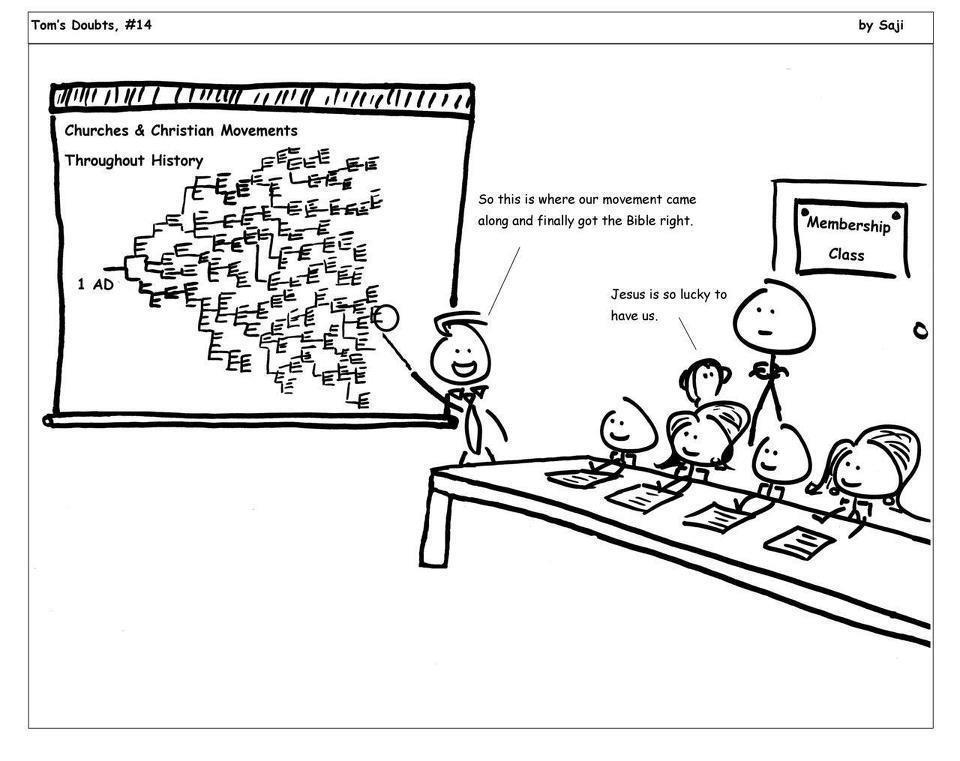
Cartoon used by gracious permission from Pastor Saji of St. Thomas the Doubter Church, Dallas, TX.

For a different take on the temporary nature of theological systems and creeds, see Jim Jordan’s Symbolism: A Manifesto (particularly the last 3 pages).


Why Complementarians MUST Ordain Women, Part 3: Does Gender Difference Make a Difference?

26 February 2012

The church at Corinth is justly famous for its problems, but it was also noteworthy for its gifts.  So richly gifted was the Corinthian church that Paul said they come short in no gift.  There’s all kinds of discussions we could have about the various differences between Corinth and the present milieu, but let’s start by trying to understand what was happening in the church then.  There’s a particularly rich vein of discussion centering around how the Corinthians were supposed to use the gift of prophecy, so we’ll focus our discussion there.  They had a number of prophets functioning in the Corinthian church — in fact, they were completely out of control, and part of Paul’s purpose in writing the epistle is to help restore a measure of order to their worship service.

So let’s take a little time to look what the practice of that particular gift was supposed to look like in the church.  The first stop is 1 Corinthians 11:1-16.  Again, lots of ink spilled on whether we need to do this head covering thing today, and for the moment, let’s bypass all that and focus on what Paul wanted the Corinthians to do.  It’s pretty simple, actually: men, when praying or prophesying, should uncover their heads; women, doing the same, should cover their heads.  Why?  As a sign of submission.

Let’s just sit with that for a moment.  Here we have a man and a woman.  Both are believers; both have the gift of prophecy; both have a word from the Lord to speak.  No problem with any of that; they can both speak, but Paul insists that the man uncover his head to do it.  Paul also insists that that the woman cover her head to exercise her gift.  This from the same guy that wrote, “There is neither Jew nor Greek, there is neither slave nor free, there is neither male nor female; for you are all one in Christ Jesus,” to the Galatian churches earlier in his career.  Has he changed his mind?

Of course not.  Jesus is one with the Father; Jesus is not the Father.  The Father sent; the Son obeyed to the point of death; the Father raised and exalted Him.  Christian unity is trinitarian unity: real equality in value and glory, but not sameness in either identity or function.  The application here to men and women fits well with the internal logic of Pauline iconography; a husband represents Christ and a wife represents His Bride, the Church.

If we stop right there, we have something valuable already: Paul plainly teaches them that both men and women can (and should) pray and prophesy, but not in exactly the same way.  Which is to say, gender difference makes a difference in how the gift should be exercised in the Corinthian church.  It could also make a difference today, could it not?

But let’s keep walking with the Corinthian church a while, because there’s more to say.  A woman in the church of Corinth is certainly supposed to use her gift of prophecy for the benefit of the Body.  Does that mean she may prophesy in the church meeting?  There are two options here, and they have to do with how you understand 1 Cor. 11 and 14:31 as over against 1 Cor. 14:34-35.  The latter passage says,

Let your women keep silent in the churches, for they are not permitted to speak; but they are to be submissive, as the law also says.  And if they want to learn something, let them ask their own husbands at home; for it is shameful for women to speak in church.

Let us begin, first of all, by discarding the notion that we cannot just stomp a foot, say “That’s not fair!” and disregard this portion of Scripture.  It’s there; God said it, and if you’ll pardon a note of philistine biblicism here, we’re just going to have to live with it.  God loves us, and He knows what He’s doing.  It will turn out, if we obey wisely, that this is a good thing, a glorious thing, and not some scourge to be borne until the Lord returns.

But how to obey? Of course, we have to consider how to map the Corinthian situation onto our own situation (and that’s coming, Gentle Reader, but first things first), but before we can do that, we still need to settle out what Paul was asking the Corinthians to do.

The problem is that we have a seeming contradiction.  Paul has already said, back in 1 Cor. 11, that women are to pray and prophesy with their heads covered, which means that he believes women should pray and prophesy.  He has also said, just a few verses earlier, that all can prophesy one by one, so that each one may learn and be encouraged.  So how are we to take it when, just a few verses later, he then says women are not to speak?  There are two basic positions that seem viable.

Option A is that women are supposed to exercise their gifts of prophecy within the church, but not within the church meeting proper.  This understanding has the virtue of a commendable simplicity, but it seems to leave a number of unanswered questions in the context.  Option B is that women are to prophesy in the church meeting just as men are, but they are not to take part in the judging of the prophecy that follows a prophet speaking.  This latter understanding seems to answer more questions in the context and follow the argument more closely, but at the same time feels a bit like a cop-out given the absolute-sounding statement in v.34.

Up to this point, I have felt that either understanding made equally good sense, and neither answered all my questions.  I have not been able to rule out one or the other.  If you’ll bear with me in an experiment, Gentle Reader, I want to undertake the project of exploring these two positions over the next few weeks and seeing if I can rule one or both of them out.  If we can do that, then we can consider how this might map onto the present day.


Community

11 December 2011

I recently had occasion to hear from a disaffected pastor who felt that my talk about “community” was an affectation, an unnecessary flirtation with a popular buzzword.  That furnished me with an occasion to think a little more deeply (and theopoetically) about why community has become a pillar of my practical theology.  Below you’ll find some of my ruminations; I hope they’re helpful to you.

One person is a rotten image of the Triune God.

In the beginning, God saw that everything He made was good, except for one thing: a solitary person.  It wasn’t that there was anything wrong with the person: the “not-good-ness” was very specific: “It is not good that man should be alone.”  God is three Persons; one person is not a good image.

The fix?  God puts the man in a death-like sleep, tears him in two, and fashions woman — the crown and glory of man — from his very flesh.  She is different from him, other than him, not-him.  And yet, what does he say?

“This is now bone of my bones and flesh of my flesh.  She shall be called woman, because she was taken out of man.”

He sees her, and knows her for what she is.  She is his flesh — if you’ve seen her, you’ve seen him.  And then, you haven’t; they are different.

“Show us the Father,” Philip says to Jesus, “And it is sufficient for us.”

“He who has seen me,” Jesus replies, “has seen the Father.”  He later adds that He indwells the Father, and the Father indwells Him.  In big theological polysyllables, we call this perichoresis.  (That’s Greek for “dancing around,” by the way.)  In another author’s terms, “In Him dwells all the fulness of the Godhead bodily.”   This extends to the Church, and that’s only natural: we are the Body of Christ, of His flesh and of His bones, which is to say, His Bride.  And while He has ascended, the Body remains here on earth, a tangible witness to the Father.

A solitary person, no friends, no family contact, is a lousy image of God.  This is the image of the Trinity in the world: that we dwell in each other’s lives.  A lot.  In a husband and wife, this dancing around one another leads to nakedness and physical union, an intimacy so deep and glorious that it’s too dangerous to share with more than one person.  Too much glory can kill you.  On the other hand, that glory is also the ultimate picture of Christ and His church.

In other contexts, this dancing around leads to the shedding of masks and armor, so that we can see and love one another for who we are.  A different sort of nakedness, to be sure, but it’s still quite threatening, and we’re still tempted to start stitching fig leaves together.  Another person in my life is going to act like…well…not me.  He’s going to be himself.  In my life.  He might not like me; he might not do things like me.

That’s all true, and it’s my job to give him the freedom to do that, as a gift.  And to receive the same freedom from him, if he’s willing to offer it.  That mutual gift becomes a dance that lets us both be ourselves, in harmony, richer than we could be separately.  Sinners can’t do this naturally, but God never meant for us to be only natural; we were always meant to partake in the divine nature.  The dance depicts the Trinity, and the dance requires the presence and guidance of the Trinity, or it will never work.

When it does work…wow.  God has blessed me with this dance in a number of relationships, and I am rich beyond measure.  I can’t begin to express my gratitude adequately, but the very least I can do is name some names: my Sunday morning thinktank partners, Jim and Michele; my youth ministry partners, Joe and Becca; my “huddle,” Dave, Jody, Brad and Joe (again); my church family at The Dwelling Place, whose names are too numerous to list, but y’all know who you are; and saving the best for last, my Lady Wife, Kimberly.  I aspire to be the sort of blessing you have all been to me.

And you, gentle reader, wherever you may be: May God bless you with the same, and may you bless others with the same, that the world may know that the Father sent Jesus, and has loved us as He loved Jesus.


Marks of a True Church

4 December 2011

When our fathers were expelled from the Church of Rome five hundred years ago, they had to reconsider what it meant to be a true church.  Since the first few centuries of the Church, they had been able to tell themselves that if they were in communion with the other churches (and then later, if they were in communion with the Pope), they were a true church.  Suddenly they found themselves cast out of the political organization they’d come to identify with the Church, and this forced them to re-confront the question: What is a true church?  How can you tell if you’re in one?

I’m not going to review the whole discussion here, but suffice it to say that over time, the Reformation fathers settled on an answer: the marks of a true church are faithful proclamation of the Word, faithful practice of the Sacraments, and church discipline (which protects the other two).   For quite a long while, “word, sacrament and discipline” were considered the marks of a true church throughout the Protestant world.  Even today, many Protestant churches consider these marks to be the core of their church activity.

As a result, a certain sort of superstition has grown up around the marks of a true church.  Many people believe that if a church is faithful to just maintain word, sacrament and discipline, then God will bless that church.  Unfortunately, in the world we actually live in, churches are regularly closing despite what they would consider their faithful preservation of word, sacrament, and discipline.  Something wrong there…

In my own tradition, the word/sacrament/discipline got boiled down to just word, which is to say, doctrinally sound teaching.  A similar superstition plagues us: if we will just maintain the teaching of sound doctrine, God will bless us, and the rest will come.  But in our tradition also churches are closing every day, despite having maintained the teaching of sound doctrine.

***

Scholars have often commented on the stance of the OT sage as a distinct vantage point, especially as distinct from Moses as lawgiver or the other prophets.  Where the prophetic stance begins with direct verbal or visionary revelation, the sage does not.  The sage observes God at work in the world, and the sorts of things that God tends to do, and draws conclusions.  In other words, the prophet starts with “Thus says the Lord…” and the sage starts with “How’s that working out for ya?”

The sage — even the inspired sage of the book of Proverbs — appeals to observation and experience.  See Prov. 24:30-34, 6:6-11, etc.  The sage catches things that the doctrine-wonk might miss, like: “Hey, guys?  This isn’t working.”  This is quite openly an appeal to experience, and if you have the doctrine-wonk turn of mind, you’ll object that everybody’s experience is different, and how can you really appeal to that?

The answer, of course, is “carefully.”  It is actually easier to decode God’s revelation in His Word than in His spoken World.  It’s easier to misread the World.  But for all that, the World is revelation, meant to be read and understood.  If it requires wisdom, then we will need to be wise.

***

Experimental science arose from ‘natural philosophy.’  One of the key points of departure between philosophy and science (as we now know it) is the willingness to go out and look.  Philosophy can be done from an armchair — if you know the basic nature of things, then you can arrive at all the conclusions you need by thinking through how they interact together, or so the natural philosophers once thought.  But they kept being wrong about the way the world actually worked.  The experimental scientists realized that there are lots of ways God could have made the world — if you want to know how He did make it, you have to go look.

***

The ‘marks of a true church’ approach to church ministry is like old-school natural philosophy; it revolves around sitting in a study and doing lots of thought experiments.  If we’re meeting the standards, then of course we’re doing it right, and of course God will bless our efforts.  The path of wisdom is a little more complex: it involves getting out into the world and seeing what God is, in fact, blessing.

It will turn out that the ‘marks of a true church’ approach is also bad doctrine, but that’s not really the point.  The point is that God reveals that it’s bad doctrine by not blessing it, and so you learn it’s bad doctrine by going out into God’s world and seeing that it doesn’t actually work.  What does?  Love.  Service.  Care for children, the poor, for orphans and widows and the defenseless.  Healing the sick; comforting the broken; hugging people who stink.  Getting out of the holy huddle and engaging the people who need Jesus most.

I’m not rejecting correct doctrine here; it’s important.  I think it’s important enough that I make time to design Bible curriculum for Christian middle school students, and to teach Greek and theology courses to Bible college and seminary students.  Nor am I rejecting the proper practice of the sacraments; in fact, I dare say I take a much higher view of the sacraments than the vast majority of you who will read this post.  And I’m certainly not denigrating church discipline.

What I am doing is observing that being the Body of Christ in the world involves a ministry profile that looks like Jesus.  If we don’t look like Jesus, then how dare we console ourselves because our teaching is good?


The Tradition

13 November 2011

The Tradition is a building.  The foundations are set in stone, as they ought to be.  Some rooms are finished and decorated, for the moment.  We may redecorate, or even renovate them eventually, but not right now.  Others were finished, but someone left the windows open all winter.  There’s a lot of water damage, and it’s starting to leak into other parts of the house.  And there’s a nest of rattlesnakes that live under the bureau, and bats in the closet.  Need to do some serious work in there, pronto.  Other rooms are framed in, but there’s exposed wiring, sawdust and tools everywhere, the occasional hole in the floor.  You probably don’t want to let a kid in those rooms yet, at least not unattended.

***

Adding to the Tradition is part of the Tradition.  Always has been.  When Moses gave the Torah, the only music in the Tabernacle liturgy was somebody occasionally blowing a trumpet.  And not a Louis Armstrong trumpet, either — a shofar, a hollowed-out ram’s horn.  Don’t get me wrong, I love the shofar.  But there’s a reason nobody’s recording a whole CD of shofar music.  It’s not capable of a particularly broad range of musical expression.  Along comes David, and brings the Ark up to Jerusalem, where the Temple will one day be.  He makes musical instruments, writes psalms, and organizes the Levites to bring a service of musical worship that parallels the service of animal sacrifice in the Tabernacle.  There’s not two words about any of this in Torah, but David does it anyway, and when Solomon builds the Temple, the musical worship is included in the Temple as well as the animal sacrifice.

Scraping off accumulated barnacles is also part of the Tradition.  Jesus does this very forcefully in a number of ways, with His “You have heard it said…but I say unto you…” utterances, His parables, His miracles and actions.  But Jesus is not leading some sort of fundamentalist “Back to Torah!” movement.  When He cleanses the Temple, He drives out the bazaar in the court of the Gentiles, but He leaves the choristers and musicians alone.  He celebrates Hanukkah, too.  Some changes harmoniously build on and glorify the foundation that has been laid; others obscure and obstruct it.  Jesus differentiates between the two, as well He ought to, since He’s about to introduce some innovations of His own.

Of course it’s not as simple as “good accretions” versus “bad accretions” to the Tradition.  Moses makes the bronze serpent; Hezekiah destroys it. To everything there is a season: some accretions are glorious in their time, but not intended to be everlasting.  The Tabernacle gave way to the Temple.  Animal sacrifice gave way to the death and resurrection of the Messiah.  (The veil was ripped top to bottom, but the folks in charge of offering sacrifices didn’t take the hint, so about 40 years later God razed the Temple to the ground.  Hadrian constructed a temple to Jupiter some 40 years after that, God apparently preferring demon-worship on the Temple Mount over the emptiness of animal sacrifice after His Son’s death. Even today, God apparently prefers to keep the Temple Mount out of the hands of His chosen people.)  The feast of the peace offering gave way to the feast of the Lord’s Table.  Bread and wine at that Table now will give way to drinking new wine with Jesus in the Kingdom of His Father, as we hear Him declare the Father’s praises in our midst…but I’m getting carried away.  Back to the Tradition…

It’s a living Tradition, a succession of experiences and relationships mediated by the Holy Spirit.  Along the way, there are ordinations, baptisms, structures of civil and ecclesiastical government, and so on, but the succession of those things is a characteristic of the Tradition, not its backbone.  The Tradition is the life of the Church, the Body, the fullness of Christ, and is in turn perichoretically filled by the Holy Spirit.  It is the life God gives, manifested among men.  Think River Ecclesiology here — where the living water flows, the Tradition is alive.

The Spirit inspired the Scriptures within that mighty stream of experiences and relationships: “Holy men spoke as they were borne along by the Holy Spirit.”  The Scriptures are part and parcel of the Tradition.  It’s a serious category mistake to talk about “Scripture and Tradition” as though the two were separate sources — no matter which one you want to have primacy.

Can the Tradition be wrong?  Of course.  If Christ is not risen, if Yahweh is not king above all gods, if the gods of the nations are not idols, then the Tradition is finally, fatally, irrevocably wrong.  But since Christ is risen, Yahweh is king above all gods, and all the gods of the nations are deaf and dumb idols…the Tradition is not wrong.

Praise Yahweh for His goodness, and for His wonderful works to the children of men!


Maginot Lines

2 October 2011

At the close of The Great War, the French were determined never again to suffer an invasion from Germany.  To that end, they constructed a massive line of fortifications, naming it after then-minister of war, Andre Maginot.  It’s not necessarily a bad strategy.  Worked pretty well for China, once upon a time.  It was state-of-the-art all the way — cafeterias for the troops, air conditioning, underground railways to connect different fortifications, and a vast number of blockhouses, turrets, shelters and observation posts bristling with the latest in machine guns, grenade launchers, and artillery.  The Maginot Line would, in fact, have been very difficult to breach…

…so the Germans invaded the Low Countries instead, and then came down into France from the north, sweeping the entire country in days and completely avoiding the irrelevant fortresses of the Maginot Line.

***

We are God’s people in exile.  “Here we have no continuing city, but we seek the one to come.”  Despite the plain biblical revelation on this point, we persist in investing ourselves in the permanence of our Christian institutions–governments, cathedrals, seminaries, churches, mission agencies, charities and so on.

I am not saying that we shouldn’t build these things.  When the governors are Christians, they certainly ought to build a Christian government.  When the populace will furnish and fill a cathedral, they should build one.  When the church needs trained men and is incapable of training them as it ought to do, someone certainly ought to start a seminary.  When single churches can’t undertake the expense of funding a pioneering missionary on the other side of the world, a mission agency is a good idea.

But we can’t fool ourselves that we’re building something permanent with these structures.  The God-fearing governments of Christendom have given way to pagan states that acknowledge no god but themselves.  The great cathedrals, more often than not, stand empty, as do many of our large church buildings.  Most seminaries have managed to lose their effectiveness, often with in matter of a few generations.  Spirit-led mission efforts ossify and become self-serving bureaucracies that Spirit-led missionaries have to work around in order to fulfill the Great Commission.

All is mist, as the wise Preacher once said.

Having forgotten what it’s like to do without these things, we build new Christian political movements, new church buildings, new seminaries, new mission agencies.  Well-meaning Christian people scrimp and save and sacrifice to pour massive amounts of resources into these new institutions, constructed on the same principles as the old ones, and vulnerable to the same failings in the end.  History has not been kind to this strategy, but we have forgotten our earlier history, and don’t know what else to do.  Which is to say that when the enemy outflanks one Maginot Line, we build another.  And another.  And another.  The really awful part?  We have no continuing city to defend with all these fixed fortifications.

To everything there is a season, and this is not the season for building fortifications.  Defending Jerusalem is a nice thought, but unless the Lord guards the city, the watchmen watch in vain, and if you’re at Jeremiah’s point in the story rather than Hezekiah’s, the Lord isn’t interested in guard duty.  Christendom 1.0 was glorious, but in God’s providence it’s crumbling, and while Christendom 2.0 is rising, it will be a long time before we see more than foundations — far, far longer than I’ll live.  It’s Jeremiah time, and those who can’t see this harsh providence for what it is will die defending walls that can no longer even support their own weight, let alone protect anyone.

So where does that leave us?  It’s an interesting question.  We may have to find out as we go.