What Doesn’t Belong to Caesar?

4 July 2012

As I’ve acquired a deeper and more theological view of American history, I’ve grown deeply ambivalent about uber-patriotic church services.  There’s a pep-rally atmosphere to it, a partisan spirit that seems deeply at odds with the Great Commission’s leveling admonition to disciple all the nations.  We’re glorying in our team, simply because it’s ours.

There’s an idolatry in it.  The Christian flag is on the speaker’s left, and the American flag is in the superior position, on the speaker’s right.  Now, I have issues with the ‘Christian’ flag, too — modeled after the American flag as it obviously was — but if we’re going to have a flag with a cross on it, why are we displaying it in the inferior position?  Is Jesus King of kings and Lord of lords, or is He subservient to the American government?  “Well,” people say, “that’s what the law requires.”  So it does.  Once upon a time it required burning a pinch of incense to the emperor as a god — a different way of indicating the same thing.  Christians used to know how to handle that kind of requirement.  What happened?

The pledge — which we say in church — is to the flag, and to the republic for which it stands.  That’s right, a bunch of professing Christians stand up, put their hands over their hearts, and pledge allegiance to a piece of cloth, and they won’t even blink.  I mean, it’s not like it’s actually a graven image; it’s sewn.  That’s totally different.  The finial on the flagpole is a golden eagle, not a golden calf — again, totally different.  This is your god, who brought you out of the land of Britain.

We are Christians.  Support of the civil magistrate is required of us.  In a certain way, then, there is a form of patriotism that is also required of us.  But we must have no other gods before Yahweh.  If we actually pay any sort of attention to what we are doing, is not our participation in the cult of the flag a blasphemous idolatry?  The words “under God” in the Pledge don’t wipe all this away; they make us like the ‘good’ kings of the northern kingdom in Israel — Jehu destroyed Ba’al worship at Yahweh’s command, but he did not take away the high places and he continued in the ways of Jeroboam the son of Nebat, who caused Israel to sin.  Yahweh doesn’t much appreciate ‘true’ worship mixed with idol worship — because that’s not true worship.

**

Then there are the comparisons between what we’ll do for America versus what we’ll do for the church.

America is an ideal, a culture, and it has its forms, which we conservative evangelicals respect.  When we have a July 4th service — and boy, do we put on a show for those — we do not remix the Star-Spangled Banner to some contemporary jingle so the young people can “relate.”  We don’t do this to America the Beautiful either, nor to God Bless America.   We stand when the national anthem is played, and we put our hands over our hearts.  We say the pledge, in unison, without a second thought.

Aside from the issues about the Pledge already noted, I’m happy with all this, in its place.  I think it’s great, and I don’t want to seem ungrateful that we’re willing to show genuine reverence somewhere.

But this in a church service, from people who won’t do anything approaching this level of reverence for the Christian faith?  Something is out of balance.

We won’t say the Creed in church because it might be vain repetition, but we think nothing of saying the Pledge.  We change our songs like they were dirty socks — an apt metaphor for some of them, I admit.  We can’t resist the temptation to ruin a centuries-old, grand, well-constructed song by resetting the chorus to some advertising jingle.  We forsake the music of the past just because it’s old, but we’d never think of doing the same with our iconic American music.  We stand for the national anthem without being told, but will we stand up for the reading of Scripture? Dream on.

We tell ourselves that this is because the truth of Christianity transcends all these low, material, ritual things.  We tell ourselves that.  But the truth is a little different. The truth is that our Americanism is profound, meaningfully incarnated in the life of our community.  Our Christianity is so weak and shallow we don’t even meaningfully incarnate it in church, let alone in the public square.


Resting With Lifted Hands

24 June 2012

Two days ago, I returned from a 10-day trip to visit some friends and family in Minnesota.  It was an incredible time, filled with joy and tears and good fellowship, and I came back home in desperate need of some down time.  I have not been able to rest as completely as I really wanted to — a friend is getting married this weekend — but it’s all good.

Taking rest in the middle of the hurly-burly is a growth area for me right now, and this is a golden opportunity to practice.  I’d like to say something about how it’s all about attitude or whatever, but I don’t know what it’s all about.   I’m just fumbling along, trusting God to deliver me from my anxieties and give me peace.  The Lord has not given us a spirit of fear, as the apostle once said.  For all that I’ve been a Christian for most of my 37 years, I’m still kinda new to this dimension of walking with God.

***

I’m new to a lot of things.  Although I had been aware of 1 Timothy 2:8 for a long time, I’d never really been convicted that it was something important to follow until pretty recently.  Suddenly I find myself lifting up my hands in prayer, and I don’t really know why other than that God says to do it.  I’m a theology geek — I want to understand before I dive into things like this.  I don’t understand, not at all.  I can dig through the biblical passages that talk about lifting hands (there’s a fair few, it turns out), and I can get a general concept for what the practice is about, more or less.  Some conclusions rise to the surface pretty readily.  But to be honest, I don’t really get it.  So I find myself having to simply rest on the Father.  He knows what it’s about; He’ll take care of it.  I’m just aiming for obedience seeking understanding.  I expect to understand in a year, or five.  But understanding comes from the Father; He’ll give it when it’s time.

I fumble about with this one too.  Sometimes I just plain forget.  Other times I find myself caught in a cleft stick between obedience to the command on one hand, and on the other hand, obedience to other commands like loving my neighbor or not putting a cause to fall in my brother’s way.  I do have a few people in my life who are thoroughly put off by the whole thing; seeing me raise my hands this way grieves and annoys them.  I’m not sure what to do about that.

Re-introducing obedience to a culture that has grown comfortable with disobedience has a lot of inherent problems, and I don’t navigate the territory perfectly.  There’s no recipe for this; I’m making decisions on a case-by-case basis, and sometimes I make the wrong call.  All I can do is try to remember to keep an eye on the Father and follow what He leads me to do.

And rest.  He knows what He’s doing.


Beyond Advice

17 June 2012

There are times when advice is exactly what you need, because you don’t see as well as other people.  There are many other times, though, when you aren’t quite that helpless.  This does not mean, however, that you do not need the collective wisdom and experience of the community.

Let’s say you ignore all advice that boils down to “Do it the way I did.”

Let’s say you also ignore all advice that boils down to “Don’t do it the way I did.”

What do you have left?

Quite a lot.  What you’re looking for is not advice.  What you’re looking for is experience by proxy.  Ask “What did you have to give up to get what you have?”  “What were the advantages of your choice?”  What were the disadvantages?”  “How would your life be different if…?”

If someone gives you flippant, easy answers, just move on.  Find someone else to talk to.  You’re listening for thoughtful reflection on a life unlikely at every turn, a life where there were always thousands of other choices — as you will always have thousands of other choices.  Your interlocutor will value certain outcomes and devalue others; that is his (or her) affair.  You might adopt some of those values; others you might pass by.  But the experience, the chance to learn how the world works by looking closely at someone else’s story — that’s gold.

You can’t just do what someone else did before you.  There are millions of little details that make your situation different from theirs.  Teenagers learn this and endlessly argue that they aren’t about to repeat a stupid mistake: “This is different!” they whine.  Of course it is.  But as their parents know, often the differences don’t really make a difference.  You aren’t looking for anything so simple as “I did it this way; you can too.”  No, you are looking for paths, for well-worn trails where many individuals, each of them with their own story, motives, and dreams, each one different in endless ways, nonetheless wore a common rut in the world.  Don’t want to wind up where the rut ends?  Don’t start where it starts.  But if it goes where you want to go…now you’ve got something.

To see the ruts in the world, you can’t think like a lab tech.  It’s not a science.  The world you live in is not a mechanism.  Yahweh is not a watchmaker; He is a spoken Word artist, and everything you see and smell and taste and touch, He spoke into being.  He is upholding it all, even now.  If you would live in harmony with His world, His art, then you have to make decisions artistically. You have to think in metaphors and symbols and types, in foreshadowing and themes.  You think typologically, not technically.

You can’t plan your life.  You can make plans and blueprints and timelines until you’re blue in the face, but God is the One who speaks the world into being, who fashioned the days for you, when as yet there were none of them.  He allows you to collaborate with Him, but there are thousands of other paths, and many of the critical decisions in your life are not up to you.  Will that car suddenly swerve across the double yellow line and hit you head-on at 55 miles an hour?  You don’t get to decide.  You drive straight on, trusting that it won’t.  So far, you’ve been right.  The next time, you could be wrong.  All is mist, as the Preacher once said, and all your plans are shepherding mist.

You can’t plan your life.  What you can do is live in a way that matches the sort of world in which you find yourself, a way that honors the Artist and His intentions for the work.


Betrayal?

9 June 2012

I was reflecting recently on the pastors I’ve known who’ve fallen over the years, and the “sense of betrayal” that attends such an event.  (And no, before anybody asks, this is not because another one has bitten the dust.  Just looking back and ruminating.)

“Sense of betrayal” is in scare quotes above for a reason.  Granted that the man failed to live up to the obligations of his office — but let’s be honest, how much of this “sense of betrayal” was real, honest, personal betrayal?  Most of these people who feel so betrayed didn’t know his strengths and weaknesses, his triumphs and his temptations.  They didn’t know him to be an excellent human being, and then find themselves horrified that he had hidden some dark secret from them.  They didn’t know him at all.  To them, he was a position, not a person; he was trained to maintain professional distance, and they were frankly more comfortable with him at arm’s length.  They didn’t know the man, and they didn’t want to.

So the “sense of betrayal” in this case isn’t at all the same thing as, say, a wife experiences when she discovers her husband has had an affair.  This is not the shock of discovering that a person you know turns out to have a side you didn’t know.  This is the shock of discovering that your pastor is a person at all.  It is not the pain that comes from an unfaithful friend, but the scandal that attends a toppling idol.

And this is why, in some circles of the church, they simply can’t restore a fallen minister.  It isn’t that they could not do the hard work of coming to know the whole man in his brokenness and shame, ministering Christ’s healing grace to him, and bringing him back to full expression of the gifts and calling that God has irrevocably given him.  The fall of a minister is a tragedy, a disaster.  But it happens because of sin.  I don’t want to trivialize it at all, but it’s not some mysterious and insoluble malady — it’s just sin.  Jesus died for it.  We’re the church, for crying out loud, the very Body of Christ, whose body was broken and blood was shed to reconcile the entire creation to God.  Restoration is what we do.  In heaven, we all will be perfectly restored, and “Thy kingdom come on earth as it is in heaven,” right?  These people pray it — why can’t they abide the thought of God answering their prayers?

Because they never conceived of their pastor as a fallen human being who serves God imperfectly in the first place.  They can handle the thought that their fallen former minister might some day serve God imperfectly.  What they can’t do is restore the illusion that this particular man can’t fall, and in those circles, that’s a basic qualification for holding the job — as is complicity with the illusion.  And then we wonder why so many of them fall.

Here lies a toppled god
His fall was not a small one.
We did but build his pedestal
A narrow and a tall one.

______

The above theological light verse is a Tleilaxu epigram from Frank Herbert’s Dune Messiah.


Survivor to Lifeboat: “You’re Losing Me.”

3 June 2012

This week I happened upon Fors Clavigera, the blog of James K. A. Smith, and read a suggestive little post on the millennial generation (for those of you who haven’t heard the term, it refers to people born from 1981 to 2000, or thereabouts).  In this post, Smith opines that it’s possible that millennials are just wrong about some things.  He links to a very well-written piece on the debates over homosexual marriage by millennial author Rachel Held Evans, which presumably articulates some of the attitudes he feels millennials may be wrong about.

In reading Ms. Evans’ article, one phrase leapt off the page at me.  “You’re losing us.”

It struck me for two reasons.  The first one is that it’s rather obviously true.  Millennials are, in fact, greatly put off by the culture wars, by continuing political battles over abortion, and certainly by the battles over homosexual marriage.  These battles are largely being waged by older generations, and millennials (taken as a group) want no part of it.  Millennials are famously one of the least-churched generations in American history, but Ms. Evans is speaking from the standpoint of Christian millennials who think of themselves as part of the church, but can’t stand the political battles.  Hence the message to the church: “You’re losing us.”

Which brings me to the second reason that phrase struck me so forcefully: “You’re losing us” is the language of consumerism, the complaint of a dissatisfied customer who is being kind enough to clue the business owner in on why his other customers are disappearing.  That is a really odd way to address the church, which a wise man once described as the pillar and ground of the truth. The church is the New Jerusalem, and she is the mother of us all.  Like the man said, “Forsake not the law of your mother.”

We have a duty to cling to her — including the past generations that are part of her.  The younger generation may well see the older generation’s follies for what they are, but “foolishness is bound up in the heart of a child.”   If the younger generation takes the older generation’s mistakes as excuses not to walk with the wise and learn what its elders have to teach, well…fools hate wisdom and instruction.  Solomon knew as well as anybody that the older generations were composed of sinners, but he wrote what he wrote for a reason.

Which is to say that I want to take a step further than Prof. Smith.  It isn’t just that millennials are wrong about some issues.  It’s that millennials have a fundamentally skewed orientation toward church.  They need to stop thinking of the church losing them, and start being concerned that they are losing the church. The church is a lifeboat, and it’s a wide, deep, shark-infested ocean out there.  Striking out on your own is a bit naive at best.  You might complain that there’s a centipede crawling around the bottom of the lifeboat, but you don’t jump overboard because of it.

Some of what millennials are reacting to — the teaching that homosexual behavior is sin, for example — is just black-letter Bible, and they need to make their peace with it.  Yes, it’s hurtful to your LGBT friends.  Mine too.  Yes, that strains the relationship and causes you distress.  Loving your (sinful) neighbor and your God is tough that way; welcome to the trials of the Christian life.  “Count it all joy when you fall into various trials, knowing that the testing of your faith produces patience.”  Can’t handle that?  Can’t see how it all works out for anybody’s good?  “If anyone lacks wisdom, let him ask of God, who gives to all generously and without reproach, and it will be given to him.”  Pray more.  Sounds simplistic, I know.  It’s not.  Pray more.

But let’s be honest.  The responsibility for the situation is not all on the millennials.  Just because they have a duty to remain in the lifeboat doesn’t justify someone stocking the boat with centipedes. Some of what millennials are reacting to is just plain sin.  For example, the outright hatred that many in the older generations heap upon the LGBT population.  Other things are perhaps not sin, but certainly a bit foolish.  For example, a commendable desire to defend the institution of marriage that inexplicably expresses itself as a ferocious dedication to setting up legal bans against gay marriage, but not a single word about re-criminalizing adultery.  Really, guys?  Which destroys more marriages in your experience, old-fashioned adultery or a couple of gay guys getting hitched?  If the goal was really to bring the weight of the legal system to bear in order to protect the institution of marriage, which one would go further, do ya think?  (Which brings us back to the hatred issue, doesn’t it?  Try getting a law passed that re-criminalizes adultery.  Can’t be done, and we all know it.  Why?  That’s “protecting marriage” too.  But of course you know why — the gay marriage bans aren’t getting passed because people want to protect marriage; they’re getting passed because a sizable chunk of the population hates gays.)

There’s work to do on all sides here.  In the past year it has been my very great privilege to work with a group of millennials that cares very much about clinging to the church, about building bridges to the older generations.  It’s been wonderful to see.  I’m hoping to see the older generations respond by embracing the younger cohort and hearing the very real concerns their different generational vantage point allows them to see.  It’s a big Body; we need all the parts working together.


Expiration Dates

27 May 2012

Theological systems come and go.  Mostly, there are some central insights that don’t really fit into the milieu from which the new system arises, and then people try to push those insights out into the corners.  The result is a new theological system.  Often, that initial crucial insight is good — a breath of fresh air, a kiss on the lips, water in the desert.  Usually, some of the derivative insights that arise in the early days of the system are also good.

But the system as a whole has some blind spots and a few problems.  As time goes on, these get developed and magnified rather than reduced, and the whole thing gets stale.

Meanwhile, the Church at large is internalizing those crucial initial insights without necessarily converting to the system (“Well, I don’t agree with those guys on everything, but they’ve got a point about xyz”).  Alternately, the Church converts to the system, internalizes its key aspects, and then de-converts without losing those crucial insights in the process.  It’s important to realize that this dynamic wouldn’t happen without the formation of a system.  The core insight is not usually obvious to people in the beginning.  It conflicts with the existing system at a number of points.  That insight has to be elaborated in some detail and its implications worked out before people are willing to accept it.  System-building provides that work of elaboration.

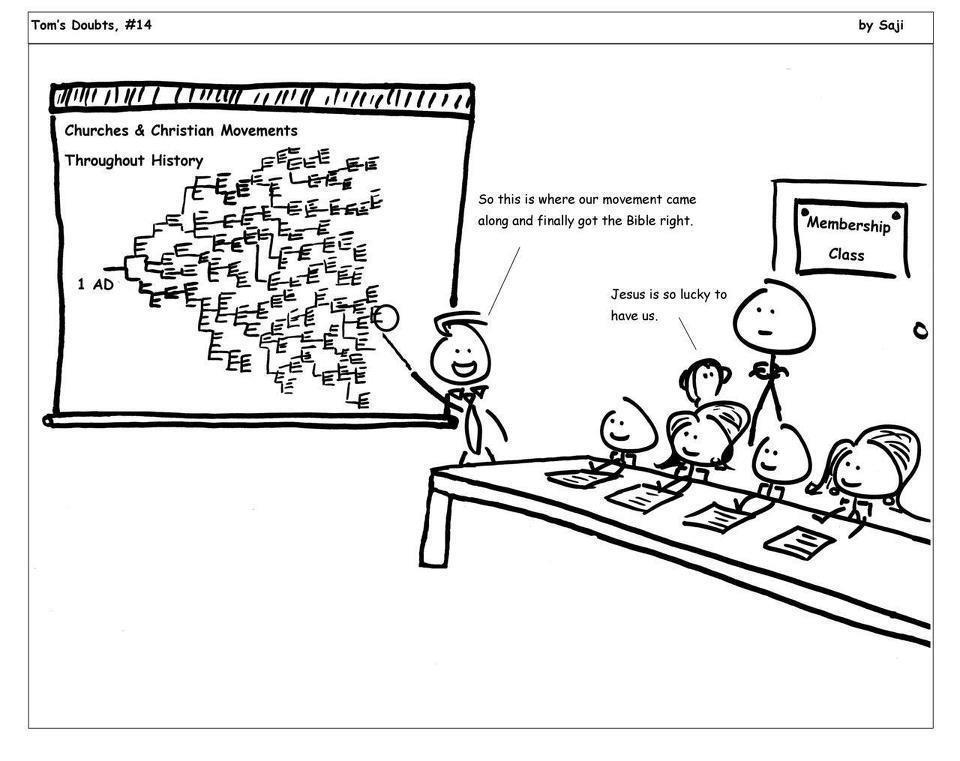
However, there comes a point where the system has had the impact it’s going to have, the Body has absorbed its benefits, and it’s time to move on.  The system has reached its expiration date; as a system of thought, it has outlived its usefulness.  Its purpose, in the end, was to serve as a vehicle through which the Body could come to grips with a few crucial truths.  That work done, the members of the Body now regard those truths as self-evident, and the delivery vehicle can fall to the wayside.  There’s no need to keep the old wineskin after you’ve drunk the wine.

One of the signs that a system has reached its expiration date is that people will deny the system while holding to its key insights as self-evident.  In extreme cases, people are totally unaware that the “self-evident biblical truths” they are affirming only came to be considered self-evident because the system they so despise made people aware of them.  For example, missional types who regard the Trinity as the central biblical teaching for human relationships, but can’t say the word “Christendom” without sneering — they have somehow forgotten that Christendom furnished the historical conversation that resulted in the “self-evident” doctrine of the Trinity.  The Calvary Chapel movement furnishes another useful contemporary example.  Where else can you find pre-mil, pre-trib theology that holds to a firm distinction between the Church and Israel — and so abominates dispensationalism as a divisive and damaging doctrine that they actually ban discussion of dispensationalism in a home Bible study?

**

Ugly stuff happens along these fault lines.  I know of a situation where a Calvary Chapel-connected school was offered three faculty members — a Bible/theology teacher, an OT/Hebrew teacher, and a NT/Greek teacher — all three capable, all three offering skills and teaching far beyond anything the school had in its existing program.  The doctrinal statement wasn’t a problem.  The financial arrangements weren’t a problem.  Then somebody allowed as how all three teachers hailed from a dispensational background, and that was the end.  Not “Uh, guys, listen, can we talk about that?”  No deal, no discussion, nope, sorry, never gonna happen.  The school spooked and ran, and never looked back.  In fact someone tried to oust the president of the school simply because there’d even been a thought of working with dispensationalists.

Sad.  The students could have developed whole skill sets that school couldn’t and can’t deliver, but the administration they were trusting to deliver a good education couldn’t see past a word.

**

On the other hand, did it serve anyone well for the three teachers to use that word?  Was the term “dispensationalism” really necessary — or even helpful?

I’m not sure it is.  Dispensationalism is so diluted and diverse now that it’s necessary to heap adjectives upon it in order to have any hope of describing an actual position — “progressive” and “classic” are the favorites, but they don’t help much.  There’s substantial difference among “classic” dispensationalists — four dispensations, seven dispensations, etc. — and even more among the folks who take the “progressive” label.

When a student balks at learning a laundry list of theological terms, we tell him that it’s necessary in order to help the conversation along.  Having labels for things helps us to understand each other so that we can have good discussions.

Certainly worked out that way, didn’t it?

**

So it is that people who try to have a dispensational take on everything are about as helpful as those who try to have a Reformed take on everything — both systems, in their respective times, were a kiss on the lips, manna from heaven, good and godly work highlighting key aspects of Christian truth that were in danger of being forgotten.  Glory to God for them both.

Both systems, as systems, have now passed their expiration date.  In the end, they were not timeless systems of thought, but simply delivery vehicles for a few key insights.  The work is done; the Great Conversation has moved on.  Not everyone has accepted those few key insights, but they have been rendered difficult to forget: a Roman Catholic divinity student might ignore Hus, but he’s going to have a hard time avoiding the Reformation.  Moreover, a great many of the reforms called for by the Protestants (e.g., moral reform of the clergy) did take place in the Counter-Reformation, because the moral purity of the Protestant churches put the Roman church to shame. So the Reformation had its impact even on the Roman church which supposedly rejected it.  Dispensationalism likewise: today you can hear people who were never dispensational talking about how a certain biblical event took place “at a different point in the story” than where we are today, and you have to take that into account.  Hmmm….

Christ is building His Church, and He is using all these different movements and theologies to do it.  The gates of Hades have not prevailed, and will not.  And what Christ is building is His Church, not some sect or movement or particular theological system.  Christ’s blessing rests on these subsets of the Church for a time, as a means to edifying the whole Church.  Working in such a subset is good, honorable work, but it helps to keep in mind that you only see part of the picture.

Whatever strand of the Tradition you’re part of, whatever theological system you subscribe to, remember this lesson.

**

Cartoon used by gracious permission from Pastor Saji of St. Thomas the Doubter Church, Dallas, TX.

For a different take on the temporary nature of theological systems and creeds, see Jim Jordan’s Symbolism: A Manifesto (particularly the last 3 pages).


Seven True Things I Have Gotten In Trouble For Saying Out Loud

20 May 2012

In the ecclesiastical tribe that raised and trained me, we are accustomed to thinking of ourselves as absolute followers of Scripture.  If the Bible says the earth is about 6,000 years old (which it does), then it is, and carbon dating be hanged.  Some other explanation for the C-14 ratios must be found.  If the Bible says that the whole world was covered by water in Noah’s flood, then it won’t do to postulate that someone’s bathtub overflowed in Mesopotamia somewhere, and that’s all it was really talking about. If the biblical account of the Exodus doesn’t fit with our timeline of Egyptology?  Crying shame those poor historians put in all that work without taking account of the most important primary source we have….  Better luck on the next attempt, guys.

We take it all, straight up the middle, no matter who says “You can’t say that!”  We’re famous for it.

Except, of course, that we don’t.  I have to admit, I had believed our propaganda, and it was therefore with considerable surprise that I discovered that it just wasn’t true.  Not only that, but “I was quoting the Bible” turned out to be a highly inadequate defense for saying things that my community found uncomfortable.  With no further ado, I present to you seven such things.

  1. Baptism saves you.
  2. Belief takes place in the heart.
  3. The purpose of holiness is eternal life.
  4. In communion, we are sharing the body and blood of Christ.
  5. The things that happened to the Exodus generation are all types for our benefit.
  6. A cheerful Christian should be singing Psalms.
  7. God’s children don’t sin.

______

See 1 Peter 3:21, Romans 10:9-10, Romans 6:22, 1 Corinthians 10:16, 1 Corinthians 10:11, James 5:13, 1 John 5:18.

______

Feel free to question, challenge, or discuss.  The more the merrier.


The Tradition: Dealing with Error, Part 2

13 May 2012

My second post on the Tradition a while back ended with a question: “How shall we reject the antisemitism of our (early church) fathers without rejecting our fathers, and thereby repeating the very same sin that they committed?”

It’s quite a dilemma, isn’t it?  The race hatred of our fathers was a sin, and we must reject it.  We must speak against it.  We must say that it is incompatible with Christian life and faith.  We may not overlook it; we may not simply pretend it didn’t happen.  Period.

On the other hand, these men — Chrysostom, Luther, and so many others — are our fathers in the faith.  They paved the ancient paths on which we walk, and we may not overlook that, either.  We may not pretend that we have simply come de novo to the Bible, and we owe them nothing.  Even if we had come de novo to the Bible, we would owe them a debt we could never repay for their labor in recognizing, preserving and propagating the canonical books — but we owe them far more than that.  We have not come de novo to the Bible after all; we are taking part in a Tradition to which we owe a great deal.  Nor is it enough for us to simply say we owe them and then move on: genuine gratitude must be meaningfully incarnated, or it is just cheap sentimentality.

The fashion of the age is to avoid this sort of trouble by damning anyone* who indulges in race hatred.  Such a person (so goes conventional wisdom) is benighted, backwards, and useless, and could have nothing worthwhile to say.  For a Christian, this is not an acceptable stance to take.  First of all, we have our own sins, and if we would not have others dismiss us out of hand because of our failings, then we may not dismiss others for theirs.  Second, as a matter of historical fact, our fathers had quite a lot to say that was, and is, worth hearing.  The Spirit did not fail to speak through the teachers of past ages; Christ has been building His Church right along.  So the fashion of the age be damned; we’re Christians and we’ll have to do better than that.

I propose we do better by simply telling the truth, all the way around.  Luther was a great man whose great contributions we respect and use, and who fell into a great sin that we hate and renounce.  What’s so impossible about that?  We know that we can sing David’s psalms without falling into his adultery; why doesn’t it occur to us that we could acknowledge Luther’s contributions without expressing some sort of tacit approval of his antisemitism?

______

*Not actually true.  There are people who can get away with it, even today.  Louis Farrakhan’s antisemitic statements come to mind.


Paint by Numbers?

6 May 2012

The artist regards the canvas for a long moment, then takes up his brush.  He touches it lightly to the palette, then to the painting, just a single stroke.

“Why did you put the brush stroke there?” the apprentice asked, watching from his shoulder.

“Do you see the way the shadow falls just there, on the model’s cheek?” the master said.

“Yes.”  The apprentice nods vigorously.  “The principle of attention to detail.  They drilled that into us in art school.”

“Do you see the way it changes the color of the blush on her cheek?” the master continued.

Again, the apprentice nodded vigorously.  “Sure.  The principle that light level changes the way that the colors look.  I’ve read all about it.”

The master looked back at his painting, frowning.  “So now you understand?”

“Completely, sir.  All the principles are in the textbooks we used at school.”

A grin tugged at one corner of the master’s mouth.  “Excellent.  Since it’s all in the principles you already know…where will I place the next stroke?  Will it be heavy or light?  Which brush will I use, and which color?”

The apprentice opened his mouth to speak, his finger reaching for a spot on the painting.  Halfway extended, his arm faltered, and his expression slowly changed until it was an open-mouthed gape.


Why the Missional Movement Will be Good for the Church…and ‘Fail’ Anyway

29 April 2012

If you’re not familiar with the missional movement, it’s probably best just to ignore this post.  You could google it and read a couple of things, but I’m speaking here to a problem within the movement, and if you’re still wondering what “missional” might mean, you’ll just be borrowing trouble.

Still here?  Well, then here we go.  The ‘good for the church’ part is easy.  On the one hand, we have churches with varying degrees of good, solid teaching who really think that if they just keep doing that, people will come to them.  It’s not happening, and it’s not going to — at least not fast enough to replace the ones that are leaving, moving away, dying off.  A renewed missional emphasis will get the church out of its siege mentality and return it to being an army on the march.  You can’t prevail against the gates of Hades from inside a castle; you’ve got to get out there and swing the battering ram. The missional movement brings this emphasis in spades.  This is a Good Thing, a return to the concerns and character of Jesus Christ, and through it, the missional movement will be one of God’s instruments for returning His church to greater effectiveness in the world.

On the other hand, the missional movement insists on defining itself as over against ‘Christendom.’  Various caveats attach to the use of the word in an attempt to avoid getting skewered for being sloppy, but…the use of the term is sloppy, and worse.  It’s fundamentally wrongheaded, and the caveats are an attempt to patch a ship that ought to be scuttled and replaced.

The first century church was on mission, but as the Roman world became Christian, the church got a little complacent.  God moved in the unwashed Germanic hordes next door, which woke the Roman Christians to their responsibility, and started one of the largest and most successful missions efforts in Christian history.  At the end of that mission effort, Europe was Christian for 1000 years: the phenomenon we know of as Christendom.  Even by a fairly minimal definition — the Church in the central position of power and influence in society, say — THIS WAS A GREAT THING!!!!  When a missions effort is successful, you get Christendom, the church at the center of power and influence in society, because all the people of power and influence are Christians.  This is an anticipation and partial realization of the Kingdom, and again, we pray for His Kingdom to come, so there’s no reason to complain when God answers our prayers.  (Sure, the people in question are fallible and the realization of Kingdom is only partial — but so what?  Your personal realization of eschatological perfection is only partial, too, but you don’t on that account stop walking with God.  No, you celebrate the successes, repent of the failures, and move on as best you can.  As with individuals, so with societies.)

Moreover, Christendom became the launch pad for the great missions movements of more recent history, which carried the gospel of Jesus Christ to the uttermost parts of the earth.  That was a triumph, and we have Christendom to thank for it.  The North American church in particular ought to be aware of this, because we live in the uttermost parts of the earth.

Using ‘Christendom’ as a word to describe what’s gone wrong with the church is just lunacy, and this is where the missional movement is dropping the bowling ball on its own toes.  A missionary opposing Christendom is a missionary opposing the success of his own mission.  Seriously, think about how you would respond if you heard a bunch of Buddhist missionaries going on and on about how the whole Buddhist thing went off the rails when entire societies converted to Buddhism.  Huh?

Jesus took Europe by storm, and here we have a part of His Bride that’s unhappy about it.  Come again?  At best this is just cluelessness; at worst, it’s sedition against the Kingdom, and the only good thing I have to say about it is that it’s well-intentioned and utterly unwitting.

But it’s still sin; specifically, it’s ingratitude.

Yahweh don’t dig ingratitude, and this is where my prediction for the future of the missional movement comes in.  It will die off, because, unable to celebrate the victories of the past, it will in the end be unable to celebrate its own success.  What does not get celebrated, as Reggie McNeal is fond of pointing out, does not get done — and so one way or another, real success will not be forthcoming, because it is not valued.

Not that this is a huge problem.  Like many other movements that have come and gone in the Body over the last couple of millennia, this one will leave its residue — good and bad — and pass.  The children or grandchildren of the missional folks will take commitment to mission as a matter of bedrock necessity, and also begin asking how they can seek the redemption of the power structures of human society, rather than just railing against Christians who are involved in them. If the Lord tarries, we will yet have more earthly and imperfect portraits of how good a Christian kingdom can be.  And in the end, no matter how much some of us oppose big government and Christian involvement in same, Christ’s kingdom will come, and of the increase of His government and peace there will be no end.  Maranatha!