The World is Magic

19 October 2018

I am a Christian. I believe the Bible, all the way through.

Therefore, of necessity, I believe in magic. I believe in the bad kind — which I steer well clear of, of course — the witch at En Dor calling up the dead, the prophets of Ba’al cutting themselves to get their god’s attention, sacrificing a living baby to sexual freedom Molech, and so on. Vile stuff.

But I also believe in the good kind: multiplying bread and fish, walking on water, parting the seas, calling down fire or food from the clear blue sky.

And not all of it is “nice.” Moses’ serpent devours the serpents made by the Egyptian sorcerers. Elijah stops the rain, and won’t bring it back for three whole years. Walk around the walls and shout, and Jericho’s defenses crumble. Moses holds his staff over the battlefield, and Israel prevails. Joshua orders the sun and moon to stand still so Israel can crush her enemies.

Why does this sort of thing work?

A better question might be: why not? The whole world is spoken into existence to start with. It didn’t evolve in place by inexorable natural process; the world is magic from the word go. (Actually, the word was “Light!”) The things which are seen are not made of the things which are visible.

Which is to say that the materialist conception of the physical world is wrong, all the way down. It’s not true “as far as it goes,” but missing an additional layer of spiritual truth. Richard Dawkins is wrong about Newtonian physics, he’s wrong about quantum physics, he’s wrong about the nature of the rock under his feet and the sun over his head and the air in his lungs. He says those things are just there, matter in motion. We know those things are words. They were spoken into existence by God and continue to be upheld by the Word of His power, and that is a difference that goes all the way down.

For what it’s worth, here’s some other good discussions on the subject:

DRTV: It’s a Magical World

N D Wilson and Doug Wilson on Magic in Literature

N D Wilson and Doug Wilson on Magic, Part 2


God the Gardener

12 October 2018

The Kingdom of Heaven is like a king who took seeds from a rebellious province and planted them in his garden. Under his care, they grew larger and more fruitful in his garden than they had grown anywhere else. And people came from the north, south, east and west to see what the plants had become, and taste their fruit.


Spiritual Healing is a Thing

5 October 2018

I grew up in a church where “spiritual healing,” to the extent that it was discussed at all, was understood to be talking about healing the rift between us and God in a conversion-at-a-revival-meeting kind of way. (For those of you who know the theological language, that meant spiritual healing = justification by faith, and that was all there was to it.) I vividly remember the day I realized there was more to it than that. I was in a course on healing prayer, and our teacher pointed out that Jesus Himself said that He came to heal the brokenhearted. And then one of the facilitators began to tell story after story of spiritual healings she had seen–her own, and others’.

I left class that day deeply discouraged. Does that surprise you?

I had already learned the hard way, at the age of 16, that knowing things wasn’t enough–I actually had to forgive the people I had grudges against. Hard as it had been, I had done that (until I reached the point where I was totally unable, and then God worked a miracle–but that’s a story for another time.)

I had been taught (not explicitly, but by implication) that once I had given forgiveness, I would grow automatically through mastering the doctrine–the religious ideology of our tradition. I had given myself to that task, and I had been successful. I was a fair-haired son of our tradition, a rising young theologian.

But forgiveness is not healing, and studying is not healing. Forgiveness lays the necessary groundwork for healing. Studying can bolster your faith that God can heal. But laying the groundwork and believing that it’s possible is not all there is to it. The initial act, the sin against me, was like getting a splinter shoved into my skin. Holding a grudge was like letting it stay there and fester. Forgiveness was like pulling the splinter out and cleaning out the pus. But that does not magically close the wound — there’s still the actual healing to be done. It’s not automatic, or at least, it wasn’t for me.

I hadn’t healed. I was still carrying significant wounds, and suddenly I knew it. As far as I could tell, I still had a long, long road ahead of me. I hated it. I wanted so bad to just be done, and I wasn’t. I wanted to leave that healing prayer class, and never come back. I wanted to pretend I didn’t know.

But I stayed, and I asked God to work. He did. The road was not easy, but neither was it as long and grueling as I’d feared, because God is gracious. When we are injured, He gives back to us. But that’s a tale for another time.


“Above All Your Name”

28 September 2018

Over time I have noticed a trend in my understanding of Scripture. I can’t figure out what a passage means. It seems odd, or an odd way of saying something. Then one day, I see God do the thing that the passage is talking about, and suddenly it couldn’t be any clearer — it’s exactly the right way of describing what happened.

So Psalm 138 has baffled me for years. What could it possibly mean to say to God, “You have magnified Your word above all Your name”?

Let’s look at the whole first movement of the psalm:

I will praise You with my whole heart;

Before the gods I will sing praises to You.

I will worship toward Your holy temple,

And praise Your name

For Your lovingkindness and Your truth

For You have magnified Your word above all Your name.

In the day when I cried out, You answered me,

And made me bold with strength in my soul.

The speaker is in a foreign land. He sings the praises of Yahweh in front of the demonic powers of that place. Think Daniel, praying toward Jerusalem in Babylon.

So what does it mean in this foreign sojourn that God has magnified His word above His name? I didn’t know until I saw it happen: pagans following the word of God, not out of obedience to Him but because it’s good advice and their lives are better off when they do it. They may have encountered the principle — Sabbath rest, tithing, generosity, what have you — as a word of advice from a friend, or as a principle from inner witness, or whatever. They don’t attribute it to God because they don’t know it came from Him.

Because He has magnified His word above His name. He is willing for people to know what to do without Him getting immediate credit for it. More people know how to live than know that He is the source of direction — that is what it means to have the law written on your heart.

The second half of Psalm 138 says

All the kings of the earth shall praise You, O Yahweh,

When they hear the words of Your mouth.

Yes, they shall sing of the ways of Yahweh,

For Yahweh’s glory is great.

Though Yahweh is on high,

He still regards the lowly;

But He knows the proud from afar.

God will not allow His word to forever remain anonymous. Because He is humble and He loves us, He is willing for people to say, “Wow! That’s a great idea!” and not know, at first, where it came from.

But as it is the glory of God to conceal a matter, so it is the glory of kings to search it out. Kings want to know where the good ideas come from, because where there’s one, often there’s more. As they investigate, they will find Yahweh, because whoever seeks Yahweh (knowingly or not) will find Him. And when they do, they will praise Him.


Triple Triangle

21 September 2018

Christian decision-making can be difficult. It’s simple enough to ask yourself, “What would Jesus do?” But the disciples who walked with Him for three years and knew Him best had a hard time predicting what He would do. How are we supposed to do it?

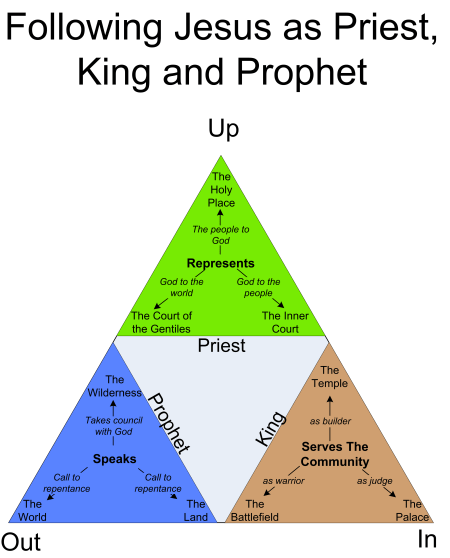
One way of approaching this is to remember who Jesus is: our High Priest, our King, and God’s Prophet during His earthly ministry. There were plenty of priests, kings, and prophets in the Old Testament, but Jesus fulfills all three roles perfectly–and then He calls us to follow Him.

So let’s look at what that might look like…

TripleTriangle(1)

Suppose Hollywood makes some grandly offensive movie about Jesus. What is our response?

The first question is, “Who am I dealing with: God, God’s people, or the world?” This is a problem in our relationship with the world, so it’s outward-facing.

The second question is, “What would each role do in this situation?” A kingly response is to go to war: boycott the film and the studio, publish scathing op/ed pieces that decry Hollywood’s war on Christianity, and so on (sound familiar?). A prophetic response might look like calling the people involved in the film to repent, which is very different from the angry op/ed piece: one is punishing them for what they did, and the other is offering them a way to get right with God again. A priestly response might be directly approaching the producers of the film and asking how you can bless them and pray for them. Being cursed, we bless, remember? (By the way, there’s a ministry in Hollywood that does exactly that, and they enjoy quite a bit of success.)

The third question is, “Which response are you called to?” Walk with God and see. Different parts of the Body may be called to different things.


The Shape of Ministry

14 September 2018

This is a speech I imagine giving at a seminary chapel. Nobody — for reasons that will become obvious — has invited me to actually give this address, so I’m gonna just publish it as a blog post.

As I look out across this auditorium, I see eager, bright people. I see the makings of a corps of intelligent, upwardly-mobile ministry professionals. And I’m afraid I have some very bad news for you. I have some good news for you too, but unfortunately the bad news has to come first. If you will stick with me through the bad news, then the good news will be — for some of you, at least — profoundly liberating.

So, the bad news. Secure corporate jobs are a thing of the past. It’s a gig economy now, and it really shows no signs of changing anytime soon. What does that have to do with you? Well, the same thing is true in the ministry world, albeit for slightly different reasons. The pool of ministry jobs that pay a decent full-time salary is shrinking. There are tons of bright, motivated, qualified people who — despite papering the country with their resumes — haven’t even gotten so much as a call back in the last year. There’s a bunch more who have done a ton of interviews, but someone always just seems like a slightly better fit.

Some of you — a very few of you — will land good ministry jobs out of school, and stay in that world for your entire careers. I wish you well, and you can probably tune me out now, because the rest of what I have to say won’t really apply to you.

The problem is, most of you who think I just gave you permission to tune me out — you’re wrong. You will spend at least some — and maybe most or all — of your career outside that glorious, enchanted, nigh-mythical land that is paying full-time ministry. So unless you have a crystal ball telling you otherwise, just assume that at some point, what I’m about to say will be relevant to you.

So much for the bad news. Let’s move on to the good news, which is that you don’t need the permission of some paycheck-issuing body to do ministry. I know a bunch of folks in the full-time, fully-paid ministry world, but let me tell you about the other folks I know for a minute.

Gabe started a handful of drop-in youth centers around Denver, and supports himself by working at a brewery. Heather runs a cafe, which she uses as the site for a very fruitful ministry. Dave started a day center for the homeless. He’s also the world’s leading expert on Victorian trade cards — you don’t know what that is, and I’m not going to try to explain it now, but he’s written a half-dozen books on the subject, edited a magazine for the field, and supports himself buying and selling these things on eBay. Bob is a full-time missionary now, but for years he supported his ministry projects by working 10 days a month for a marketing firm. Jenny is an itinerant prayer warrior who splits her time between here and Africa; she supports herself as a massage therapist.

Let me tell you about how this has worked out for me. I got hired out of seminary to teach. I was half-time as an adjunct faculty member, and half-time associate pastor at a local church. After a year, the seminary brought me on full-time. I quit the pastor gig, but then got another, very part-time gig with a little church plant (that turned out to be a counter-cult exit ministry disguised as a church plant, but that’s a story for another time.) I was full-time at the seminary for four years. That was the last time I had a stable, full-time paycheck from ministry — more than 10 years ago now.

You know what? I really liked being a professional geek. But life’s been a lot more interesting since I got dynamited out of that comfortable gig.  Since then, I’ve worked for another seminary part-time, and a couple more churches. I’ve started a nonprofit, done youth work, written Bible curriculum, driven a school bus. Presently, I’m a pastor-at-large ministering in the gaps between churches. I’ve baptized people in the Platte and served communion in shot glasses off the tailgate of my car. I’m also a massage therapist, because pastor-at-large is not the sort of job that comes with a fat paycheck.

Or any paycheck, most of the time.

You may not want this kind of life for yourself. You’re investing in a good education, and why shouldn’t you have a solid career, just like if you went into medicine, finance, education, or some other well-educated profession?

By way of an answer to that, let me tell you about another guy. He was a professional theologian; good education, pretty secure gig, and then he got mugged by spiritual reality. He spent the next 14 years trying to figure out what happened to him. After that, he traveled around sharing with anybody who would listen. Sometimes he planted churches. Sometimes he was fully supported; other times he supported himself while he did the work. He even wrote a few books, but they weren’t really theology books. They were mostly compilations of good pastoral advice to other people who had been mugged by the same spiritual realities, teaching them how to live with what had happened to them. For those of you who haven’t caught on, I’m describing Saint Paul. If he wasn’t too good to support himself, then what makes you so special?

God has a destiny for you, and if you step into it, He will supply what you need. You certainly will have needs, and here are some of them.

  • You need a useful trade. If you have no marketable skills, I advise you to get some, and soon.
  • You need a team. Anything really worth doing is big enough that it won’t be sustainable to tackle it by yourself. And we’re Christians — we’re the image of the Trinity; we’re not meant to do anything alone.
  • You need oversight. It is not healthy to have nobody who can tell you no. You need open-minded, experienced people who believe in what you’re doing — even if they don’t quite understand it — and are willing to help you do it. That last bit is important. Don’t trust people who are not invested in your success to give you directional guidance.
  • You need excellent self-care skills. That means you need a regular sabbath, you need retreat time, you need to clear margin for your relationships, and build a good support network.
  • You need to be able to say no without feeling guilty. The more you divide your time between different places, the more people will feel that it’s reasonable for you to give them just a little more — and you can’t give “just a couple more hours” to 4 different places in the same week.

If this sounds daunting, it is, but remember the examples we’re following. Paul faced some daunting prospects himself: go out into an overwhelmingly pagan world with virtually no support and plant churches. (And be quick, because you’re going to have to skip town before they kill you.) The good news, again, is that you do not need anybody’s permission to have a powerful and fulfilling ministry. If you are willing to go outside the shiny, professional box, it’s a big world out there, and the opportunities really are endless. I wish you well. 


A Cautionary Letter

7 September 2018

The Discernment Committee of the Tribe of Levi
Horus Street
Pithom, Egypt

Aaron ben-Amram
Goshen, Egypt

Dear Mr. ben-Amram,

We thank you for notifying us about the practices in which you and your brother Moses are engaged. In these turbulent times, many people have grown confused about the worship of the Most High. The Discernment Committee exists to educate Israel about the proper worship of the Almighty, and to expose the many pagan practices that have infiltrated the congregation of Israel.

Unfortunately the practices of your brother fall into this category. Upon review of our history, we find no precedent for any of the so-called “revelations” that your brother brings to the table. The God of Abraham spoke to Abraham face to face, as a man speaks to his friend, and to the other patriarchs in dreams. There is no precedent whatsoever for the Almighty speaking out of a burning bush, still less some paranormal bush that was “burning but not consumed,” whatever that means.

Moreover, the “miracles” that your brother brings to validate his “revelations” are the furthest thing from the sort of uplifting and worshipful miracles that might genuinely befit the Most High. These signs your brother brings — turning his hand leprous, turning water into blood—are disturbing, morbid, and frankly just bizarre. And again, there is just no precedent of the Almighty doing such things.

As to the matter of turning sticks into snakes, well…if I might be frank, a Levite of your education ought to know better. You know our troubled history with the serpent, and the very idea of validating some sort of connection with the Almighty by turning your walking stick into the symbol of Satan…well, surely you’re not that tone deaf. This is not the work of the God of Abraham.

Moreover, our research indicates that this snake-stick demonstration is a practice of the Egyptian sorcerers Jannes and Jambres, among other local occultists. These men are worshippers of a variety of false gods, entities that you and I know to be demonic in nature. Surely you can see that participating in such an occult practice opens a wide door to the demonic in your own life, and we would urge you to immediately repent of and renounce your involvement in this grave sin.

If you’ll forgive a personal note here, I knew your late father, may he rest in the bosom of Abraham, and he would be deeply grieved to see his sons carrying on in such a manner. Moses always was a bit impulsive, so perhaps it’s understandable. But for you, Aaron, to get caught up in this…I just don’t know what to say. You and your sister Miriam have always been the sensible ones. May the Most High forgive me for saying so, but I’m honestly glad your father didn’t live to see you getting carried away by Moses’ nonsense. Amram was always rightly proud of you, and this would have just broken his heart.

But recriminations won’t solve anything, and we need to find a way to move forward. I’m afraid the best-case scenario here is that your brother has serious mental health issues. Four decades alone in the desert would be a strain for anyone, and it’s not implausible that his frustrated lifelong desire to be the liberator of Israel finally caused a psychotic break. As awful as it sounds to say so, I sincerely hope this is the case. Our people have always made excellent psychiatrists, and there is some hope that with lengthy therapy, your brother could be delivered from his delusions and return to a somewhat normal life. If indeed they are delusions. I sincerely hope they are, because the alternative is to take your brother’s account at face value.

In that case, some entity known as “I am” spoke to your brother from a burning bush and induced him to perform these morbid and bizarre pagan practices. Given the pagan associations of these practices, we can only conclude that the entity known as “I am” is a demon, and for your own safety, we would urge you to have no further contact with your brother while he is under the influence of this unclean spirit.

We maintain a resource list of mental health professionals and exorcists for concerned families in your unfortunate situation. Please find it enclosed. I urge you to consult with one or more of them regarding next steps for your brother.

We pray that the Almighty’s mercy will cover you and your family during this very difficult time.

Sincerely,
Yochanan ben-Zacharias
Communications Director
Discernment Committee of the Tribe of Levi


Voting on the Wolf

20 August 2018

[EDIT: There’s been some complaint about this “anonymous” article, so let’s set the record straight: my name is Tim Nichols, I live in Englewood, and I wrote this piece. This is my blog, my name is on the About page, and every article on here is written by me, in case anybody was wondering.]

We are children of Abraham by faith; we are called to be a blessing. We like to think that our call to blessing means we can be nice to everybody, all the time, and we’re wrong. That’s just wishing to live in a world that doesn’t exist. It is pretending that you can love sheep and never raise your hand to a wolf. That may be true for a while, but only as long as there aren’t any wolves around. When the wolves come, the shepherds fight. And the people who professed to love sheep, but “don’t want to get involved” as the wolves feast, are revealed for what they are: hypocrites, cowards, sentimentalists addicted to an insipid niceness that’s a poor substitute for love.

In Englewood, Christians stand at that crossroads. The situation will be sharpest for the voters of District 3, but the whole city is deeply affected, and city-wide discussion is appropriate. In late August, the city will mail out ballots asking whether to recall Council Member Laurett Barrentine. The voters of District 3 will have to decide on one of three responses: yes, no, or refuse to answer.

Let’s talk first about refusing to answer. In our democratic republic, all voters are bound by the challenge to civil magistrates to function as “God’s servant for good” (Romans 13:4). When a police officer ignores a bank robber, preferring to “not get involved” in such messy business, we all see this for what it is: willful desertion of his duty. When a matter comes to a vote, voters are in the same position. By God’s good providence, they are involved. (That doesn’t mean abstention is never the right thing to do, but a voter need a reason to abstain, just as he needs a reason to vote yes or no. No one gets to wash their hands, Pilate-like, and pretend that somehow absolves them of responsibility.)

Moving beyond futile attempts to remain loftily above the fray, let’s talk about voting yes or no. The charges against Barrentine are serious and well-founded. She has habitually sowed conflict and division in the city, in order to champion one side against the other for her own private advantage. This is something that God hates (Proverbs 6:19), and Christians are required to oppose it. She has used her position of power to falsely accuse those who help our poorest and most vulnerable citizens–and this while claiming the name of Christ. In that respect she is precisely what the Pharisees were, and Jesus would be at war with her, as He was with them. She has spread gossip and lies about various city employees, accusing them of incompetence, criminal negligence, and conspiracy. It has gotten so bad that a number of valuable employees have sought employment elsewhere. Proverbs tells us exactly what to do about this: cast out the scorner, and the strife will cease.

You can review the evidence for those claims at (www.englewoodrecall.com); I’m not going to rehash it all here. The point for our purposes is that if the claims in the above paragraph are true (and they are), every Christian in District 3 should vote to recall Barrentine, and should do so because they are Christians.

There is simply no Christian way to vote “no” without concluding that the claims are not true, or that there’s insufficient evidence to support them. (Given Barrentine’s talent for deception, a good Christian could mistakenly vote against the recall. I am saying that it would be a mistake, and a pretty serious failure of discernment at that.)

But the point for our purposes today is that a Christian voter has an obligation at this point to review the evidence, and having examined the evidence, to get involved. This is the kind of controversy where Christians should take a very public stand. Let me tell you how I came to that conclusion.

What Would Jesus Do?

“What would Jesus do?” can be a hard question to answer. Jesus regularly surprised everyone, even the disciples who knew Him best and walked with Him for three years. 

Jesus didn’t treat everyone the same; He knew that He had different responsibilities upward, toward God, inward, toward God’s people, and outward, toward the world. He was also called to fulfill three very different roles: priest, king, and prophet. Jesus calls us to follow Him, to live our lives by the patterns He set. Since He’s not fulfilling only one role, there’s never just one answer. In any given situation, there’s a priestly response, a kingly response, and a prophetic response; we have to ask what God is calling us to do in that particular situation.

The priestly response is to bless, despite everything, and that is where we started. My allies and I have been working hard to bless our city for years now, both on our own and in coordination with others who want to help. We now find the people we are pastorally responsible for being injured by a wolf in our midst. At that point, I felt compelled to do something more direct. 

We moved next to a prophetic response. We challenged the lies, gossip, and hypocrisy directly, naming the sins for what they were in multiple city council meetings. That was not fun, and we had to defend the necessity of it to many of our friends and allies, who hadn’t ever seen that side of us before. (Our earlier essay, “Speaking with an Edge: The Biblical Case for Hard Words,” laid out the case for doing what we did there.) Barrentine did not respond well to the rebuke and doubled down on her ugly behavior.

Unfortunately, that makes it necessary for the people of Englewood to recall her. Supporting that recall effort by talking with people, writing, putting out yard signs, and every other way I can–that’s the kingly response. I am doing that, and I am doing it because Jesus requires it of me.

This is not something like a municipal bond issue, where good Christians can legitimately be on either side of the issue. There is no Christian way of approaching this issue that leads to the conclusion “vote to keep the wolf in office.” And if you live in District 3, you can no longer avoid the question except by willfully abdicating.


Household Codes

18 August 2018

I’ve been blessed to share a number of different living arrangements. Like most, I started as a child in a household. During college, I was in a dorm, then shared an apartment with three other guys, and started grad school with a similar arrangement. Later in grad school, I moved into a small apartment attached to a single-family home. I spent several months before I got married renting a bedroom from a couple with grown children. Since marrying Kimberly 15 years ago, it’s just been the two of us. (In case anybody’s wondering, I like the last one best.)

As I’ve put down roots in my community, I have also become an “associate member” of three other households. I don’t spend the night there, but I come and go without knocking and frequently take part in the family life. Two of these households have kids, and recently I’ve been reflecting on what it takes to be a good member of those households–places that are filled with children, but they’re not my children.

As a starting point, here’s a quick comparison and contrast between the roles of child in a family home, a member of a unigenerational household (like a house of grad students, for example) and an adult member of a multi-generational household.

Household Codes Chart

Unigenerational households and multigenerational households operate very differently. Unigenerational households tend to be fairly democratic; multigenerational households can’t be. The tiny barbarians lack the skills and impulse control to function in the world apart from adult support. As a result, there’s a much higher degree of planning and coordination, and a great deal less spontaneity than in a unigenerational household: all the adults can’t leave the house at the same time, food has to be prepared at specific times and in specific ways, the house needs to be quieter at nap times, and so on.

Childcare responsibilities are not equally shared among adult members of a household, for reasons that start with basic biology: women get pregnant, and men can’t breastfeed. Taking one thing with another, responsibilities that involve leaving the house for extended periods of time will fall disproportionately to the father, and responsibilities that can be done at home with children underfoot will fall disproportionately to the mother. (Technology mitigates, but does not eliminate, these effects.) But the sharing extends beyond just the parents. While the parents have primary responsibility for the children, and other adults correspondingly less responsibility (at least in our culture), there are spill-over effects on the other adults who live in the household.

The parents’ greater responsibility means they get—and deserve—a relatively greater precedence; there is a real hierarchy here. Other adult members of the household are expected to plan their use of common resources (cooking, laundry, and bathing facilities, for example) around the needs of the parents and children. This would be grossly unfair in a unigenerational household, but where the welfare of children is at stake, it makes perfect sense. Two quick examples here:

  • When the children are brushing their teeth and making their last trip to the bathroom before bedtime, no adult has equal claim on the toilet. Getting the kids to bed on time is important, and disruptions in the routine tend to balloon out of control quickly. So the routine is maintained, and the adults can hold it.
  • When the small children are down for a nap and that’s the mother’s one opportunity that day to get a shower, nobody’s claim trumps hers. The other adults can shower earlier or later; she can’t.

Which brings us to the subject of how to be a good “associate member” of a household with children. Every household is different, so the particulars will vary a bit, but here are some general principles to work from:

  • Know your strengths. Botching a messy diaper change makes more work for everyone. Know what you bring to the table, and what you’re better off letting someone else take care of.
  • Generate surplus. Food, time and effort, emotional labor, childcare–there are a lot of areas where you can contribute. Bachelors can afford to just break even (not that there’s any future in that, even for them), but adults who live with children cannot; kids are a net drain on the community resources for years, and the adults around them have to make up for that. If you want to live like a bachelor, move in with bachelors. If you’re going to live with a family, live up to the company you’re keeping.
  • Be good with the kids. That will mean different things in different households; make a point of learning what it means to the particular children and parents you’re dealing with.
  • Plan your use of shared resources around the needs of the children and the parents. You have less responsibility and more flexibility; use it.
  • Learn how to provide emotional support to the people around you, including the short barbarians. It might be a pat on the head, a listening ear, help with a frustrating toy, babysitting while Mom gets a shower, or bringing home a bottle of wine for the parents. Pay attention to what they need, and as you’re able, be intentional about adding value to their lives.
  • Short of debilitating injury, don’t put all your needs on the parents. Parents already have their hands full, and the children’s needs will always trump yours. Build your network and find other people to rely on. If you fall down the stairs and shatter your femur, of course the parents will do their best to help you, but even then, the children have to be cared for. Of course friends look after each other’s needs, but friends also understand one another’s obligations; no good friend thinks their own needs trump the children’s.
  • Know when to disappear. You are part of the household at some level, but you are not part of the family, and that matters. There are times the family needs their space, and at those times, the most valuable thing you can do is back off.

Parents, feel free to weigh in here. What am I missing?


Against Methods

10 August 2018

Method is sometimes an excellent substitute for wisdom — insofar as there is any such thing as an excellent substitute for wisdom. But wisdom takes time, and method is a lot easier to pass on to a bunch of people quickly.

We can’t make every teacher, hospital tech, day care worker, etc. into a doctor. But we can get them all CPR certified in a day. Wisdom is the kind of deep understanding of the body that you would need to invent or modify CPR. To just do it, all you need is a good method, taught by a competent teacher.

Method depends on slicing time in a certain way, at certain key junctures.  That works to an extent, but when life deviates from the expected, your method can quickly fall apart. The next “slice” won’t work the way it’s supposed to, and you either blindly follow the method anyway, not realizing it won’t work, or you stall, not knowing what to do.

Lots of people succumb to the temptation to believe that they understand a field of endeavor, when all they really know is how to execute a particular method. I’ve seen this phenomenon in fields as diverse as martial arts, combat shooting, biblical exegesis, first aid, bodywork, construction, and more. The more success a person has had applying the method they know, the more certain they become that they understand the whole field of endeavor. The illusion usually persists until they are humbled by a situation their method doesn’t cover. There’s a difference between monkey-see-monkey-do and actual wisdom. Everybody starts with monkey-see-monkey-do, and a wise man doesn’t chafe at that. He submits to the necessity to walk before he runs — but he doesn’t make it out to be more than it is. (In classical education terms, he doesn’t mistake grammar-stage competence for rhetoric-stage eloquence.)

If all you know is a method, the absolute rules are not what you think, and they don’t apply in the way that you think. The real world is not a postmodern goo-fest — there really are rules — but knowing what the absolutes actually are and which rule to apply when is a big, big deal.

Here’s a good example: in first aid, there’s a basic rule that you never move someone with a neck or back injury, unless you have to drag him away from a fire or something — too much danger of exacerbating the spinal injury and possibly paralyzing the person.  During my pastoral internship at a church in eastern Washington, we had a week-long family camp. One afternoon, an older man collapsed with a lower back injury while jumping rope with the little girls.  He was going into shock, and a friend of mine came and — over the vehement protests of several of the man’s family members — got the man up on his feet, walked him around, and had him do several particular movements and then keep walking around until we could round up a vehicle and a driver to take him to the hospital.

The same family members who protested so vehemently were greatly surprised when, at the emergency room, the attending physician had the man walk around and do the same movements my friend had made him do earlier.  My friend, it turns out, used to manage an assisted living facility.  While he’s not a doctor, he had seen a lot of this type of injury, and knew that shock was a greater threat at that moment than paralysis.  He knew that getting the patient up and moving him around carefully in those particular ways would be safe, and would keep him from going into shock.  In drawing on his greater wisdom and understanding of the situation, he violated a basic tenet of first aid — but so what? First aid was specifically made for people who lack that greater medical wisdom and understanding.

True wisdom understands the heart of the matter, and knows when to depart from method for the right reasons. This understanding is at the heart of many of the biblical stories. So David eats the showbread, Hezekiah asks God for mercy at the Passover, Rahab betrays her city to Joshua’s spies, Jael offers Siserah a snack and a nap, Namaan the Syrian bows down with his master in the temple of Rimmon, and many more.