A propos of my recent post Not Dead, Just Relocated, I just ran across a Free Press story about a professor who is trying to revive the humanities at Princeton, of all places. May his tribe increase!
Actual Humanities at Princeton?
1 June 2024
 Comments Off on Actual Humanities at Princeton? |
  Uncategorized |
  Permalink
 Posted by Tim Nichols
Coming Soon!
20 January 2024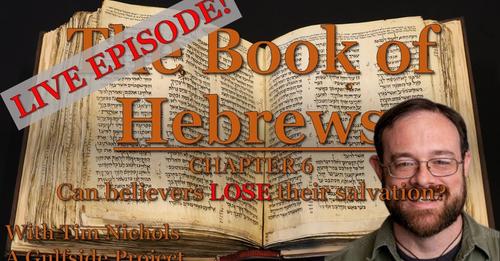
I’ll be joining Chris Morrison of Gulfside Ministries for a special live podcast on Hebrews 6 on January 27th at 10 am Mountain Time. Come join us!
Comments Off on Coming Soon! | Exegesis, Uncategorized | Permalink
Posted by Tim Nichols
Two Books That Changed My Teaching
9 January 2024When someone comes to me for discipleship, I tell them that I only teach four things: how to read, how to pray, the story of our people, and fruitful living. (I have a specialty in practical doctrine of creation and dust-and-breath anthropology, but that falls under the heading of fruitful living.) Today, I’d like to highlight two books that have changed my approach to teaching the more recent parts of the story of our people.
The historical development of science is a bit of a puzzler for most people. Modern science was created by Christians, and arguably couldn’t have been created by anybody else. If you rewind a few centuries, you find people like Robert Boyle, Matthew Maury, Michael Faraday, Lord Kelvin, and many more–faithful Christians moved by their Christian worldview to investigate the world God made. They would be shocked and puzzled to discover that today everybody “knows” that science and Christianity are in conflict; they never found that to be true. I had long been aware that the “conflict thesis” was nonsense, and worse, carefully constructed propaganda (about which, see Of Popes and Unicorns for the riveting tale, but that’s not why we’re here today.) But the history around Draper and White and their promotion of the conflict thesis never quite explained the speed with which Christians adopted it.
Paul Tyson’s A Christian Theology of Science has filled that gap. Tyson shows how the roots of the conflict thesis lay, not in 19th-century academia, but in currents of thought that run back to the medieval European church. He also shows how deeply we’ll need to repent to come back to a proper understanding of science’s place in the world. (I’m not with him in his largely negative appraisal of young-earth creationism, but he’s fair, and offers a rare compliment on pp.145-6. I’d love to buy the guy a beer and chat about it for a couple hours.) It’s not a thick book, but expect to expend a little skull sweat getting through it. It’ll be worth it. You’ll find that it inspires you to think differently — and harder — about contemporary discussions in which both religion and science have a stake.
In a similar vein, American Nations: A History of the Eleven Rival Regional Cultures of North America by Colin Woodard sheds light on the development of American political thought and practice. It’s obvious enough from a glance at the news that today, the people of the United States do not have a single dominant conception of what it means to be American, what the good life is, or what good government should look like. Woodard’s thesis it that we never really had that, and he starts in the 1500s to demonstrate his point.
I was raised at a history teacher’s knee, and my father would often contrast the Plymouth Bay Colony and Jamestown, pointing out their rival religions, attitudes, and forms of life as a key lens through which to view the development of the early American republic. Woodard takes that observation much further, and his historical unfolding of the American founding is really helpful. We frequently talk about the “Founding Fathers” as though they were a single group of people with a single shared set of values; that is simply not the case. Rather, the documents of the American founding represent a struggle to hammer out a working synthesis among multiple competing visions. I would argue that synthesis, despite its notable imperfections, was largely successful, and remains an important guiding light for us today.
Woodard maintains that the eleven distinct and competing cultures he describes continue to operate today (here’s a county-by-county map), and offers his synthesis as a broadly useful lens through which to view and explain current cultural battles. That claim seems to be where he has garnered the most criticism. You’ll have to make your own determination about that. I will say that I’ve found his eleven nations a helpful filter in considering some interpersonal conflicts. If you’d like a quick overview, this podcast is a good place to start.
Comments Off on Two Books That Changed My Teaching | Uncategorized | Permalink
Posted by Tim Nichols
The Older Son
12 December 2023My new post on the prodigal’s older brother is up at Theopolis.
Comments Off on The Older Son | Uncategorized | Permalink
Posted by Tim Nichols
Which is Quite a Thing to Miss
28 November 2023I was maybe 14 or 15 when I first read Frank Herbert’s Dune. In college I discovered the sequels–all 5 of them–and I’ve returned to them a number of times since. Herbert’s sociology of religion shines in certain ways. The average sociologist of his time is a fairly woodenheaded materialist who thinks of religion as humanity’s first and worst answer to being lost in a perplexing cosmos, an ill-fitting patch pulled over a waning ignorance, soon to wither away before the growing light of Science. Herbert knew better — he understood that religion is one of the fundamental driving forces of human society, and it’s not going away; in fact the opposite: the more humans explore their potential, the more powerful religion is going to get. His explorations into the human potential movement only took him further in that direction. The theme is implicit in The Santaroga Barrier, touched lightly in The Dosadi Experiment, and explored rather thoroughly in the Dune universe.
What Herbert fails to explore is the possibility of genuinely supernatural elements operative in religion. He can countenance humans shaped by extreme training (The Dosadi Experiment, the Sardaukar legions) and even radically transformed by millennia of selective breeding (the Guild Navigators, the Tleilaxu, the various products of Bene Geserit breeding programs, the children of Siona). But as close as he gets to a genuinely *other* presence is the Caleban race of Whipping Star and The Dosadi Experiment, and he situates the Caleban within the ConSentiency universe (which is full of aliens, as opposed to the Dune universe, which has none) as one more alien species, perhaps a little stranger than most.
Which is to say, Herbert takes the enduring presence and power of religion seriously, but he treats it as an entirely human artifact; it doesn’t seem to occur to him that any of it might be real. This dyed-in-the-wool materialist approach could easily be a rational business decision to work within the default approach of the genre. Working with deity in fiction is tricky; even Tolkien (a devout Catholic of immense narrative power) mostly left religion out of his books — and he was writing in fantasy, where he could have gotten away with it.
But Herbert, as far as I can tell, just didn’t take the existence of a deity seriously, at least in his fiction. He viewed religion as a complex force entangled with deep and poorly understood parts of the human psyche, and therefore having an immense power that was a sort of emergent property, greater than the sum of the inputs and therefore capable of turning on even sophisticated manipulators like the Bene Geserit. So he avoids the deus ex machina problem by having no actual gods, and gains some of the plot tension divine intervention can create via that emergent-property power. Far from being puppet masters, his religious manipulators discover they’re riding a tiger and barely holding on.
He’s certainly right that humanly created religious manipulations have a way of turning on the manipulators. He misses that this is because God will not be mocked.
Comments Off on Which is Quite a Thing to Miss | Uncategorized | Permalink
Posted by Tim Nichols
Theopoetics Levels Up?
14 November 2023I’ve been advocating for a while for an angle of approach that I refer to as theopoetics. I’ve elaborated on that in other places, so I won’t repeat it here.
I was surprised and delighted to find that my friend Bob Hitching has independently coined the term logospoetics, and is in the process of elaborating his project. There’s substantial overlap between us, and we have a lot to talk about. In the meantime, check out what he has so far.
2 Comments | Uncategorized | Permalink
Posted by Tim Nichols
Who Knew Not Joseph
3 October 2023I am responding here to a particular sort of free-market conservative. Not everybody in those circles thinks in the way I’m going to harpoon here, but a number of folks do, and I’m writing to urge them to think things through a little better. And what better way to do that than to tell a story? So pour yourself a mug of cocoa and pull up a chair. Our journey together begins in a desolate place….
Let us imagine a vast and uninhabited tract of land, backside of nowhere, inhospitable and generally of no use to anyone–the sort of place that, despite its nonexistence, is the perfect setting for a thought experiment. This particular spot is might be populated exclusively by an exceptionally perky roadrunner, an exceptionally bedraggled coyote, and a film crew that markets tales of their hijinks to young children. Now other than the film crew, this land is really of use to nobody….
…except that an enterprising young fellow on the film crew noticed signs that, were he to dig a really big hole in the ground, he might be able to pull good-sized quantities of coal out of it for the next century or so. Having recently come into a fairly large inheritance, this young fellow, one Phineas Edgerton Farrow III, proceeded to buy the land and do exactly that. The hole needed miners, and miners need houses and a bank and a grocery store and a saloon. The opportunity brought miners and their families, and families meant children, and children meant a school, complete with playground and a ball field out back, and before you know it, Phineas had a whole town going. He owned all of it, but he was a decent sort and a good judge of character, so his rents were decent and he handled things fairly enough and hired competent people who did the same. Folks were generally happy with him.
One day, Phineas was down in the mine on an inspection tour when they had a cave-in. A canny old miner named Joseph saw it coming a few seconds before everybody else and snatched Phineas to safety. Grateful to the man who saved his life, Phineas asked Joseph how he could repay him. Joseph allowed as how a bowling alley and some parks for the kids might be a nice addition to the town. Phineas did all that and more, and a couple years later when Joseph got hurt and couldn’t work in the mine anymore, Phineas moved the old man into his own house and had his staff take care of him. Phineas and Joseph had breakfast together every morning, and supper together every night, and Joseph found ways to occupy his time umpiring baseball games for the children and such. For his part, Phineas never forgot that one of his miners had saved his life, and he continued to find ways to make life in his town a delight to live in. So the school band had new uniforms every year, and the parks were well-maintained, the school baseball team was well-coached, and like that. It cost a little more, but the price of coal was good, and he was making plenty of money. He didn’t mind using it to bless the people he cared about. In short, Phineas’ mining town was the sort of place where a union organizer couldn’t even get started.
And so Phineas found that by the early part of middle age, he had it all, except that he’d never taken the time to find a wife to share it with. Turning his attention to the task, he shortly wooed and won a terrific young lady. A little while after the wedding, old Joseph died, and a little while after that, Phineas and his new wife had occasion to redecorate Joseph’s old room as a nursery. A few months later, a son was born: Phineas Edgerton Farrow IV, affectionately known as “Phin” to the whole town as a kid. As he grew into a young man, Phin was less affectionately known as “Sharkey” to old miners who would not have recognized a Lord of the Rings reference if someone dropped it into their story right in front of them, but who knew a predatory gleam in the eye when they saw it.
As is the way of things, middle-aged Phineas Farrow became old Phineas Farrow and in due time both he and Mrs. Farrow died, leaving Sharkey as their sole heir, and so a Farrow arose who knew not Joseph. Young Sharkey had known for some years that his father was wasting money on unnecessary amenities and otherwise failing to maximize the profit-making potential of his holdings. Being the only employer and sole property-owner for miles in every direction, he was not slow to take advantage of his monopolies. Prices and rents rose; wages fell, and the town shortly became the sort of place where a union organizer is the kind of fellow people might want to know.
***
There’s a certain sort of conservative who is happy to say that Sharkey may, in specific instances, be committing sins by ‘grinding the faces of the poor,’ but is content to leave that matter between him and God. This conservative fellow will maintain that Sharkey leveraging his monopoly on jobs to force his workers to accept lower wages is not, in itself, wrong, and no governmental or economic actor should be intervening in his right to do as he wills with his property. This same fellow–I am not making this up–will also say that if the miners resort to collective bargaining, they are guilty of extortion.
And so we are presented with the ridiculous spectacle of a “conservative” who would permit Sharkey to take full advantage of his virtual monopoly on jobs, but wouldn’t permit the miners to exploit their virtual monopoly on the labor supply. Why is it permissible, if regrettable, in the one case, and high rebellion against God in the other?
But let’s go further. Suppose I’m a miner in Sharkey’s town. Everybody agrees that I’m allowed to negotiate my own wages, and withhold my labor if the pay’s not high enough to suit me, right? And we all agree that I don’t have to go about this silently — I’m allowed to chat with my next-door neighbor about my reasons for what I’m doing. I’m even allowed to suggest that he do the same. In fact, I’m allowed to have that conversation with everybody in town, am I not? And if we agree together that we’re all going to stay out of the mine until the pay’s back at acceptable levels, then…I’m a union organizer and this is a strike, and our “conservative” interlocutor is going to call me a commie. But where have I done anything that violates God’s law?
This is a “conservatism” that–to borrow Dabney’s phrase–conserves nothing.
3 Comments | Uncategorized | Permalink
Posted by Tim Nichols
Believe the Works
19 September 2023I wrote last week about the practical unity I found in Englewood that had been lacking in other places I’d called home. One of the roots of that unity was simple obedience: God wanted us to be one, so the Englewood pastors set out to see how hard they could obey. They didn’t use doctrinal differences as excuses to disobey; they knew they weren’t going to iron out every difference, and they wanted to see how much they could obey anyway. That will carry you a long way. But there were also some doctrinal components that helped the obedience along. One of the big ones was their theology of the Kingdom of God.
These guys constantly talked about the Kingdom of God. I remember at first thinking that they were being really sloppy with their Christianese terminology. I didn’t think there was (or could be) any real theology behind it. See, within my tradition at the seminary, the Kingdom was entirely future. The only time I remember anyone talking about it as a present reality, it was presented as a “mystery Kingdom,” present in some nebulous form that had no real practical outworking. In terms of ethics and everyday conduct, the only impact of the doctrine of the Kingdom was to live now in such a way as to receive rewards in the future Kingdom. (In theory, that’s a pretty good motivator, but it didn’t work very well in actual practice; sometimes people are more motivated by present animus than by any distant future reward.)
In Englewood, on the other hand, the Kingdom is a present reality. We don’t over-theologize it: a kingdom is where a king rules, so the kingdom of God is where God rules. Everywhere we obey God’s rule is a little outbreak of God’s Kingdom on earth.
The fullness of the Kingdom, the consummation of all things, is of course still future. The lion will lie down with the lamb, and we’re not there yet. “We do not yet see all things put under Him,” the author of Hebrews says, “but we see Jesus.” This Jesus once told His enemies, “If I drive out demons by the finger of God, then the kingdom of God has come upon you.” Has come. Even back in Jesus’ day, the Kingdom came — and there was the formerly demonized man in his right mind to prove it! The Kingdom will not come fully until God’s good time, but He is pleased for it to come truly in the present.
If you stop and think about it a moment, this is not such a strange thought for us. The resurrection is yet future, but Scripture teaches us to expect regular intrusions of resurrection life into the present: “If the Spirit of Him who raised Jesus from the dead dwells in you, He who raised Christ from the dead will also give life to your mortal bodies through His Spirit who dwells in you.” That is the very essence of the Christian life. Likewise, Jesus taught us to pray for intrusions of the Kingdom: “Thy name be hallowed, Thy Kingdom come, Thy will be done, on earth as it is in heaven.”
All this was a constant theme in Englewood. The shared prayer, worship, and unity of the Englewood churches was a conscious, deliberate reflection of the assembled throng on the last day: every tribe, tongue, and (denomi)nation. If you ask these folks why they are united, they’re going to tell you about the Kingdom of God, and how it’s coming–truly, if not yet fully–to Englewood.
Remember the instructions of Hebrews 13: “Remember those who rule over you, who have spoken the word of God to you, whose faith follow, considering the outcome of their conduct.” I found myself compelled by Hebrews 13 to reconsider my theology of the Kingdom. The Englewood pastors were living out a faith worth following. And as it turns out, they were right.
Comments Off on Believe the Works | Uncategorized | Permalink
Posted by Tim Nichols
Far Better, and Far Simpler
11 October 2022As simply as I can say it, the new birth is irreducibly relational; you are born again when you trust Jesus Christ to save you. There is no consistent reading even of John’s gospel, let alone the whole New Testament, that successfully presents a single proposition as the content of saving faith. The thing can be described in propositions to an extent, but it’s not actually a matter of subscribing to propositions. Propositions didn’t die for your sins; Jesus did.
Many people balk. “How does one have assurance?” they want to know. “What must I believe, to be sure that I am saved?”
Ah, my friend, if you’re thinking in terms of “what I believe,” you’re missing the point: it’s not “what,” but Who! It isn’t about “correct belief” or “fulfill[ing] the ‘belief’ condition.” The news is far better, and far simpler, than that.
This Jesus that we meet in (say) the pages of John’s gospel — He wants to save you, sacrificed everything to save you, and He means to see it done. You need not fret about fulfilling conditions or fussing about with propositions any more than you need fret about your insufficient moral merits. Rest assured, you are inadequate! Whether we’re talking about your morals or your theology, you are inadequate! The whole point is that Jesus met the conditions for you, and He will save you. He’s got you; your assurance comes from knowing that it’s Him that’s got you.
Theologically speaking, that’s sufficient. Practically, there’s another avenue as well. Eternal life just is knowing God (Jn. 17:3) and it’s not something you hope to get eventually, it’s something you have now (Jn. 5:24). Assurance naturally grows in the living of it. I have the paperwork to prove that Kimberly married me, but where do I get my day-by-day comfort and assurance that our relationship is what I think it is? Not from looking at the paperwork – what kind of relationship would that be? I am assured that I know Kimberly in the day-to-day living with her, and so it is here, because like a good marriage, eternal life is not having your papers in order; it is knowing a Person.
2 Comments | Bare Minimum Gospel Foolishness, Controversies, Meditations, Person/Proposition, The Free Grace Food Fight, Uncategorized | Permalink
Posted by Tim Nichols
If You Lied About The Product, Can I Get My Money Back?
26 August 2022This is a hot take on the ethics of the student loan forgiveness situation. As with all hot takes, I may later have to repent, and if that turns out to be the case, I’ll link it here. <- If that’s not a clickable link, then I haven’t changed my mind.
If you borrow money, then you should pay it back. I think we all agree on that; it’s basic ethics.
If someone sells you a product, and it turns out they lied outrageously about the product, you should be able to get your money back. I think we all agree that, too, is basic ethics.
It’s easy if the product is a physical item. If I buy a brand-new carbon fiber tennis racket from your eBay store, and what you actually send me is a cracked wooden racket you found in your grandma’s attic, the situation should be easy to remedy: I give you back your granny’s broken racket, and you give me back my money.
It’s harder if the product is an experience or a service. As a massage therapist, if I don’t deliver on what I promised my client in the session, do I give his money back? He can’t give me my hour back, so it’s not quite like returning a product. But still, YES, I give his money back. Now it may be that what I promised was entirely unlikely, bordering on impossible, and any reasonably-informed consumer ought to have known better than to believe me. I don’t get to keep the money because my client was a sucker who should have known better. If I walk away with his money telling myself, “Well, I guess he learned a valuable life lesson,” I’m not an honest businessman, I’m a con artist.
Suppose he didn’t pay up front; I agreed to finance the cost over time, so my customer can better afford my services. If I delivered what I promised, then he ought to follow the payment schedule he agreed on. If I did not deliver what I promised, then I ought not to expect payment. “You agreed to pay” is nothing to the purpose if I didn’t hold up my end of the bargain.
We lied outrageously to an entire generation about college. And grad school.
This situation is much messier than the above scenarios, and I’m not trying to pretend it’s as simple as all that. I am seeking to introduce some balance into the discussion. “You should pay back what you borrowed” is a relevant ethical principle, but so is “You should refund when you lied about the product.”
To be fair to the education-debt-mongers, the life script they were selling (higher education as a ticket to a better salary and standard of living) did actually work, once upon at time. I’m prepared to concede that even as late as the early 90s (my era) a conscientious high school guidance counselor could sell that life script in good conscience. Now, for a great many of us, that script was going to collapse, but they didn’t know. They were doing the best they could with the information they had. Nobody owes us a refund for that.
But in 2005? 2010? Come now. That’s at least culpable negligence, if not outright lying. By that point, we had every reason to know that a $50,000 degree in medieval French literature, or gender studies, or English, was wildly unlikely to put the graduate in a position to pay back the student loans. What did we do? We kept stuffing kids into the debt machine. What did we think was gonna happen?
But someone will say, “Nobody put a gun to their heads! They signed the loan agreements of their own free will!”
Imagine a doctor is treating a patient. He prescribes a particular medicine, encourages the patient to take the medicine, and has the patient sign a bunch of “informed consent” documents to the effect that medicine is not an exact science, this is just a recommendation, etc. It later comes out that multiple studies published years earlier had found the drug ineffective, and the doctor had every reason to know about it. Perhaps we can’t be sure that he did know about it, but we can be sure that he should have known about it — it was his job to know. In that scenario, refunding the money the patient paid for the medicine is the very least we expect.
In fact, we are likely to regard the refund as far too small a response. The doctor needs to be censured; the drug should no longer be prescribed for that condition, and so on. We would want to see systemic change.
Just so. The unsuspecting 18-year-old signing a student loan document has a very limited knowledge of the world. He’s legally an adult, but he’s not a real adult, and we all know it — we won’t even let him buy a beer! He’s heavily reliant on the older and putatively wiser people around him. Those people failed him, extravagantly and negligently. There’s no reason the kid should carry the whole cost while the negligent adults skate. Nothing is sillier than the Boomers whose generation unquestionably created the bubble bitching because Millennials and Gen Z don’t want to shoulder the whole cost of the collapse. Why should they?
Conservatives will complain that they were never in favor of the student loan bubble to start with. There’s some truth in that, and it’s worth a good, solid “I told you so!” from them that did. But this is just the way the world works. All Germans were not universally in favor of Kaiser Bill’s foreign adventures, but they all labored along under the devastating effects of the Treaty of Versailles anyway, dissidents and true believers alike. Conservatives are supposed to know better than to kick at how the world actually works; we use our energy in more productive ways.
So this is how the world actually works: an influx of too-easily-available money created what easy money always creates — massive decadence and waste — and the result is likely to be very costly for everyone. No sense in complaining about that. Forgiving at least some of the student loan debt that was foisted on unsuspecting 18-year-olds is too little, too late, but we are where we are, and it’s not the worst possible starting point.
What we should be doing now is what Microsoft used to do with public standards: embrace and extend. “Joe Biden has heroically taken the first small step toward a long-overdue overhaul of a very broken system,” we should say. “We’re grateful for him beginning the process; let’s all work together to finish it.” And let’s do exactly that.
Comments Off on If You Lied About The Product, Can I Get My Money Back? | Uncategorized | Permalink
Posted by Tim Nichols
 Full Contact Christianity